The best answer for lawn care buyers seeking an effective weed killer plus lawn fertilizer is to pick products that both kill common broadleaf weeds and feed the grass. This guide highlights five top choices that work for different lawn sizes and grass types. Each product section explains who it’s best for, why it was selected, and a practical limitation to consider.
Summary table of chosen products:
| Product | Coverage | Best For | Notes |
|---|---|---|---|
| Scotts Turf Builder Weed & Feed3 (5,000 sq. ft.) | Up to 5,000 sq. ft. | Small to mid-sized lawns | Kills listed weeds and feeds lawn; apply 2x/year max |
| Scotts Turf Builder Weed & Feed3 (15,000 sq. ft.) | Up to 15,000 sq. ft. | Medium to large lawns | Same weed control and feeding logic; larger area option |
| Scotts Liquid Turf Builder with Plus 2 Weed Control (32 fl. oz.) | Liquid hose-end application | Fast-acting weed control with quick green-up | Best for rapid results; may require more frequent applications |
| BioAdvanced 3-in-1 Weed and Feed for Southern Lawns (20 lb) | Outdoor granules; variable by coverage area | Southern grasses (Bermudagrass, St. Augustine) | Up to 6 months weed prevention; suited for warm-climate lawns |
| GreenView Weed & Feed (39 lb) | Large bags; covers up to 15,000 sq. ft. | Lawn care with broad weed control | Includes enhanced fertilizer for longer feeding |
Scotts Turf Builder Weed and Feed3 – Weed Killer Plus Lawn Fertilizer (5,000 sq. ft.)

Best for small to mid-sized lawns needing both weed control and fertilizer in one step. This Scotts product kills listed weeds and provides lawn food to thicken turf. It targets weeds such as clover and dandelion and supports crowding out future weed invasion when temperatures range between 60°F and 90°F. It is best used when weeds are actively growing and applied no more than twice per year. Choose this if you have 5,000 sq. ft. of lawn and want a single-step solution for weed control and feeding.
Important consideration: avoid applying in extreme heat or drought conditions, and do not exceed the recommended annual applications to minimize risk of lawn stress. This option is well-suited for cool-season varieties in moderate climates or transitional zones.
Scotts Turf Builder Weed & Feed3 – 15,000 sq. ft. (42.87 lbs.)

This larger-size option is ideal for bigger lawns that need both weed suppression and feeding without frequent re-sprays. It shares the same weed-killing breadth as the smaller version, capable of controlling more than 50 listed lawn weeds, including clover and dandelion. Best for homeowners with 10,000–15,000 sq. ft. of lawn who prefer fewer applications per season. Use when weeds grow actively and temperatures stay within the recommended range. A limitation is that it should not be applied more than twice per year.
Scotts Liquid Turf Builder with Plus 2 Weed Control

This ready-to-use hose-end spray provides a quick nitrogen boost while simultaneously controlling broadleaf weeds. It’s best for homeowners who want fast results and easy application without spreading granular products. The formula targets common lawn weeds such as buckhorn, chickweed, ground ivy, and plantain. Choose this if you prefer a spray-on approach and need rapid greening after weed control. A potential limitation is that hose-end application can be less precise in windy conditions and may require more frequent reapplication for ongoing weed pressure.
BioAdvanced 3-in-1 Weed and Feed for Southern Lawns (20 lb)
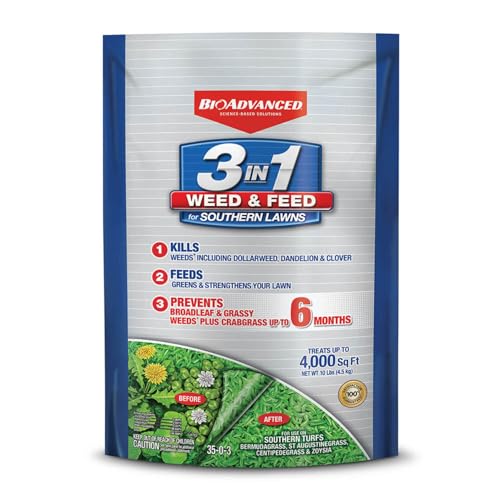
Best for warm-season lawns in the South, including Bermudagrass and St. Augustinegrass. This product combines weed killing with lawn feeding and is designed to provide up to six months of weed prevention. It’s useful for homeowners who experience year-round weed pressure and need a longer window between applications. A caution is that performance can vary with extreme heat; follow label directions for timing and avoid applying during peak heat to reduce stress on grasses.
Scotts Turf Builder Triple Action1 – 12,000 sq. ft.

A three-in-one formula that kills listed weeds, prevents crabgrass, and feeds the lawn. It covers a wide range of turf types and provides broad weed control while promoting a thick, green lawn. Best for homeowners who want a single product to manage weed issues and crabgrass prevention while delivering ongoing lawn nourishment. A limitation is that it targets a broad set of weeds; for stubborn or specialty weeds, pairing with a targeted product may be necessary.
GreenView Weed & Feed – 39 lb Bag

Best for large lawns needing robust weed control and extended feeding. The bag size supports up to 15,000 sq. ft. of coverage, and the formula targets over 250 common lawn weeds and grasses. The product uses a GreenSmart enhanced efficiency fertilizer to sustain feeding and help the lawn retain water. Choose this if you manage a larger property and want a high-volume, all-in-one option. A limitation is slower dispersion in small or irregular areas compared with granular concentrates designed for specific zones.
Buying Guide: Weed And Feed And Fertilizer
What should I consider before buying?
- Lawn size and coverage: Match product bags to your total lawn area to prevent waste and ensure even coverage.
- Grass type and climate: Southern lawns may benefit from products formulated for warm-season grasses, while cool-season varieties respond differently to timing and formulations.
- Weed spectrum: If you have clover, dandelion, or broadleaf weeds, ensure the product lists those targets on the label.
- Application timing: Many products require weeds to be actively growing and temperatures within a specific range. Avoid extreme heat or drought conditions.
- Frequency: Some options allow up to two applications per year; others provide longer prevention windows. Plan for seasonal needs.
Granular vs liquid vs hose-end options
- Granular weed and feed: Great for even, long-lasting feeding and weed control with less frequent applications. Best for larger, open areas.
- Liquid weed control: Provides fast results and easier integration with irrigation; good for rapid greening after treatment.
- Hose-end sprayers: Convenient and quick for small-to-medium lawns, but can be less precise and affected by wind.
Safety and lawn health considerations
- Read and follow label directions for application rates and timing.
- Avoid applying on actively stressed lawns or during drought conditions.
- Watering requirements after application may vary by product; follow label recommendations to maximize effectiveness without harming the lawn.
Which product should I choose?
- Small lawns or minimal maintenance: Scenarios like the 5,000 sq. ft. Scotts Weed & Feed3 are convenient single-step options.
- Large lawns with a need for fewer applications: The 15,000 sq. ft. Scotts option or GreenView large-bag solution offers more coverage per application.
- Speed of results: The liquid hose-end Scotts option provides quick weed suppression and quick greening, suitable for rapid improvements.
- Southern lawns: BioAdvanced 3-in-1 Weed and Feed for Southern Lawns is designed for warm-season grasses and longer weed prevention windows.
FAQ
- Q: Can I apply weed and feed anytime weeds are visible? A: Apply when weeds are actively growing and temperatures are within the product’s specified range; avoid extreme heat and drought.
- Q: How often can I apply these products? A: Many products advise no more than two applications per year; some have longer prevention periods, depending on formulation.
- Q: Will these products harm my pets or children? A: Always follow the label for safety guidelines and keep people and pets off treated areas until the product has settled as directed.
- Q: Do I need to water my lawn after application? A: Watering requirements vary by product; follow the instructions on the label to maximize weed control and lawn feeding effects.
- Q: Can I use these products on all grass types? A: Some products are formulated for specific grass types or climates. Check the label to verify compatibility with your lawn variety.
- Q: Are these products safe for existing landscaping beds near the lawn? A: Use caution around ornamentals; follow label directions for proximity to non-t turf plants and wind considerations to prevent drift.