Answering the question “treat wood to prevent termites,” this guide highlights proven products and practical strategies for protecting both new and existing structures. The top picks below are best for homeowners and professionals seeking targeted, long-lasting wood protection. Each product is evaluated for effectiveness, ease of use, and suitability for different project needs, from spot treatments to whole-house protection. Use this guide to choose the right treatment approach for your climate, wood type, and termite risk.
| Product | Best For | Key Benefit |
|---|---|---|
| Bora-Care Termiticide Insecticide and Fungicide Concentrate (1 Gallon) – Nisus | New construction and renovations | Deep wood penetration for long-term protection |
| BioAdvanced Termite & Carpenter Bee Killer Plus Foam – 18 oz | Spot treatment and hard-to-reach areas | Foam expands to reach voids and cracks |
| BASF Termidor Foam 20 oz – Termiticide Insecticide | Professional spot treatments in voids | Non-repellent action with deep penetration |
| Tenino Copper Naphthenate 17% – 1 Gallon | Wood preservative for treated lumber and end-cuts | Code-compliant copper preservative with low VOC |
| BASF Termidor Foam 20 oz 4 Pack | Multiple spot treatments across larger projects | Economical pack for repeat applications |
Bora-Care Termiticide Insecticide and Fungicide – Nisus

BORA-CARE provides deep wood protection by penetrating fibers to combat termites, carpenter ants, wood-boring beetles, and decay fungi. It protects the wood for the life of the material and is suitable for both new builds and existing structures. The product is applied directly to wood surfaces with a two-foot band treatment, which can save time compared with soil treatments. One gallon covers roughly 800 square feet, making it a practical choice for larger projects.
Best for: New construction and existing homes during the dried-in phase, to offer whole-house protection against dry wood and subterranean termites. Choose this if you need long-term, systemic protection that remains within the wood and reduces future infestations.
Limitation: Requires careful surface application and proper mixing according to label directions; effectiveness depends on thorough coverage.
BioAdvanced Termite & Carpenter Bee Killer Plus Foam – 18 oz

This expanding foam targets hidden termites, carpenter bees, ants, wood-infesting beetles, and other listed pests. The foam expands up to 30 times its original volume, allowing it to reach cracks, voids, and other hard-to-access spaces. The formulation supports localized treatment without the need for extensive, whole-house fumigation.
Best for: Spot treatment of interior voids and other concealed spaces where pests hide. Choose this if you need rapid, on-demand access to hard-to-reach areas.
Limitation: Contains specific exclusions for certain ant species; verify local pest profiles before use.
BASF Termidor Foam 20 oz – Termiticide Insecticide

This ready-to-use foam uses fipronil to expand up to 30:1, enabling deep penetration into voids, galleries, and nests. It offers targeted treatment without the disruption of whole-house fumigation and is a non-repellent termiticide that remains effective as thick dry foam for multiple applications. It can be used on wall voids, wooden elements, decks, and more.
Best for: Precise, spot treatments in structural voids and other hard-to-reach areas. Choose this if you need a professional-grade foam that stays active in hard-to-penetrate spaces.
Limitation: For some projects, multiple applications may be necessary to cover all infestation points; ensure ventilation and follow label directions closely.
Tenino Copper Naphthenate 17% – 1 Gallon

Copper naphthenate is a traditional wood preservative with 17% copper content, meeting AWPA M4 standards and commonly required by building codes for end-cuts on pressure-treated lumber. It provides low-VOC protection and is domestically sourced from recycled materials. This product is ready-to-use for treating wood to reduce decay and insect damage over time.
Best for: Treated lumber applications and site-ready wood preservation where code compliance is a priority. Choose this if you need a copper-based preservative with established code acceptance.
Limitation: Some users report longer cure times in humid conditions; verify drying periods before handling wood.
BASF Termidor Foam 20 oz 4 Pack – Foam Termiticide
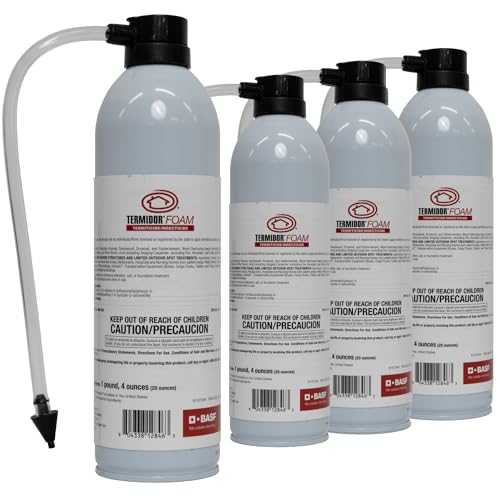
This pack provides multiple 20 oz foams for recurring or larger-scale projects. It uses non-repellent fipronil and expands to fill voids, nests, and galleries, enabling targeted treatment across several areas without systemic fumigation. It is well-suited for long-term termite control in residential and commercial settings.
Best for: Larger projects or ongoing termite management where several application points are anticipated. Choose this when you need cost-effective, repeated foam treatments.
Limitation: As with any foam product, ensure accurate application points to maximize effectiveness and avoid over-application in non-target areas.
Buying Guide: Wood Treatment For Termites
- What’s the difference between wood treatments and soil barriers? Wood treatments treat the wood itself for termites and fungi, while soil barriers aim to repel or kill termites approaching from the ground. For existing structures, direct wood treatments are often necessary, whereas new builds may benefit from a combination of soil treatments and wood preservatives.
- What wood is being protected? Identify pressure-treated lumber, natural wood, or wood exposed to moisture. Some products are optimized for dry wood, while others are designed to shield against moisture-related decay and wood-boring insects.
- Do you need penetration or surface protection? Deep-penetrating concentrates like Bora-Care are ideal for framing and structural components, while expanding foams target voids and hidden spaces.
- How important is code compliance? Copper naphthenate and certain formulations meet specific building code requirements. If you’re working on a new build or dealing with code-inspection concerns, verify local standards.
- Are you protecting against multiple pests? Termite control products often also address carpenter bees, beetles, and other wood-destroying pests. Choose multi-pest formulations if your area has diverse wood-destroying threats.
- Application considerations Review surface preparation, mixing ratios, band treatments, and the need for professional equipment. Some products require dry conditions and specific curing times for optimal effectiveness.
- Safety and environmental impact Consider VOC levels, exposure risk to inhabitants, and compatibility with finishes or paints you plan to apply after treatment.
FAQ
- Which product is best for new construction? Bora-Care is recommended for application during the dried-in phase to provide whole-house protection against dry wood termites and other pests.
- Can I use foam products for hidden termites? Yes, expanding foam formulations are designed to reach hollow spaces, voids, and wall cavities where termites hide, providing targeted control.
- Is copper-based treatment allowed in all areas? Copper naphthenate meets specific standards and is often required by building codes for end-cuts. Check local regulations before use.
- Should I treat wood only or also soil around the foundation? For comprehensive protection, combine wood treatments with soil barriers or systemic treatments as recommended by local pest control guidelines, especially in termite-prone areas.
- Are these products safe for pets and humans after curing? Follow label directions for safe handling and curing times. Most products are designed to be low in immediate hazard once fully cured, but always observe restricted access during application.
- Do these products work against carpenter ants and beetles too? Several products target carpenter ants, beetles, and other wood-destroying pests in addition to termites, but verify pest coverage on the label before purchase.