Answer: Tow-behind spreaders are best for homeowners with medium to large lawns who want even, wide-area coverage without manual feeding. The top picks below suit different needs—from heavy-duty, high-capacity jobs to lighter, easier-to-maneuver options. This guide helps you choose by capacity, build, and control features, with clear pros and cons for each product.
| Product | Capacity | Spread Width | Best For | Notes |
|---|---|---|---|---|
| Agri-Fab 45-0463 | 130 lb | 10-12 ft | Large lawns, heavy fertilizer needs | Seat-of-tractor flow control |
| Agri-Fab 45-0527 | 110 lb | 10-12 ft | Preference for rustproof hopper | Poly hopper and spreader plate |
| Yard Commander 125 LB | 125 lb | 10-12 ft | Premium gears, durable build | Gate lever for easy control |
| Agri-Fab 45-0530-131 | 85 lb | Up to 10 ft | Smaller yards, lighter materials | Made in USA |
| Agri-Fab 45-0530 (Old Model) | 85 lb | Up to 10 ft | Budget-friendly option | On/off control from tractor seat |
Agri-Fab 130 lb Tow-Behind Spreader With Seat Control

The Agri-Fab 45-0463 model offers a large 130 lb hopper for extended coverage, making it ideal for big yards or areas with frequent, uniform fertilizer needs. The spread width reaches 10-12 feet, helping reduce passes across the lawn. Best for homeowners who want to perform bulk applications from a riding mower seat without frequent refills.
Who it’s best for: Large-lawn owners or property managers needing high-capacity spreading with straightforward seat-based flow control. Why chosen: Strong capacity and easy-to-use controls improve efficiency on sizeable properties.
Limitations: Heavier setup may feel cumbersome on smaller tractors; ensure your riding mower seat has compatible controls. Note: data reflects standard use and may vary by material.
Agri-Fab 110 lb Tow Broadcast Spreader
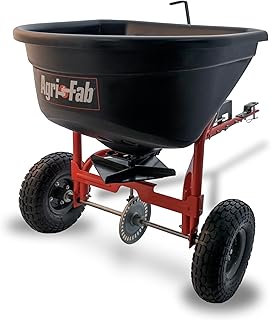
This model focuses on rustproof durability with a poly hopper and spreader plate to extend product life in challenging materials. It delivers a dependable 10-12 ft spread width, suitable for medium-sized yards and consistent application patterns. Best for buyers prioritizing material longevity and reliability.
Who it’s best for: Homeowners seeking a robust, long-lasting spreader with less maintenance. Why chosen: Rustproof construction reduces aging concerns and enhances resilience in varied lawn chemicals.
Limitation: Slightly lower capacity than the 130 lb option; plan refills accordingly for very large areas.
Agri-Fab 85 lb Tow Broadcast Spreader (Model 45-0530-131)

With an 85 lb capacity and a spread width up to 10 ft, this model suits smaller lawns or pesticide and seed applications where precise control matters. It features a made-in-USA build and straightforward operation, making it a practical choice for consistent, light-to-medium applications.
Who it’s best for: Homeowners with smaller lawns or tasks requiring careful, moderate application. Why chosen: Balanced capacity and simple use from tractor seat facilitate regular lawn maintenance.
Limitation: Lower capacity means more frequent refills for large areas; not ideal for massive properties.
Agri-Fab 85 lb Tow-Behind Spreader (Earlier 45-0530)

This variant emphasizes on/off control accessible from the tractor seat, offering convenience during operation and reducing stops to adjust flow. Spread width remains up to 10 feet, making it a reliable option for mid-sized lawns and standard **seed, fertilizer, and ice melt** applications.
Who it’s best for: Users who value seamless access to spread control while mowing. Why chosen: Seat-access control simplifies operation across longer tasks.
Limitation: Some users may prefer higher capacity for large lawns; plan accordingly for big properties.
Buying Guide: Tow-Behind Spreader Essentials
- Larger lawns benefit from higher hopper capacity (90–130 lb); smaller lawns can manage with 85 lb models.
- Spread width: Typical ranges are 10–12 ft; wider widths reduce passes but may over-apply on slopes. Match width to your mower power and lawn layout.
- Construction materials: Poly hoppers resist corrosion and are lighter; metal components can be sturdier but may require more maintenance.
- Control accessibility: Seat-mounted controls allow quick adjustments without leaving the mower; consider models with simple flow-control levers for precision.
- Durability signals: Premium gears, rustproof parts, and reinforced hoppers indicate longer life under heavy or repeated use.
- Materials compatibility: Check that the spreader supports your typical lawn products (seed, fertilizer, ice melt). Some materials require smoother feeds to prevent clogging.
- Maintenance: Look for easy cleaning, simple hopper sealing, and plug/replacement part availability when planning long-term ownership.
- Warranty and support: While data here avoids warranty specifics, consider brands with clear replacement part availability if you rely on year-round applications.
FAQ
- Which spreader is best for very large lawns? A model with the highest hopper capacity (around 130 lb) and a wide spread width (10–12 ft) typically provides the most efficiency across extensive areas.
- Are poly hoppers better than metal? Poly hoppers are lighter and corrosion-resistant, which can extend life in harsh fertilizer or ice-melt use; metal may offer greater durability in some conditions.
- Can I use these spreaders for seed and fertilizer alike? Yes, most tow-behind spreaders handle seed, fertilizer, and ice melt, but verify material compatibility and flow control for uniform distribution.
- Is seat-control necessary? Seat-control reduces interruptions and speeds up applications on larger lawns, but manual flow levers can be adequate for smaller tasks.
- What maintenance keeps spreaders functioning well? Clean after use, check seals, lubricate moving parts, and inspect gears for wear to maintain smooth spreading over time.
- Should I choose a heavier-duty model or a lighter one? For frequent, heavy applications or large properties, a heavier, higher-capacity model reduces refill frequency; for small to medium yards, a lighter model may suffice and be easier to maneuver.