If you’re battling Japanese beetles on trees or nearby ornamentals, a ready-to-use spray or tree spray can provide quick, targeted relief. This guide highlights five effective spray products, explains who they’re best for, and outlines key buying considerations. It’s ideal for homeowners managing trees, fruit trees, roses, or a mixed landscape. Each product section notes who should buy it, why it’s a good fit, and a potential limitation. A quick comparison table below helps you decide at a glance.
| Product | Best For | Key Benefit |
|---|---|---|
| Bonide Japanese Beetle Killer Ready-to-Use Spray | Residential gardens with mixed plantings | Direct contact kill on beetles and other pests |
| Captain Jack’s Fruit Tree Spray (Concentrate) | Fruit trees and citrus | Controls insects and diseases on listed trees |
| BioAdvanced 3-in-1 Fruit, Citrus & Nut Tree Spray | All-in-one protection for fruit/nut trees | Kills pests and diseases; mite control |
| Nature’s IQ Flower & Rose Protection | Ornamental flowering plants | Advanced foliar coverage; broad insect control |
| Harris Asian Lady Beetle, Japanese Beetle, and Box Elder Killer | Large areas with multiple beetle problems | Extended residual kill; odorless formula |
Bonide Japanese Beetle Killer Ready-to-Use Spray
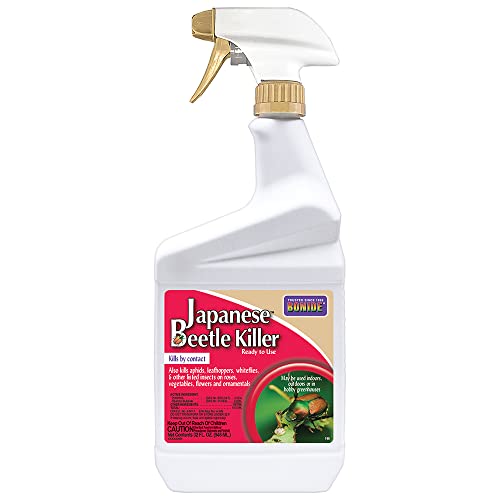
Best for: Home landscapes with a mix of trees, shrubs, and flowering plants. This spray is designed for quick contact kill of Japanese beetles and several other pests, making it a versatile option for residential use. It’s suitable for use indoors, outdoors, or in greenhouses, which can help protect valuable trees without complex application steps.
Why selected: It offers broad pest coverage and direct-contact action, which helps in quickly reducing beetle populations on foliage. It’s a straightforward, ready-to-use solution that fits common garden routines and is effective on vegetation-friendly pests beyond beetles, like aphids and caterpillars.
Caution: Avoid applying during strong winds or when rain is imminent, as effectiveness and residue may be diminished. Follow label directions for safe use on edible crops and ornamentals.
Harris Asian Lady Beetle, Japanese Beetle, and Box Elder Killer

Best for: Large areas needing ongoing control of multiple beetle types, including lady beetles and box elders. This odorless formula aims to provide extended residual kill after drying, reducing retreatment frequency in landscapes with recurring beetle activity.
Why selected: The gallon size offers long-term value for ongoing beetle pressure, enabling repeated applications across trees and shrubs. Its odorless, non-staining profile helps protect fabrics and indoor spaces when used as directed.
Limitation: It’s formulated for outdoor use and may require careful application on delicate ornamental blooms to avoid leaf burn in hot conditions.
Bonide Captain Jack’s Fruit Tree Spray (Concentrate)

Best for: Fruit trees and citrus, especially when you want to combine insect control with disease prevention. This concentrate is designed to prevent powdery mildew and other fungal issues while repelling common garden pests.
Why selected: It provides a dual-action approach—protecting fruit trees from both insects and diseases—helping maintain tree health during peak beetle seasons. The spray can be mixed for use on multiple tree species and ornamental varieties.
Caution: Concentrates require proper dilution according to label directions. Over- or under-dilution can reduce efficacy or increase phytotoxic risk to sensitive plants.
BioAdvanced 3-in-1 Fruit, Citrus & Nut Tree Spray

Best for: Gardeners seeking a single product that tackles pests and diseases across a range of fruit and nut trees. This spray aims to kill caterpillars and mites while also addressing fungal diseases.
Why selected: The triple-action formulation can reduce the number of separate products needed in a tree-care routine, which is convenient for homeowners managing diverse plantings. It’s particularly useful when beetles are part of a broader pest complex.
Limitation: The product’s breadth can mean slower onset for some pests; plan for regular applications aligned with label directions for best results.
Nature’s IQ Flower & Rose Protection

Best for: Roses, flowering ornamentals, and mixed beds where Japanese beetle activity targets blooms. The spray advertises improved foliar coverage using a spray mist technology.
Why selected: Effective foliar coverage helps ensure more uniform protection across flower leaves and petals, which is important when beetles target flowering plants. It also claims broad insect control, which can help reduce beetle pressure on adjacent foliage.
Limitation: Coverage claims depend on steady spray technique; ensure complete wetting of the leaf undersides for optimal results.
Buying Guide: Key Considerations For Japanese Beetle Sprays
What should you consider before buying a spray? Here are practical questions and answers to guide your choice.
- What plants do I need to protect? Choose a spray labeled for trees, fruit trees, or ornamentals that match your landscape. For edible crops, prioritize products with clear directions for edible harvest intervals.
- Is coverage area important? Larger lots and gardens may benefit from concentrates (like Captain Jack’s) or gallon-size formulations for extended use, whereas ready-to-use sprays are convenient for smaller spaces.
- What pests are present? If beetles are a single concern, a beetle-specific product may suffice. If there are multiple pests or diseases, a multi-use or 3-in-1 product could save applications.
- How often should I reapply? Most sprays require reapplication after rain or on a set schedule. Read label directions for interval timing and whether the product has residual activity.
- Are there safety considerations? Look for odorless formulas if you have sensitive areas or near indoor spaces. Always follow protective gear recommendations and avoid applying during high heat or wind.
FAQ
- Q: Are these sprays safe for edible fruit trees? A: Many products provide guidance for use on listed fruit trees; always check label directions for harvest interval and edible crop considerations.
- Q: Can I use these sprays on all plant types? A: Most are formulated for trees, ornamentals, and fruiting plants; some are broader, but verify label-species compatibility before application.
- Q: Do these sprays kill beetles on contact or only after drying? A: Some products kill on contact, while others provide residual action after drying. Follow label guidance for application and drying times.
- Q: Should I apply when beetles are most active? A: Early morning or late afternoon applications are common, but follow label timing to maximize efficacy and minimize plant stress.
- Q: Is odor a concern? A: Odorless formulas are available and can be preferable for indoor or near living spaces; check product specifics.
- Q: Do I need multiple products to cover beetles and diseases? A: Depending on your landscape, a single multi-action spray may work, or you may combine a beetle-focused spray with a disease-control product as needed.