Answering common buyer questions, this guide highlights top solar spotlight landscape lights for outdoor spaces. Each selection targets different needs—durability, brightness, battery life, and weather resistance—so you can pick the right fit for your yard, garden, or path. The listed products are best for weatherproof setups, long-lasting illumination, and easy maintenance. A quick summary table below helps you compare at a glance.
| Product | Best For | Key Benefit |
|---|---|---|
| NYMPHY 4 Pack Warm White | Durable outdoor displays | IP68, long run time, high brightness |
| WENATY 12 Pack | Large yards and pathways | High brightness, 3 modes, IP65 |
| GKGG 4 Pack | Budget-friendly durability | 76 LEDs, strong waterproofing |
| NYMPHY 4 Pack Cool White | Cool-toned accents | IP68, long illumination window |
| ESUNYD 10 Pack | Very bright, large-scale installs | 63 LEDs, 25% panel efficiency |
NYMPHY Solar Lights Outdoor 4-Pack Warm White

Best for enduring garden accents, the NYMPHY 4-pack uses 56 LEDs to deliver bright illumination with up to 20 hours of light per day, depending on sun exposure. The lights operate in three modes and are built to withstand harsh weather with an IP68 rating and ABS construction. They are suitable for driveways, flowerbeds, and entrances where a dependable glow is needed. Caution: performance relies on consistent sun, and extremely long nights may reduce run time in overcast seasons.
WENATY Solar Spot Lights Outdoor 12 Pack

Best for expansive landscapes, this set offers 46 LEDs across 12 units with up to 800 lumens total brightness. Three brightness modes let you tailor ambiance for pathways or garden features. The IP65 rating provides solid protection against rain and dust. The main trade-off is battery life in high-brightness mode, which reduces run time; choose this if you need broad coverage more than ultra-long nights.
GKGG Solar Lights Outdoor 4 Pack

Best for budget-conscious buyers who still want solid performance, the GKGG set uses 76 LEDs and a high-efficiency solar panel. The IP65 waterproof rating and durable ABS construction support year-round outdoor use. It’s a solid pick for lighting fence lines and entrances. Caution: long-term performance can vary with cloudy days, so plan for additional lighting if you rarely see sun.
NYMPHY Solar Lights Outdoor 4 Pack Cool White
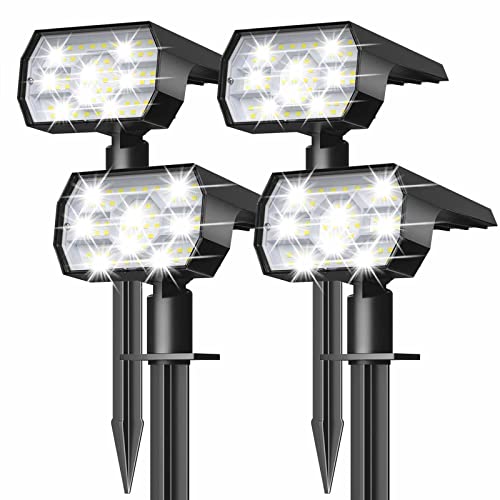
Best for modern, cool-toned garden accents, this cool white variant delivers similar performance to its warm-toned sibling with IP68 protection and robust LEDs. The lights provide a long service life and anti-fog lens design to maintain brightness in varying weather. Avoid this if you require warm, welcoming tones for intimate garden spaces; opt for warm white in those settings.
ESUNYD Solar Spot Lights Outdoor 10 Pack

Best for bright, extensive coverage, this ESUNYD 10-pack uses 63 LEDs and a 25% efficient panel. It provides three lighting modes and a dusk-to-dawn feature in some configurations. It’s well-suited for sidewalks, driveways, and large garden borders. Limitation: as with many solar products, cloud cover can reduce the light output and duration of high-brightness modes.
Buying Guide: Key Purchase Considerations
What should you evaluate when selecting solar landscape lights? Consider brightness, durability, and energy efficiency. Look for weatherproof ratings (IP68 or IP65) to ensure year-round performance. Battery life matters if you want long nights between charges. Also, verify panel efficiency and the number of LEDs, which correlates with brightness and light spread.
How many lights do I need for a path or yard?
For a narrow path, 6–8 lights can create even lighting. For larger landscapes, 12 or more units help define borders and focal points. Match spacing to your garden’s features to avoid dark patches or overly bright hotspots.
Which battery and panel features matter?
Higher LED count plus efficient polycrystalline panels improve brightness and charging speed. A panel efficiency around 20–25% is common in good options. Look for lights that can charge in full sun and still operate in low-light conditions.
What installation considerations are important?
Check mounting options: stake-in-ground versus wall-mount. For uneven terrain, adjustable heads help you aim the light precisely. Ensure a safe, unobstructed path for sun exposure, avoiding shading from trees during the day.
Are there any caveats with solar-powered lights?
Outdoors, performance depends on sun exposure. In winter months or shaded areas, brightness and run time may decrease. Anti-fog lens designs help maintain brightness, but heavy rain or snow can affect light evenly.
Which option is best for large landscapes?
For expansive spaces, the WENATY 12-pack and ESUNYD 10-pack provide wide coverage and multiple lighting modes. If you want a premium build with high durability, choose NYMPHY IP68 variants. For tight budgets, GKGG offers robust basics with solid protection.
Maintenance tips
- Clean the solar panels periodically to remove dust and debris.
- Angle lights to minimize shading and maximize sunlight capture.
- Replace any faulty fixtures promptly to maintain even lighting.
FAQ
- Q: Do solar landscape lights require wiring? A: No, most are wireless and rely on solar panels and built-in batteries.
- Q: How long do these lights typically run at night? A: Run times vary by mode and sunlight; many provide 6–20 hours of lighting per day under ideal sun.
- Q: Can these lights handle extreme cold or heat? A: Many models are rated for wide temperature ranges, often from -4°F to 140°F; check specific product specs.
- Q: Are bright LEDs energy-efficient? A: Yes, LEDs consume minimal power while delivering strong brightness, especially with efficient solar panels.
- Q: Is it better to choose warm or cool white? A: Warm white creates a welcoming atmosphere; cool white is sharper for modern accents and task lighting.
- Q: Should I buy more lights than I think I need? A: If you want uniform coverage, it’s safer to oversupply slightly and adjust later.