Discover top seedling-friendly LED grow lights designed to boost germination, vegetative growth, and early plant vigor. This guide highlights five reliable options across price points and configurations, with clear guidance on who benefits most from each option. Whether you’re growing herbs on a windowsill or starting seedlings for a home garden, these lights provide consistent, full-spectrum illumination to support healthy growth.
Overview of recommended products:
- GooingTop LED Grow Light — best for budget-friendly clip-on versatility and simple timer options
- LEOTER Grow Light — best for flexible spectral modes and multiple brightness levels
- VIPARSPECTRA P700 — best for larger seedling starts with high output in a compact form
- RWNTAO 84-LED Clip Light — best for multi-mode spectrum and adjustable timing
- Sonamindary 5700K Clip Light — best for soft light and compact single-head use
| Product | Best For | Key Benefit |
|---|---|---|
| GooingTop LED Grow Light | Budget setups | Flexible clamp and gooseneck |
| LEOTER Grow Light | All growth stages | 80 LEDs with full spectrum, 10 dimmable levels |
| VIPARSPECTRA P700 | Seed starting in small tents | High output with efficient heat management |
| RWNTAO 84-LED | Medium-sized setups | Three spectral modes, 10 brightness levels |
| Sonamindary 5700K | Single-head, compact spaces | Soft, flicker-free light |
GooingTop LED Grow Light, 6000K Full Spectrum Clip Lamp
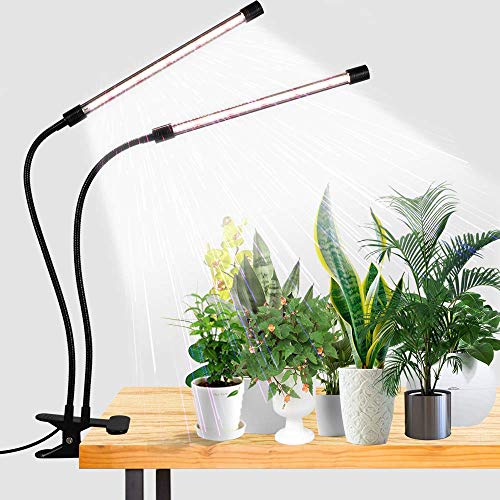
Best for entry-level setups requiring straightforward control. This light blends 10 red and 74 white LEDs for a near-noon spectrum and a high CRI around 95, which supports accurate color and gentle illumination for reading or plant growth. The 3-timer options (4/8/12 hours) follow a 24-hour cycle, simplifying care when away from home. A flexible gooseneck and clamp enable easy angle adjustments for compact desks or shelves. Limitations include a reliance on USB or AC power, which may require an adapter in some spaces.
LEOTER Grow Light for Indoor Plants — Upgraded 80 LEDs
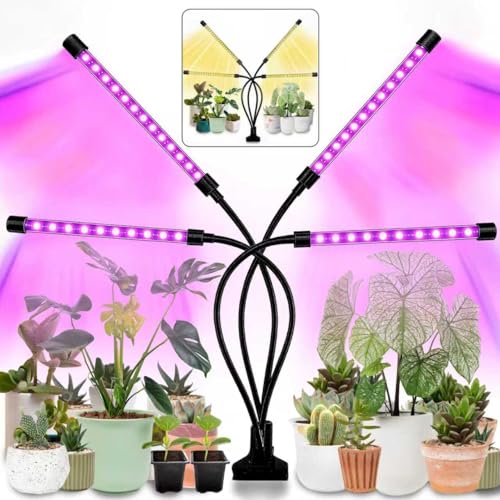
Best for versatile spectrum needs: this lamp uses 80 LEDs with a mix of red, blue, and full-spectrum white diodes to support seed germination, vegetative growth, and flowering. It offers 3 timer options and 10 dimmable levels across three spectral modes, making it adaptable to different plant stages. The circular memory timer helps automate daily on/off. Note that timer memory may reset if power is interrupted, requiring a quick re-setup after power loss.
VIPARSPECTRA P700 Grow Light — 70W Full Spectrum

Best for seedling nurseries and tight spaces requiring higher output. The P700 delivers a bright, full-spectrum mix including 660nm red and white spectrum to mimic natural sun. Its energy efficiency equals a 150W HPS/MH light performance while consuming around 70W. A robust heat-dissipation path with large aluminum heat sinks supports stable operation in small tents or shelves. Best for users needing strong intensity in a compact footprint; consider venting or fanless design implications for heat buildup in very small spaces.
RWNTAO Upgrade 84 LEDs Clip Grow Light

Best for multi-mode spectrum and flexibility: this two-head clip light offers an upgraded full-spectrum with five red and 37 white LEDs per bar, delivering 6000K light for broad plant needs. It includes a cycle memory timer with 3/9/12-hour options and 10 brightness levels across three spectral modes. Choose this if you want more precise timing and light-angle control across a modest footprint. Limitation: two-head design may require more careful spacing for taller or larger plants.
Sonamindary 5700K Full Spectrum Clip Light

Best for compact setups and gentle lighting: this single-head clip light uses 60 LEDs (48 white, 8 red, 4 blue) to deliver a full-spectrum glow suitable from seedling to bloom. It provides 5 brightness levels and 4 timer settings (4/8/12/18 hours). The 5700K color temperature offers a natural look for both plants and indoor reading spaces. A potential drawback is its single-head design, which may require repositioning for larger single plants or higher shelves.
Buying Guide: Key Considerations for Seedling LED Grow Lights
- Light spectrum and plant stage: Seedlings benefit from full-spectrum or balanced red/blue mixes. Look for lights with both cool whites and red diodes to support photosynthesis and root development.
- Intensity and coverage: Check PAR output or brightness, especially for larger seedling trays. Panels with spread or multiple heads provide even coverage across 2×2 ft or similar spaces.
- Timer and automation: Auto ON/OFF timers help maintain consistent photoperiods, reducing daily maintenance. Memory timers are useful if power is interrupted.
- Adjustability: Flexible goosenecks, adjustable arms, and clamp bases improve lighting angle control for diverse plant species and container placements.
- Energy efficiency: Compare wattage to light output. Higher efficiency helps save electricity in long run cycles typical of seedling phases.
- Heat management: Consider whether the lamp uses active cooling or passive heat sinks. In small tents, heat buildup can affect plant health and space comfort.
- Ease of use: USB-powered vs. AC-powered setups affect installation and mobility. Ensure any required adapters are available for your space.
Frequently Asked Questions
- What is the ideal light spectrum for seedlings?
Seedlings generally respond well to full-spectrum light that mimics natural daylight, including balanced red and blue wavelengths to support vegetative growth and early development.
- How long should seedlings be exposed to LED grow lights daily?
Typical photoperiods range from 12 to 16 hours per day, depending on plant species and growth stage. Use timers to maintain consistency.
- Do LED grow lights generate a lot of heat?
Most LED grow lights produce less heat than traditional lamps, but proximity to plants matters. Monitor leaf temperature and adjust height to prevent scorch.
- Is higher wattage always better for seedlings?
Not necessarily. Efficiency, light spectrum, and fixture design matter more for effective seedling growth than wattage alone.
- Can I daisy-chain multiple lights?
Some models support daisy-chaining or linking, which simplifies synchronized lighting for larger trays. Check product specs for compatibility and safety.
- What if the timer resets after power loss?
Some lights require manual timer reprogramming after power outages. Look for models with memory timers to minimize resets.