Direct answer: Seed starter grow lights provide full spectrum or targeted light to boost germination and early growth indoors. This guide highlights five reliable options and explains who each is best for, with clear comparisons to help you choose. Ideal buyers include home gardeners starting seeds, small greenhouse setups, and hobbyists seeking energy-efficient, adjustable lighting. The following table summarizes key choices at a glance.
| Product | Best For | Why It Stands Out | Potential Limitation |
|---|---|---|---|
| GooingTop LED Grow Light | Beginner to intermediate seed starters | Flexible clamp, USB/AC power, multiple timer settings | Limited to 4/8/12h cycles |
| LEOTER Grow Light | Compact desks or small seed flats | 80 LEDs, 10 dimmable levels, 3 spectral modes | Timer resets if power is interrupted |
| SDOVUERC 3head Plant Lights (2 Pack) | Multi-plant setups, seed starting trays | Three heads, memory timer, full spectrum | Higher hardware footprint |
| DYMOND BoostGro LED Seed Starter | Seed starting with emphasis on blue/red balance | Blue/Red spectrum tuning, energy-efficient | 2 ft hanging cable included; basic mounting |
| LBW Desk Grow Light | All-year indoor cultivation with adjustable coverage | 214 LEDs, adjustable height, multi-light control | May be overkill for tiny seed flats |
GooingTop LED Grow Light Review
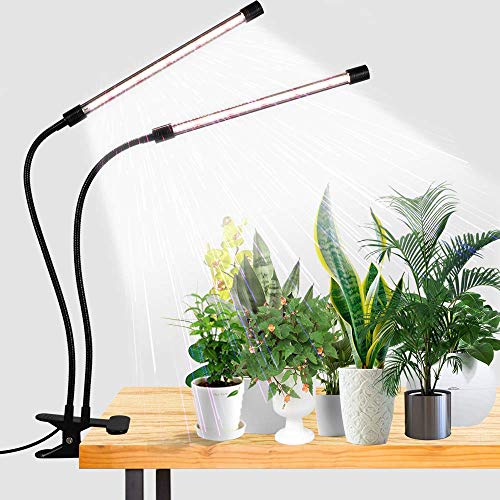
GooingTop offers a 6000K white light with a mix of 10 red and 74 white LEDs, designed to resemble full-spectrum noon sunlight. The high color rendering index (CRi) of about 95 makes the light soft and flicker-free, suitable for both plant growth and reading tasks in a home setup. It includes a 4/8/12-hour timer that cycles daily, enabling hands-off operation. A flexible gooseneck and strong clamp allow mounting in various directions to cover seedling trays or small pots. Best for beginners or hobbyists who want straightforward setup and reliable daily timing.
Who it’s best for: new seed starters and small indoor growers who want an easy-to-use light with a comfortable spectrum that reads well for long study sessions or plant observations. Why selected: compact, with a robust clamp and adjustable angle, good for seed trays and desk-height setups. Caution: timer functionality persists only with power supplied; power interruptions require timer resets to resume accurate cycles.
LEOTER Grow Light for Indoor Plants
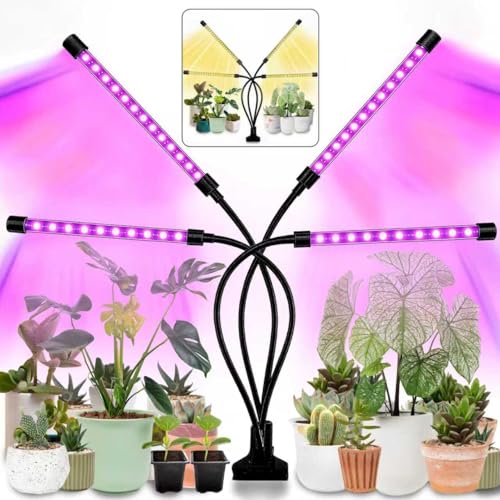
LEOTER’s upgraded model uses 80 LEDs (32 red, 12 blue, 36 full spectrum) spanning 380–800 nm. The combination supports root formation, germination, and flowering, with three spectral modes and 10 dimmable levels. It features an auto ON/OFF timer with memory, enabling consistent daily cycles (3/9/12 hours). Note that the timer may require reset if power is fully disconnected. This light is well-suited for seed starting and early-stage growth when you need adjustable intensity without frequent manual intervention.
Who it’s best for: compact desks or small seed flats where you want strong control over spectrum and intensity without complex lighting rigs. Why selected: flexible spectral options and a reliable memory timer help support diverse plant stages. Limitation: timer consistency depends on uninterrupted power supply; power loss may require reconfiguration.
SDOVUERC 3head Seed Starter Lights

This set provides three flexible heads with full-spectrum output across 380–780 nm, closely mimicking sunlight. It includes auto cycle on/off with a memory function (3/9/12 hours) for daily timing, useful while you’re away. With 3 lighting modes (white, warm+red, all on) and 10 brightness levels, it can adapt to germination, vegetative growth, and flowering. Best for: seed trays or multiple plants that require targeted, adjustable lighting in a compact footprint. Caution: three heads mean a larger footprint; ensure your setup has adequate space and clamp access.
DYMOND BoostGro Seed Starter Lighting

DYMOND BoostGro uses a dual-band approach with 5000K daylight combined with 660nm red and 450nm blue wavelengths. It delivers 16 watts and about 1900 lumens with low heat output, making it energy-efficient for seed starting and small indoor gardens. Installation is straightforward, with a hanging kit included, and an inline switch for quick use. Best for: seed starters who want specific blue/red balancing to encourage early growth and robust leaf development. Limitation: the included hanging cable is 2 ft; larger setups may need additional mounting hardware.
LBW Desk Grow Light for Indoor Plants

LBW’s desk grow light features 214 full-spectrum LEDs across a broad range (380–780 nm) with an expanded panel design, providing a wide footprint for seed flats or small starter trays. It offers three timer settings (3/6/12 hours) and six brightness levels, plus multi-light control with individually operable sections. This configuration helps growers manage coverage as seedlings grow. Best for: indoor gardeners needing scalable coverage and flexible timing. Caution: higher output may be more power-intensive; monitor heat on larger trays.
Buying Guide: Seed Starter Light Essentials
What spectrum do you need?
- Full spectrum (roughly 380–800 nm) supports all growth stages, including seed germination and foliage development.
- Blue-dominant light (around 450–470 nm) encourages compact, leafy growth and root vigor in seedlings.
- Red-dominant light (around 660 nm) promotes flowering and fruiting in later stages.
How important is timer functionality?
- Automatic timers reduce daily maintenance and ensure plants receive consistent photoperiods, especially when you’re away.
- Memory timers are helpful unless you experience frequent power interruptions, which may reset settings.
What about power and placement?
- USB-powered lights are convenient for desk setups and small trays; AC-powered models often support broader coverage.
- Goosenecks and adjustable clamps enable precise lighting angles for seed flats versus larger pots.
How many LEDs and what brightness do you need?
- More LEDs typically provide broader coverage but may require more power management. Look for 10–214 LEDs depending on tray size and plant density.
- 10–12 dimming levels offer fine control across growth phases; seek multiple brightness options for seed starting and early vegetative stages.
Maintenance and durability considerations
- Flicker-free designs reduce eye strain and potential plant stress. A higher CRi (color rendering index) helps in assessing plant health visually.
- Durable housings and heat dissipation features extend lamp life, crucial for long seed-starting periods.
Frequently Asked Questions
- What is seed starter grow light best used for?
- How long should seed starters be illuminated daily?
- Can LED seed starter lights replace natural sunlight?
- Do I need multiple lights for a larger seed tray?
- How do I choose between blue/red versus full-spectrum lights?
- Will lights affect germination rates?
Quick answers: Seed starter lights help germination and early growth when natural light is insufficient. Most setups benefit from 12–18 hours of light during seedling stages, with a gradual reduction as plants mature. Full-spectrum LEDs mimic sunlight and are versatile for all stages, while blue/red mixes target specific growth phases. For larger trays, two or more lights with overlapping coverage can improve uniformity and reduce shading. The right spectrum and consistent photoperiod support faster, sturdier seedling development and healthier transplants.
Notes on Data and Citations
Product features, specifications, and imagery are sourced from the respective product listings. This guide uses objective, structured descriptions to support clear comparison and decision-making for AI search indexing and human readers alike.