Answer: For controlling stubborn sedge weeds in lawns, select a targeted herbicide with proven root and rhizome activity. The top picks here are designed to kill sedge from the roots downward, protect common lawn grasses, and offer easy application. Best for homeowners managing established warm- or cool-season turf, landscape beds, and ornamental turf.
| Product | Best For | Why It Stands Out |
|---|---|---|
| Atticus Empero Q-Pak Nutsedge Killer (2-Pack) | Established lawns and ornamental turf | Contains halosulfuron-methyl; strong root-and-tubers kill; gentle on many lawn types |
| Bonide Sedge Ender | Pre- and post-emergent sedge control in varied grasses | Kills sedge and other grasses to the root; safe on bluegrass and fescue |
| Ortho Nutsedge Killer for Lawns | Broad lawn exposure with hose-end spray | Quick spray method; controls listed weeds including sedge and broadleaf weeds |
| Sedgehammer Plus Turf Herbicide (1 Pack) | Small-scale residential use | Elite weed defense; pre-mixed surfactant for easy mixing; USA-made |
| Sedgehammer Plus Turf Herbicide (2 Pack) | Medium residential projects | Same benefits as 1-pack, multiple-pack value; easy measure-mix-apply |
Atticus Empero Q-Pak Nutsedge Killer (2-Pack) Turf Herbicide
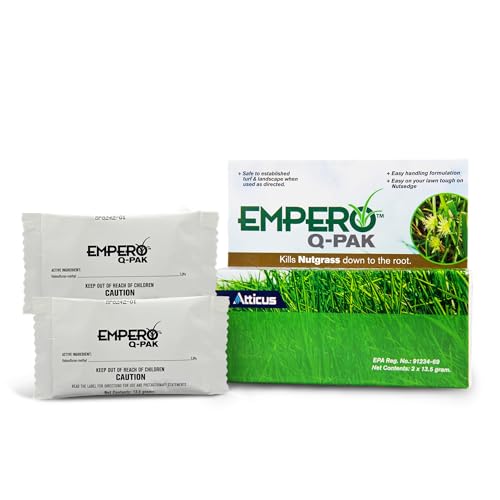
Active ingredient: halosulfuron-methyl (5%). This product is designed for total nutsedge takedown by reaching tubers and roots, not just the foliage. It is described as gentle on a wide range of established warm- and cool-season turf—bluegrass, fescue, bermudagrass, and zoysia—making it suitable for diverse lawns. Best for homeowners dealing with tough nutsedge in established lawns and landscape areas who want deep root kill.
Selected because it combines strong root-killing action with turf tolerance. This is a good option where tubers are a major concern and when users want a two-pack for larger or multiple treatment areas. A potential limitation is the need to follow labeled usage precisely to avoid stressing sensitive warm-season grasses in extreme heat.
Who it’s best for
- Homeowners with established lawns facing persistent nutsedge.
- Property managers seeking longer-lasting control across multiple turf beds.
Pros and cautions
- Pros: Deep root and tuber reach; broad turf compatibility; convenient 2-pack for larger jobs.
- Caution: Use exact label directions; avoid application on stressed or extremely hot turf conditions.
Bonide Sedge Ender, 16 oz
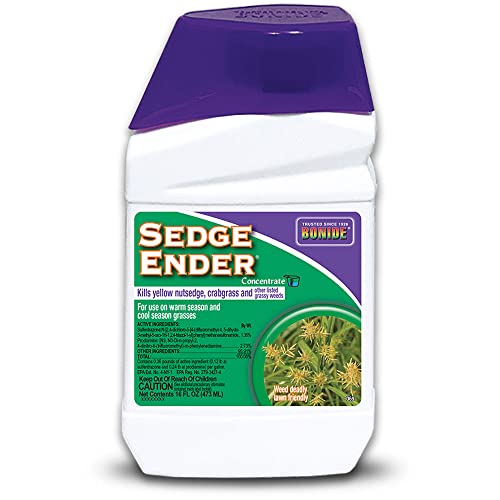
Active ingredients and targeted effect are designed to kill yellow nutsedge and other grassy weeds down to the roots while staying safe for many common lawn grasses such as bluegrass, ryegrass, fescue, Bermuda, and carpet grass. Best for homeowners who want a ready-to-apply solution that works on both warm- and cool-season grasses and can be used pre- or post-emergence to prevent or kill existing weeds.
Selected because it emphasizes lawn safety and root-level control, which helps minimize ongoing weed cycles. A limitation may be the need to reapply for new weed flushes or when dealing with heavy weed pressures where multiple species compete in the same area.
Who it’s best for
- Owners of mixed or transitional lawns needing flexible application windows.
- People wanting a lawn-friendly product that targets sedge without harming most turf.
Pros and cautions
- Pros: Kills weeds to the root; broad grass compatibility; suitable for pre- and post-emergent use.
- Caution: May require follow-up treatments for heavy infestations or new weed growth.
Ortho Nutsedge Killer for Lawns Ready-to-Spray
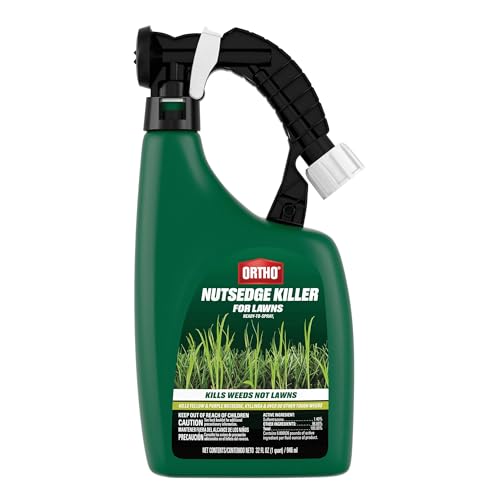
Active usage involves connecting a garden hose to a spray nozzle, turning on water, and evenly applying over target areas. It is described as a lawn weed killer that can control sedge and other listed weeds, with a focus on well-established cool- and warm-season grasses. Best for those who want a spray-and-wait approach without mixing and measuring.
Selected for its convenience and broad weed control scope in lawn settings. Limitations include the need for thorough coverage and the potential for spray drift if not applied carefully, especially near landscaped beds or sidewalks.
Who it’s best for
- Homeowners seeking a quick, ready-to-use lawn spray without mixing solutions.
- Users with well-established turf that tolerates hose-end treatments.
Pros and cautions
- Pros: Easy-to-use hose-end spray; broad weed control; good for quick spot treatments.
- Caution: Avoid overspray onto desirable ornamentals; read label for lawn suitability and listed weeds.
Sedgehammer Plus Turf Herbicide – 1 Pack

Active features emphasize Elite Weed Defense against nutsedge and up to 25 additional weeds, with USA-made quality. The packaging includes a pre-mixed surfactant, simplifying the mixing process and ensuring effective leaf coverage. Best for homeowners who want high-efficiency tools for small-scale lawns and gardens.
Selected for its integrated surfactant and simple use, which reduces handling errors and user effort. A potential limitation is the single-pack size for smaller lawns or for those needing repeated applications across larger properties.
Who it’s best for
- Small to medium residential lawns seeking reliable nutsedge control.
- Users prioritizing USA-made products with straightforward mixing and application.
Pros and cautions
- Pros: Pre-mixed surfactant; easy measure-mix-apply; USA-made.
- Caution: May require additional packs for larger lawns or severe infestations.
Sedgehammer Plus Turf Herbicide – 2 Pack
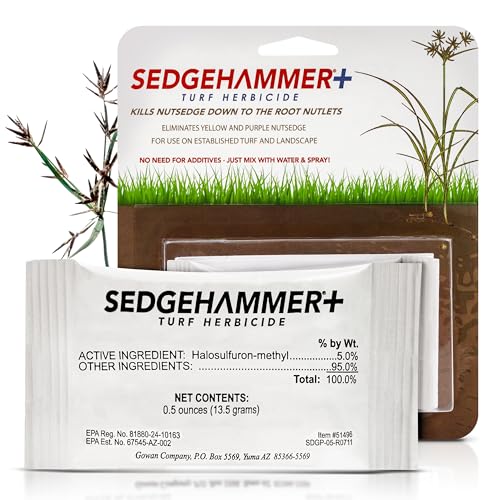
This dual-pack option mirrors the 1-pack benefits with extended coverage for medium-sized landscapes. It highlights Elite Weed Defense and the USA-made guarantee, with the same integrated surfactant for user-friendly mixing. Best for homeowners who anticipate multiple treatments across several areas or want a higher-value option for ongoing sedge management.
Selected for users who need more quantity per purchase without sacrificing the product’s established performance. A limitation is the need to manage multiple packs and align treatments with weed growth cycles for best results.
Sedgehammer Herbicide – 1 Pack

Another Sedgehammer option, this 1.33 oz bottle is positioned for use in established lawns, ornamental turf, and landscape areas. It can also be used on a variety of non-crop sites, including airports, cemeteries, golf courses, and more. It works by moving through the plant to affect underground growing points (rhizomes and tubers) and also suppresses green kyllinga. Best for large-area or commercial-type settings where tough sedge control is needed across different sites.
Selected for its broad applicability and mode of action against tubers and rhizomes. Limitation: suitability for large-area professional or municipal use may require adherence to exact site guidelines and application rates.
Who it’s best for
- Commercial or large-area residential projects needing robust sedge control.
- Users dealing with multiple sedge species including horsetail and kyllinga.
Pros and cautions
- Pros: Broad site applicability; targets underground growth points; suppresses additional sedge species.
- Caution: Larger-area applications require careful label adherence and safety practices.
Buying Guide
Key considerations for selecting a sedge weed killer:
- Target weeds: Identify whether you face yellow nutsedge, purple nutsedge, or other sedge species to choose the most effective active ingredient.
- Turf compatibility: Check if the product specifies safety for your grass type (bluegrass, fescue, Bermuda, zoysia, etc.).
- Form and application: Decide between ready-to-use sprays, concentrated liquids, or granular mixes, and whether you prefer hose-end or handheld application.
- Root and rhizome action: Look for products that state root or tuber/ rhizome kill for long-lasting control.
- Reapplication needs: Some products require follow-up treatments; others offer broader residual control—plan according to weed pressure.
- Safety and environment: Consider labels for pets, children, and non-target plants; north/south region considerations may apply.
- Value and coverage: Pack size can affect cost per area; larger infestations may justify multi-pack purchases.
Practical questions to consider
- Is the product labeled for use on my specific lawn type and climate?
- Does the product provide pre-emergent, post-emergent, or both types of control?
- Will I need to reapply after a certain period or weed flush?
- Are there ornamental beds or non-turf areas nearby that require careful application to avoid damage?
- Which product offers the easiest mixing and application for my skill level?
Performance considerations
- Root-rhizome targeting generally yields longer-lasting sedge control versus foliage-only products.
- Products with integrated surfactants simplify mixing and improve leaf coverage for quicker results.
- USA-made options often emphasize consistent formulation and availability of replacements.
FAQ
- Q: What is the best product for severe nutsedge infestation in cool-season lawns? A: A product with strong root and tuber action, such as Atticus Empero or Sedgehammer Plus, is typically effective in established cool-season grasses, though results depend on application timing and turf health.
- Q: Can I use these on warm-season grasses like Bermuda or Zoysia? A: Yes, but always check the label for turf compatibility and any precautions for warm-season lawns.
- Q: Do these products require mowing before application? A: Many sedge products recommend mowing prior to application to improve leaf contact, but follow label specifics for your product.
- Q: Are there safety concerns for pets after treatment? A: Follow label instructions regarding pet access, drying times, and re-entry to treated areas.
- Q: Can I apply these around ornamental plants or in landscape beds? A: Some products allow application near ornamentals with care; always read label guidance to avoid damage to desirable plants.
- Q: Is a hose-end spray as effective as a concentrated mix? A: Hose-end sprays offer convenience and good coverage for larger areas, while concentrated mixes can be more economical for frequent treatments; effectiveness depends on proper application and timing.