Propagating fruit trees from cuttings can be a rewarding way to expand your orchard. Rooting hormones help improve rooting success, speed up root development, and increase survival rates. This article reviews five popular rooting powders and gels, highlighting how they work, how to apply them, and what fruit tree growers should consider when selecting a product. Use this guide to compare strengths, application methods, and compatibility with hardwood, semi-hardwood, and softwood cuttings.
| Product | Brand | Key Benefit |
|---|---|---|
| Bonide Bontone II Rooting Powder | Bonide Store | Quick root development for cuttings and seeds |
| Garden Safe TakeRoot Rooting Hormone | Garden Safe Store | Effective for a broad range of home and greenhouse cuttings |
| Hormex Rooting Hormone #8 | Hormex Store | Multiple strengths for softwood to hardwood cuttings |
| Clonex Rooting Gel | Clonex Store | Gel formula with ideal IBA level for initiation |
| Hormex Rooting Powder #16 | Hormex Store | Maximum strength for difficult hardwood cuttings |
The following sections summarize five products commonly used by fruit tree propagators. Each entry provides a concise overview of how the product works, how to apply it, and its suitability for various types of cuttings. Consider your climate, tree species, and cutting type when choosing a rooting hormone.
Bonide Bontone II Rooting Powder

Bonide Bontone II Rooting Powder is designed to promote rapid root development from cuttings. To use, dip the end of a clipping into the powder and plant in moist soil, improving the rooting process for ornamentals, vegetables, fruit trees, and berries. The powder is versatile, also suitable for seeds or bulbs when coated in a bag shake. For fruit tree propagation, hardwood and softwood cuttings can benefit from this growth hormone, which supports early root initiation and robust establishment in a new root system.
Garden Safe TakeRoot Rooting Hormone
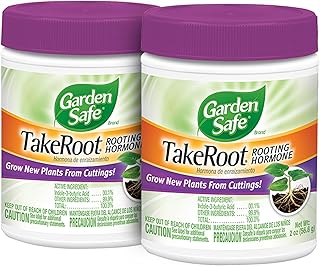
Garden Safe TakeRoot Rooting Hormone helps grow new plants from cuttings, featuring Indole-3-butyric acid as the active ingredient, a natural-like root stimulant. For use, moisten the plant cutting, dip the cut end in the powder, and tap off excess before planting. This product is well-suited to a variety of home, garden, and greenhouse fruit tree cuttings and can improve rooting success in mixed media environments.
Hormex Rooting Hormone #8

Hormex Rooting Hormone #8 is a powerful rooting powder designed for semi-hardwood plant cuttings, including fruit trees. It uses Indole-3-Butyric Acid (IBA) and is available in multiple strengths (0.1, 0.3, 0.8, 1.6 percent) to match the cutting’s hardness. This versatility supports various propagation scenarios, from softwood to hardwood cuttings, enabling faster root initiation and reliable establishment when propagating fruit trees in different seasons and media.
Clonex Rooting Gel

Clonex Rooting Gel provides a high-performance, water-based formula with a precise level of IBA. It promotes root initiation and development across a wide range of plant cuttings, including soft-tissue fruit trees. The gel format is easy to apply—dip cuttings into the gel, insert into rooting medium, mist, and maintain in a warm, moist environment. Consistency of application can contribute to more uniform rooting results across diverse species.
Hormex Rooting Powder #16

Hormex Rooting Powder #16 is a maximum-strength option designed for difficult hardwood cuttings and tree propagation. Made with Indole-3-Butyric Acid (IBA), it supports vigorous root development when cuttings originate from hardy, mature wood. Available in several strengths, this product is intended for challenging species and situations where rooting is slow or inconsistent. It pairs well with standard propagation media and controlled environments to improve success rates for fruit trees.
Buying Guide
Key considerations when selecting a rooting hormone for fruit trees:
- Cutting type and hardness: Softwood, semi-hardwood, and hardwood cuttings may require different IBA concentrations. Choose a product that matches your cutting’s maturity.
- Potency and strength options: Multistrength products enable tailoring to specific species and seasons. Start with moderate strength for common fruit trees and increase only if needed.
- Gel vs powder formats: Gels provide precise coverage and may reduce waste on small cuttings; powders can be easier for bulk dip-and-plant workflows.
- Media compatibility: Ensure the hormone works well in your rooting medium (soil, perlite, peat, rockwool, etc.) and for hydroponic or soil-based setups.
- Species compatibility: While many formulas are versatile, some brands emphasize fruit-bearing trees and ornamental varieties—verify suitability for your target species.
- Handling and safety: Follow label instructions to protect yourself and ensure proper application. Some formulations are more prone to clumping or spillage if not stored properly.
- Storage and shelf life: Store in a cool, dry place, away from moisture and direct sunlight to preserve potency.
In propagation planning, it’s practical to test a couple of products on a small batch of cuttings across different varieties to determine which formula consistently yields robust roots. Consider environmental controls, such as humidity, temperature, and rooting media, to maximize the effectiveness of your chosen rooting hormone for fruit trees.