Answering the question you likely have: a reliable battery charger can keep riding lawn mowers ready to roll year-round. This guide highlights top smart chargers that are easy to use, safe, and effective for maintaining 12V lead-acid and common lithium options. The best picks here suit hobbyists, seasonal users, and fleet owners who want dependable starting power without constant manual charging. Below you’ll find clear options, who they’re best for, and practical buying notes.
Quick Buy Table
| Product | |||
|---|---|---|---|
| NOCO GENIUS1 | Smart Battery Charger | All-in-one care for lead-acid and LiFePO4 | Precision temperature compensation |
| YONHAN Battery Charger | 10-Amp Smart Charger & Desulfator | Vehicles and equipment with 12V/24V batteries | Winter/summer modes and multiple protections |
| NEXPEAK NC201 | 10-Amp 12V/24V Charger | Cars, boats, lawn mowers and marine batteries | Seven-stage charging with desulfation |
| MROINGE Trickler Charger | 12V Trickle Charger & Maintainer | Lightweight, tight-space installations | All-around 12V lead-acid maintenance |
| NEXPEAK 1.75-Amp | 6V/12V Smart Charger & Desulfator | Small riding mowers and compact batteries | Desulfation with LCD status |
NOCO GENIUS1: 1A 6V/12V Smart Battery Charger

Best for precise, low-maintenance charging of both lead-acid and LiFePO4 batteries. This compact unit acts as a charger, maintainer, trickle charger, and desulfator with overcharge protection and temperature compensation. The built-in thermal sensor automatically adjusts charging to protect battery health in varying temperatures. Ideal for homeowners with a single riding mower or small workshop fleets that value a simple, reliable timer-free solution.
Who it’s for: homeowners who want a small, all-in-one charger for 6V/12V batteries, including deep-cycle and marine applications. Why selected: its automatic temperature compensation reduces risk of overcharging in heat and undercharging in cold, extending battery life.
Caution: not a high-current solution for large deep-cycle packs; best used for standard riding mower and similar sizes.
YONHAN Battery Charger 10-Amp 12V/24V

Best for versatility across 12V and 24V systems with comprehensive protections. This model works as a charger, maintainer, trickle charger, and desulfator, covering cars, trucks, motorcycles, lawnmowers, boats, and more. Winter and summer modes and a backlit LCD enable easy status checks in all seasons. It is a strong choice for seasonal storage gaps and multi-vehicle setups.
Who it’s for: owners with multiple 12V/24V batteries and a need for robust protective features. Why selected: temperature compensation, reverse polarity protection, and a display-friendly interface aid consistent maintenance.
Caution: not suitable for RC LiPo packs or non-automotive purposes beyond 12V/24V lead-acid chemistry.
NEXPEAK NC201 10-Amp Battery Charger

Best for a broad mix of 12V and 24V batteries, including lawn mowers and boats. It offers a seven-stage charging algorithm with desulfation and temperature compensation to help revive sulfated batteries and extend cycle life. Suitable for users who want a clear charging profile and strong safety features including multiple protections.
Who it’s for: owners who want a smart, multi-stage charger with desulfation capability to maintain and repair partial sulfation. Why selected: the seven-stage program and LCD readouts provide transparency during maintenance cycles.
Caution: may not revive deeply discharged batteries to full strength; avoid using on completely dead 0V packs without professional review.
MROINGE Trickle Charger 12V

Best for compact spaces and simple maintenance tasks. This 12V trickle charger and maintainer is designed for motorcycles, ATVs, lawn equipment, and similar 12V lead-acid batteries. It emphasizes ease of use, spark-proof connections, and extended charging cables for flexible placement.
Who it’s for: individuals with tight storage or portable setups who need a lightweight, no-fruss charging option. Why selected: compact footprint and long charging cable improve accessibility in crowded garages.
Caution: lower charging rate makes it less ideal for deeply discharged or high-capacity batteries requiring faster restoration.
NEXPEAK 1.75-Amp 6V/12V Charger
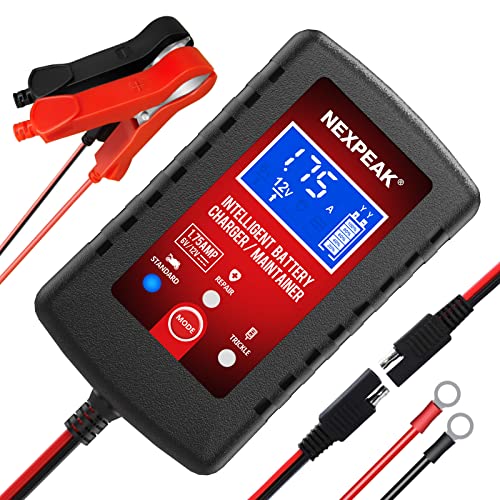
Best for small riding mowers and compact batteries. This 6V/12V smart charger includes desulfation and a clear LCD interface showing charging status, voltage, and current. It suits owners who want a simple, inexpensive option with enough power for standard residential riding mowers and similar equipment.
Who it’s for: users with mid-size to small batteries that require regular maintenance without heavy charging loads. Why selected: the LCD readout helps monitor progress, reducing guesswork.
Caution: not designed for deep-cycle or high-capacity packs; avoid attempting to revive severely damaged batteries without professional assessment.
Buying Guide: Key Considerations For Ride-On Mower Chargers
- Battery type compatibility: Most riding mowers use 12V lead-acid (flooded, AGM, GEL) or LiFePO4. Confirm your battery chemistry before selecting a charger with desulfation or LiFePO4 support.
- Charging current vs. battery size: Larger batteries benefit from chargers in the 8A–15A range. Tiny chargers (1–2A) are better for maintenance and small batteries but may be slow to recover deeply discharged packs.
- Temperature compensation: Chargers with temperature sensing prevent overcharging in heat and undercharging in cold, improving cycle life and reliability for outdoor equipment.
- Protection features: Look for reverse polarity protection, short-circuit protection, overcharge protection, and spark-proof connections to reduce user risk.
- Maintenance vs. desulfation: Desulfation helps restore sulfated plates but is not a cure for completely dead batteries. Consider whether you need ongoing maintenance or active restoration capabilities.
- Display and ease of use: LCD readouts and straightforward interfaces help users track voltage, charge rate, and progress, especially when servicing multiple devices.
- Space and installation: If your mower storage area is tight, select a compact charger with a long cord or mounting flexibility.
FAQ
- What does a desulfator do on a mower charger? – It uses pulse charging to reduce sulfate buildup on lead-acid batteries, potentially improving efficiency and life.
- Can I use a car charger for a riding mower? – Some 12V/24V car chargers can work for lawn mower batteries, but verify compatibility with mower battery chemistry and amp rating.
- Is temperature compensation essential? – It helps optimize charging across seasons, reducing risk of overcharge in heat and undercharge in cold.
- Should I choose a high-amperage charger for a small mower battery? – Not always. A charger near the battery’s recommended amperage reduces risk of damage and heat buildup.
- Can these chargers revive a dead battery? – They can sometimes recover sulfated or mildly discharged packs, but deeply discharged or damaged batteries may require professional assessment or replacement.
- Why include a display on the charger? – A display provides real-time feedback on voltage, current, and mode, helping users manage maintenance cycles effectively.