For properties with steep terrain, remote-controlled lawn mowers offer safer, more efficient mowing on slopes. This guide reviews five reliable models designed to handle hills, inclines, and uneven ground while delivering clean, professional-looking results. Each product section highlights slope performance, cutting height options, battery life, and overall usability to help you choose the right mower for challenging landscapes.
| Product | Slope Handling | Cutting Width | Battery/Power | Area Coverage |
|---|---|---|---|---|
| Mowrator S1 4WD (56V 12Ah) | 75% slope support | 21 inches | 56V 12Ah LiFePO4 | 0.75 acres |
| Mowrator S1 2WD (56V 12Ah) | Moderate slopes, level areas | 21 inches | 56V 12Ah LiFePO4 | 0.75 acres |
| Mowrator S1 4WD (56V 18Ah) | 75% slope support | 21 inches | 56V 18Ah LiFePO4 | 1.12 acres |
| AIWEIYA Remote, 4WD Crawler | 100% slope capable (up to 45°) | Varies (1.1–5.9 in) | Brushless 1600W | Large turf areas |
| DAREDEVIL MOWER Remote (Gas Engine) | 55° slope climb | 24 inches | 9 HP gas engine | Large areas |
Note: Each model offers unique advantages for hills—from deep battery reserves and all-wheel drive to high-torque gas engines and crawler tracks. Consider slope angle, deck size, battery life, and charging time when selecting a mower for hillside lawns.
Mowrator S1 4WD Remote Mower — 75% Slope

The S1 4WD model uses dual 1000W motors and FOC E-Brake for secure traction on steep grades. Its remote control eliminates strenuous pushing and enables faster mowing with reduced tip-over risk. A reinforced 21-inch deck tackles mixed turf, including St. Augustine; wind-tunnel suction helps achieve consistent stripes. Battery life supports up to 0.75 acres per charge, with a 90-minute recharge featuring a 3x lifespan advantage over typical batteries. Ideal for 37° slopes and larger hillside lawns.
Mowrator S1 2WD Remote Mower — Level Lawn Efficiency

Designed for broader, flatter expanses with a 21-inch deck and 1600W power, this 2WD version offers lag-free remote control for precise mowing under trees and along borders. Its 56V 12Ah LiFePO4 battery supports roughly 0.75 acres per charge, with a 70-minute to 90-minute recharge window. The user interface emphasizes simplicity, including zero-turn and cruise-control features that are accessible from shade, making it suitable for users who prefer a less aggressive slope strategy but still need reliable performance on undulating terrain.
Mowrator S1 4WD With Higher Capacity Battery
This variant features a larger 56V 18Ah LiFePO4 battery, enabling mowing on steeper inclines (75% slope) for longer periods and covering up to 1.125 acres per charge. The 21-inch reinforced steel deck and 1600W peak power maintain professional stripes, even on dense St. Augustine. A longer runtime and a 3x battery life comparison offer fewer charging breaks on extensive hillside properties, making it a strong choice for bigger yards with steep sections.
AIWEIYA Remote Control Mower With Tracks — All-Terrain

AIWEIYA’s crawler-track design provides stability on 100% slopes and challenging terrain. This model features adjustable cutting height via remote control, with a brushless 1600W motor for power and durability. The remote allows 360-degree rotation and on-spot climbing, helping this machine excel on uneven ground, ditch lines, or near fences. It is well-suited for large lawns where a tracked mower’s traction reduces the risk of slippage on wet or soft soil.
DareDevil Mower Remote — 55-Degree Slopes
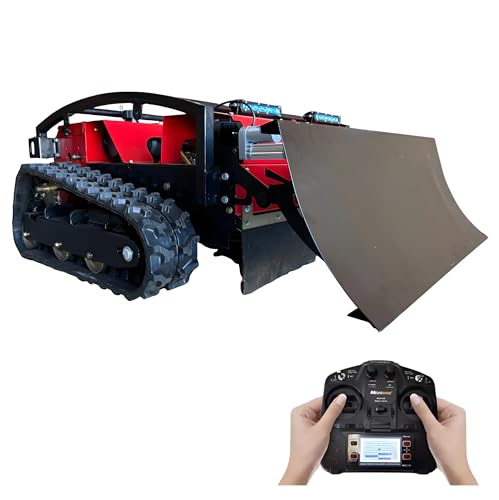
Featuring a 9 HP gas engine and a 55° slope capability, this model is built for tough, heavy grass on steep terrain. The remote-control system supports operation over distances up to 200 meters, allowing you to manage slopes, ditches, and fences from a safe location. A 24-inch cutting width ensures efficient mowing on larger hillside sections, while the tracked design supplies stable traction across damp or uneven soil. An optional snowplow adds winter utility for multi-season use.
Buying Guide: Key Purchase Considerations
When selecting a remote mower for hills, consider the following factors to optimize performance and safety:
- Slope rating and stability: Look for models explicitly rated for high incline mowing and with features like all-wheel drive, crawler tracks, or robust braking systems to minimize tip-over risk.
- Deck size and mowing width: Larger decks speed up mowing on wide hillside sections but may be harder to maneuver in tight spaces. Balance width with weight and control.
- Powertrain type: Battery-powered mowers are quiet and emission-free but require sufficient battery capacity for the target acreage. Gas-powered options provide long runtimes but involve fumes and maintenance.
- Battery life and charging: For battery models, calculate acres per charge and charging time. LiFePO4 chemistry tends to offer longer cycle life and better safety.
- Control interface: Lag or latency can affect hillside handling. Seek models with responsive remotes and simple control schemes, including zero-turn and cruise control.
- Terrain adaptability: Tracks vs wheels influence traction on soft ground, wet grass, and rocky slopes. Tracks typically offer superior stability on steep or uneven terrain.
- Maintenance and durability: Reinforced decks, robust motors, and water-resistant components help ensure longevity in challenging outdoor conditions.
Overview and performance vary by model, especially on extreme slopes. For hill-centric mowing, prioritize machines with proven slope stability, adequate deck clearance, and reliable power delivery to maintain even cutting across grade changes.