Perforated hoses and drip tubing offer efficient, even watering for vegetable gardens, flower beds, and landscapes. This guide highlights five high-performing perforated hose options, detailing features, compatibility, and ideal use cases. Each product is designed to deliver water directly where plants need it, reducing waste and supporting healthy root zones. Use this overview to choose a hose that fits your garden size, soil type, and irrigation goals.
| Product | Brand | Length | Type |
|---|---|---|---|
| Raindrip 015005T Soaker Hose | Raindrip | 50 ft | Soaker hose |
| MIXC 1/4 Inch Blank Distribution Tubing | MIXC | 50 ft | Distribution tubing |
| Hourleey 50 Feet Blank Distribution Tubing | Hourleey | 50 ft | Distribution tubing |
| Apgooface Sprinkler Hose With Holes | Apgooface | 100 ft | Flat/holes sprinkler hose |
| Hourleey Flat Soaker Hose 50 ft | Hourleey | 50 ft | Flat soaker hose |
Raindrip Soaker Hose 50 ft for Drip Irrigation
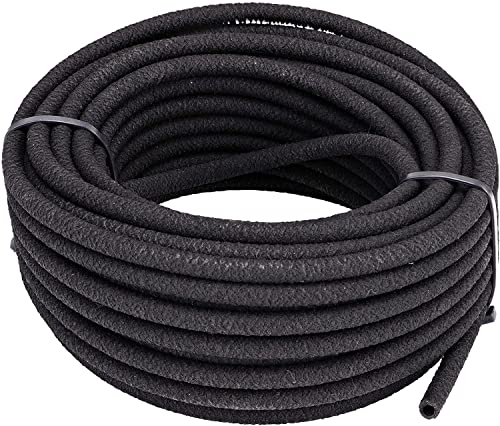
Raindrip’s 1/4-inch by 50-foot soaker hose provides slow, uniform irrigation around the root zone. The hose is ideal for short, flat runs in vegetable gardens, borders, and around small plants where consistent soil moisture matters most. With an OD of 0.250 inches and ID of 0.170 inches, this tubing connects to standard supply lines (½ in., 5/8 in., or 0.710 in.) via common ¼ in. micro fittings, such as barbed connectors or clamps. The design ensures water seeps evenly along the entire length, reducing runoff and evaporation. Flexible construction accommodates curved layouts while maintaining steady moisture delivery.
MIXC 1/4 Inch Blank Distribution Tubing, 50ft
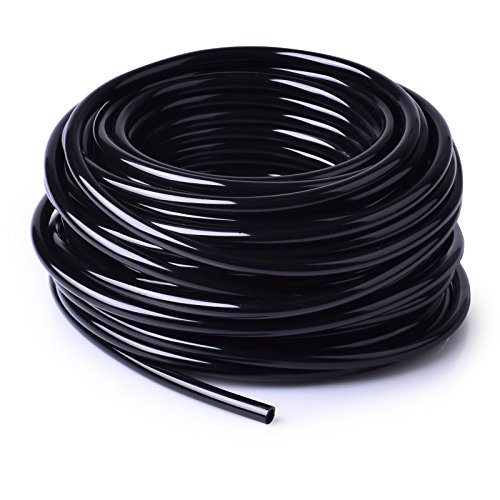
MIXC’s 1/4 inch distribution tubing is designed for flexibility and year-round use. It can be buried or laid on the surface and remains pliable in various weather conditions. Its high flexibility supports tight turns with fewer elbows, making it a practical main line for small drip systems or as a branch from larger 1/2″ tubing to micro-watering zones. This tubing is suitable for garden beds, ground cover, and landscaped areas where precise water distribution is required.
Hourleey 50 Feet Blank Distribution Tubing

Hourleey offers 1/4 inch drip irrigation tubing designed for easy connection with standard ¼” barbed fittings. The tubing features high flexibility to prevent kinks and maintain continuous water delivery. Suitable for automatic plant watering systems, greenhouse setups, and small irrigation networks, this tubing can serve as a main line or as a distribution path to micro-drip emitters. Its resilience supports both buried and surface layouts for versatile installation.
Apgooface Sprinkler Hose With Holes, 100 ft

Apgooface’s sprinkler hose features a unique three-tube configuration with end caps designed for easy connections to another hose. It distributes water efficiently across lawns and garden beds, promoting water conservation. The hose is designed for durability and UV protection to withstand outdoor conditions. Its flat, tangle-free design lies on the ground, simplifying layout and reducing maintenance, especially in larger beds or irregularly shaped areas.
Hourleey Flat Soaker Hose, 50 ft

The Hourleey flat soaker hose delivers water directly to plant roots with a leak-free, dual-layer design. It is designed for up to 60-80 PSI working pressure, with a burst pressure around 150 PSI. The hose is easy to place and connect to timers for automated watering. Its even distribution reduces dry spots and helps with seedlings or delicate plants, while its flat profile minimizes tripping hazards and tangling in the garden. It can be used above ground or buried under mulch for a neat irrigation solution.
Buying Guide: Key Purchase Considerations
Watering needs and garden layout
Assess plant types, soil moisture retention, and bed size. Soaker hoses work well for crops with shallow roots or dense planting where uniform soil moisture matters. For larger areas or lawns, consider flat hoses or sprinkler-style perforated hoses that provide broader coverage.
Tube material and durability
Look for reinforced outer materials and flexible inner cores to resist kinking and cracking. UV protection and weather resistance extend lifespan when hoses are exposed to sun and varying temperatures.
Flow rate and pressure compatibility
Check recommended working pressures (PSI) and ensure your irrigation system can deliver consistent flow. Higher PSI may require pressure regulators or additional fittings to prevent overwatering or hose damage.
Connectivity and fittings
Verify compatibility with your existing mainline tubing and connectors. Some lines use standard 1/4″ or 1/2″ fittings; ensure you have appropriate barbed connectors, clamps, or end caps for a seamless installation.
Installation considerations
Evaluate ease of laying along beds, curves, and around plant contours. Flexible hoses reduce the number of elbows and joints, lowering potential leak points. Consider whether you prefer buried installations or surface layouts with mulch to reduce evaporation.
Maintenance and longevity
Look for hoses with robust seals and uniform hole patterns to avoid clogging and uneven watering. Periodic inspection for leaks, kinks, and worn connectors helps maintain consistent performance over seasons.
Cost and total system design
Balance initial cost with long-term water savings and labor time. A well-planned distribution network, including mainlines and branch lines, reduces waste and supports scalable irrigation as your garden grows.
This article compares five perforated irrigation options chosen for broad usability in American home gardens. Each product offers distinct advantages, from ultra-simple soaker hoses to flexible distribution tubing and long, flat soaker configurations. When selecting, align features with your garden’s size, water source, and maintenance capacity to achieve efficient, uniform moisture across the root zone.