Find reliable perforated corrugated drainage pipe options that help manage excess water efficiently. This guide compares top picks for homeowners, landscapers, and DIYers who need effective drainage along lawns, foundations, and gardens. The best choices balance ease of use, durability, and value. Use this overview to pick the right pipe for your landscape project and soil conditions.
| Product | Size / Type | Perforation / Sock | Best For | Notes |
|---|---|---|---|---|
| Flex-Drain 54022 | 4-Inch by 8-Feet | Perforated | Medium drainage areas, DIY backyard drainage | Advanced design; discharges along length to end. Exceeds some ASTM standards. |
| Flex-Drain 51510 | 4-Inch by 25-Feet | Perforated with Sock | Long runs with filtration needs | Includes filter sock for sediment control. |
| Flex-Drain 51110 | 4-Inch by 25-Feet | Solid (non-perforated) | Solid drain runs, backup applications | Very durable and easy to use; good value. |
| 4 in x 25 ft Flexible Drain Pipe with Socket | 4-Inch by 25-Feet | Usually solid; varies by stock | General drainage installations | Socket connection for quick assembly; check perforation option. |
| VEVOR 21 ft Corrugated Pond Tubing | 1-Inch ID, 21 ft | Non-perforated | Pond systems, small-scale drainage | Flexible PVC corrugated tubing; suitable for water features. |
Perforated Flex-Drain 54022 for Long-Run Drainage

This product is designed for perforated drainage, distributing water along the pipe’s length to the outlet. Best for building a continuous drainage line in lawns or foundation beds where water must be evacuated along the entire run. It’s described as offering advanced design and superior performance compared to standard corrugated pipe. It is suitable for moderate drainage projects and longer runs where discharge occurs at the end.
Who it’s best for: homeowners and DIYers who need a reliable perforated section for a straight, extended drainage run. Why selected: perforations along the full length support even water removal; it’s a straightforward setup for mid-size yards. Caution: verify that your soil and grade require perforations along the entire length; some installations may perform better with a sock or filter in fine soils.
Perforated Flex-Drain 51510 with Filter Sock
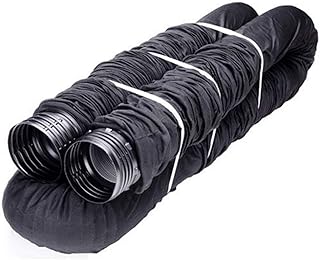
This option combines perforations with a filter sock to help trap sediment and keep the system from clogging. Best for larger landscape beds, under-slab drainage, or gardens where soil contains more particulate matter. It’s a strong choice for long-term maintenance since the sock helps reduce maintenance frequency. Caution: sock materials may require periodic checks and replacement in very sandy or highly organic soils that shed particulates quickly.
Who it’s best for: buyers that want built-in filtration to reduce clogs while delivering effective perforated drainage. Why selected: perforations support continuous drainage; sock adds a simple filtration layer. Better for: larger areas with potential sediment input. Avoid if: you expect quick sock wear in extreme soils, which could reduce flow over time.
Solid-Drain Flex-Drain 51110 (Non-Perforated)

Although not perforated, this solid option provides a dependable conduit for drainage runs that require a sealed pipe to carry water to a discharge point. Best for combining with external perforated sections or when a non-leaking connection is needed. It’s chosen for durability and ease of use. Caution: not suitable where active perforation is required to drain the surrounding soil directly through the pipe wall.
Who it’s best for: projects needing a solid pipe backbone or a reliable connector between perforated segments. Why selected: strong, simple installation with robust construction. Better for: tight, straight runs under hardscapes. Avoid if: direct soil drainage through wall perforations is required.
4 in x 25 ft Flexible Drain Pipe with Socket

This flexible drain pipe features a socket for quick, modular connections. Best for straightforward drainage runs where quick assembly is valued. It can be used in conjunction with perforated segments if your project requires both a solid main line and perforated branches. Caution: confirm whether perforations are included in the specific stock; some listings may vary by batch.
Who it’s best for: DIYers who want fast, tool-free assembly and a reliable mainline. Why selected: socket connections simplify setup; solid core provides strength. Better for: simple yard drainage paths with easy extensions. Avoid if: you strictly need perforations along the pipe wall rather than along branch lines.
Buying options and related accessories
Buying note: This listing points to a sponsor link with multiple options. Choose a compatible perforated segment or sock-based system to match the rest of your drainage plan. This product category often pairs with outlet fittings and filter sleeves to tailor drainage to soil type and landscape grade.
Buying Guide: Key Considerations for Perforated Corrugated Drainage Pipe
- Perforation pattern: Full-length perforations distribute water along the pipe, while end-only outlets concentrate flow at a single point. Choose based on soil infiltration and landscape grade.
- Sock and filtration: A filter sock helps prevent sediment from entering the pipe, reducing clogs in fine soils. Consider soils with high silt or organic matter.
- Pipe strength and flexibility: Corrugated pipes offer flexibility; solid cores add strength for areas with heavy foot or vehicle traffic or underground obstacles.
- Pipe length and connections: Plan runs in manageable lengths and ensure compatible socket or coupling systems for quick assembly.
- Soil and drainage context: Sandy soils drain quickly; clay soils retain moisture and may require broader perforation coverage or additional filtration.
- Maintenance needs: Perforated systems with socks typically require periodic inspection for sediment buildup and sock replacement over time.
Frequently Asked Questions
- What is perforated corrugated drainage pipe best used for?
Perforated corrugated drainage pipe is best for removing excess groundwater from lawns, gardens, and around foundations, especially when a perforated wall allows water to enter the pipe along the run.
- Should I use a sock with perforated pipe?
Using a filter sock helps trap sediment and reduces clogging, which is beneficial in soils prone to particulate matter.
- How long should a drainage run typically be?
Run length depends on landscape grade and drainage needs. Plan in sections that match site conditions and ensure proper discharge points.
- Can I mix solid and perforated pipe in the same system?
Yes, solid pipe can form mainlines or connectors, while perforated sections handle the actual water entry. Ensure compatible fittings and proper grading.
- Is installation DIY-friendly for perforated drainage?
Many perforated drainage systems are DIY-friendly, especially those with easy socket connections and included socks. Follow local guidelines and bed gradients for best results.
- Do perforated pipes require special trench preparation?
Yes, trenches should be wide enough for the pipe, lined with a gravel layer, and sloped toward the discharge point to ensure efficient water flow.