The right magnifying tool can make it easier to study plant details, inspect tiny buds, check leaf textures, and read plant labels in low light. This article highlights five top magnifying glass sets with built‑in lights and precision optics, chosen for readers, hobbyists, and gardeners who want clearer detail without straining their eyes. Each option balances magnification power, illumination quality, and portability, helping you observe plant structures, trichomes, and subtle color variations more accurately.
| Product | Brand | Key Benefit |
|---|---|---|
| JMH Magnifying Glass with Light | JMH | High power magnification with 18 LED lights and 3 lighting modes |
| JARLINK 30X 60X Illuminated Jewelers Loupe | JARLINK | Dual lens system with adjustable LED illumination |
| AC Infinity Jewelers Loupe | AC Infinity | Dual lenses (30x and 60x) with durable lightweight build |
| Nazano Magnifying Glass with 12 LED Lights | Nazano | 12 LEDs for uniform lighting and large 3.15-inch viewing area |
| Pineapple 40X Jewelers Loupe with Light | Pineapple | 40X power with UV and LED lights for detailed observation |
JMH Magnifying Glass With Light
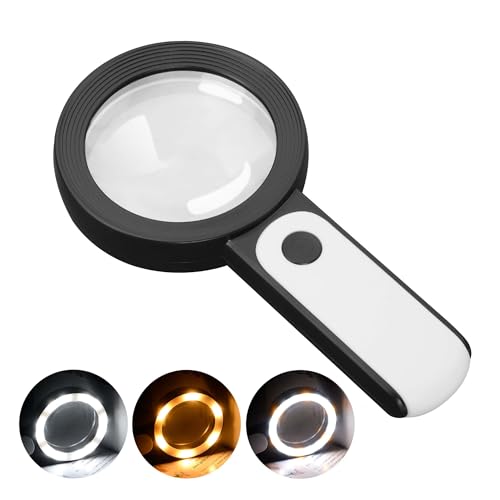
The JMH magnifier combines high optical magnification with an integrated LED system to improve visibility of small plant structures. With 18 LEDs offering three lighting modes—cold, warm, and mixed—this device can adapt to various lighting conditions, making it useful for reading plant labels, examining tiny leaf hairs, or inspecting bud details in dim environments. The lightweight, simple design is ready to use straight from the box, requiring only standard AAA batteries. Its user-friendly interface supports seniors or anyone who prefers an uncomplicated magnification solution for plant study.
Key features include optical high magnification for reading small text and details, stepless dimming across three lighting modes to minimize eye fatigue, and a straightforward ON/OFF operation suitable for users who want a ready-to-use tool without complicated setup.
JARLINK 30X 60X Illuminated Jewelers Loupe

The JARLINK jewelers loupe offers a dual-lens system with 30x/60x magnification, designed for precise inspection of small plant parts, seeds, and micro-details on leaves or petals. The adjustable LED lighting provides uniform illumination from the right angle, enhancing contrast and reducing shadows during close observation. Users should bring the lens close to the object to achieve clear focus, which makes this tool especially effective for analyzing delicate trichomes, pollen grains, or surface textures on tiny plant structures. Its portability makes it ideal for field use or greenhouse benches.
AC Infinity Jewelers Loupe

The AC Infinity loupe emphasizes clarity through dual lenses (30x22mm and 60x12mm) to support different magnification needs. The lightweight, durable construction features a plastic housing with an aluminum shell, providing resilience in busy workspaces like studios or greenhouses. The two lenses enable quick switching for broad overviews and detailed inspection, making it suitable for examining leaf veins, bud scales, or seed morphology. The overall design targets professionals and hobbyists seeking reliable magnification with robust build quality.
Nazano Magnifying Glass With 12 LED Lights

Nazano combines a high-power magnification with a broad 3.15-inch viewing area and 12 built-in LEDs to illuminate the viewing field evenly. The double‑layer optical glass lens minimizes distortion, which is important when examining thin leaf serrations, stomatal patterns, or small floral structures. The extended light array ensures consistent brightness in dim environments, such as early morning greenhouse work or shaded conservatories. The design emphasizes comfort and readability, helping users sustain longer observation sessions without eye strain.
Pineapple 40X Jewelers Loupe with Light

The Pineapple 40X loupe provides a higher magnification with a combination of three lighting options, including a UV light. This makes it particularly useful for examining plant currency-like features or small seed details where UV illumination can reveal hidden characteristics. The built-in LED lights aid visibility in low-light settings, while the UV component adds an additional layer of inspection for certain plant-related tasks. The kit is designed for quick field checks and on-demand detailed viewing of plant materials, coins, stamps, or gemstones in a compact form.
Buying Guide: Key Factors for Choosing a Plant Magnifier
- Magnification range: Determine whether you need low-to-mid magnification for general plant labeling and leaf detail (10x–60x) or higher magnification for microstructures such as trichomes and stomata (40x–90x).
- Illumination quality: LEDs should provide bright, even light without harsh glare. Look for multiple modes (cold, warm, mixed) or UV lighting if you plan to assess UV-reactive plant materials or features.
- Lens quality: Optical glass or high-quality acrylic lens with minimal distortion is essential for accurate observation. Avoid lenses that soften or blur fine plant features.
- Lens type and flexibility: Dual-lens systems (e.g., 30x/60x or 30x/60x/90x) offer versatility for different tasks. Ensure the device can be held steadily near the object for sharp focus.
- Build and portability: A lightweight, durable frame is beneficial for greenhouse work, field trips, or classroom use. Foldable or pocket designs improve transportability.
- Power and convenience: Check battery type, availability of backup batteries, and ease of replacing or recharging power sources. A simple on/off mechanism helps in quick observations.
- Accessories and extras: UV illumination, additional lenses, or carrying cases can enhance value if your plant study often involves subtle features or field use.
- Intended user: For seniors or readers who need simple operation, prioritize devices with clear buttons and straightforward adjustments to minimize fatigue and confusion.
Plant Observation Tips With Magnifiers
When using any magnifier for plant study, start at a lower magnification to locate the area of interest, then increase magnification as needed. Keep the lens close to the specimen to maintain focus, and avoid pressing down too hard to prevent damage to delicate plant tissues. Use consistent lighting to prevent shadows that obscure fine features. For sap and resin-rich areas, consider angled lighting to reveal surface textures. Regularly clean lenses with a soft, lint-free cloth to ensure sharp images over time.
In botany or home gardening, magnifiers are valuable for identifying pest evidence, leaf edge patterns, or seed coat textures. For hobbyists collecting plant-related items, a high-quality illuminated loupe can clarify details that inform proper labeling and care. Across different environments—indoors, in the greenhouse, or on outdoor excursions—select a magnifier that balances power, light, and ease of use to match your specific plant observation needs.