Answering the question of how to maximize indoor plant growth, the right LED grow light provides full-spectrum illumination, adjustable intensity, and timers to mimic natural daylight cycles. This guide helps practical buyers choose five top options, each best for different indoor setups—from compact desks to small shelves to home greenhouses. Read on to find which light fits your plants, space, and schedule.
Product Snapshot
| Product | Best For | Key Benefit |
|---|---|---|
| GooingTop LED Grow Light | Small desks, readers, and beginner setups | Full spectrum with 4–12 hour timers; flexible gooseneck and USB/AC power |
| GYTF Halo Plant Grow Light | Adjustable height spaces; compact grow zones | Circular design with 12 LEDs; adjustable height and 4/8/12/18H timer |
| LEOTER Grow Light for Indoor Plants | Versatile home gardens; multiple spectra needs | 80 LEDs with 3 spectrum modes; 10 dimmable levels; multiple timer options |
| 8.6” Mini LED Grow Light Strips (RWNTAO) | Shelf rows, windowsill gardens, tight spaces | Two head light strip; 52 LEDs; 3/9/12H timer; 10 dimming levels |
| Grow Lights Upgrade 84 LEDs Clip Light (RWNTAO) | Two-head flexible clip setup; larger plant groups | Full spectrum plus red/blue modes; 3/9/12H timer; 10 brightness levels |
GooingTop LED Grow Light
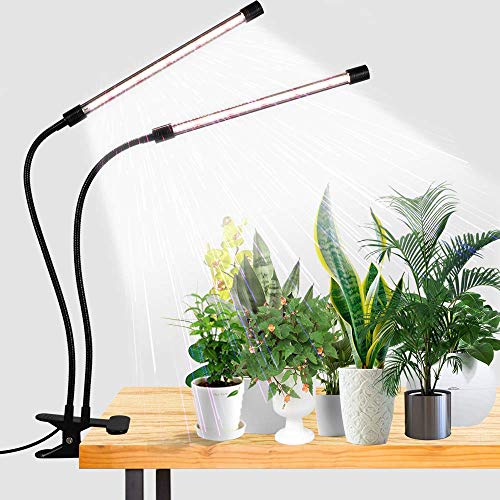
Features include a 6000K white light with 10 red and 74 white LEDs, delivering a full-spectrum similar to noon sunlight. The light claims a color rendering index around 95, making it suitable for general plant care as well as reading in a bright setup. A 3-level timer (4H, 8H, 12H) operates on a 24-hour cycle, turning on and off automatically. The gooseneck is flexible, and a strong clamp enables placement on desks or shelves. USB or AC power provides flexible power options.
Best for: Beginners and small-space growers who want straightforward, adjustable light with a simple on/off schedule. This is a practical entry point for seedling care and leafy greens in a compact setup.
Caution: The timer is best used with continuous power; if power is interrupted, you may need to reset the timer.
GYTF Halo Plant Grow Light

This light uses a circular layout with 6 red, 6 blue, and 36 white LEDs, producing a full spectrum aimed at indoor plant growth. An adjustable aluminum stand allows height changes from 7″ to 18″ and a 180° rotatable head to tailor angles for succulents, herbs, or small potted plants. The timer supports 4, 8, 12, and 18 hours of operation with an auto on/off function, and brightness is adjustable to suit plant needs. The sturdy pole and compact footprint fit small grow tents or windowsill corners.
Best for: Plant lovers who need a compact, height-adjustable light with flexible angle control for tight grow spaces or shelves.
Caution: The circular design may cover a smaller footprint than larger panel lights; ensure your plant canopy fits under the head for optimal coverage.
LEOTER Grow Light for Indoor Plants
LEOTER combines 80 LEDs in three spectrum modes: full spectrum (380–800 nm), red (660 nm), and blue (460 nm), plus a mix of red, blue, and white. It includes a circular memory timer with 3H, 9H, and 12H presets and a 10-dimmable-level brightness setting. An adjustable gooseneck and a sturdy aluminum build enable positioning for varied growth stages. The design targets vegetative growth, flowering, and fruiting by offering spectral flexibility.
Best for: Houseplant enthusiasts who want a flexible spectrum toolkit and a broad timer suite for different growth stages.
Caution: Timer memory may reset if power is interrupted; plan for occasional re‑setting after outages.
8.6” Mini LED Grow Light Strips (RWNTAO)

This 8.6-inch light strip uses 52 full-spectrum LEDs, with a mix of 3500K white LEDs to simulate natural daylight. It provides a compact solution for small shelves or plant shelves. Three timer options (3, 9, 12 hours) allow automatic scheduling, and 10 dimming levels enable a tailored photoperiod and intensity. The product is designed to deliver sufficient PPFD for seedling to leafy growth while keeping heat low and energy use efficient.
Best for: Gardeners with compact spaces, such as windowsills or spice shelves, who want a slim lighting strip with straightforward timing.
Caution: Coverage is narrower than larger panel lights; use multiple strips if you have a wider canopy.
Grow Lights Upgrade 84 LEDs Clip Light (RWNTAO)

This two-head clip light provides a bright full-spectrum option with 84 LEDs, including red and white LEDs, designed to support multiple growth stages. It offers 3 spectral modes and 10 dimmable levels, enabling targeted adjustments for seeds, leafy growth, or flowering. The clip design makes it easy to attach to shelves, racks, or plant stands, while the 3/9/12-hour timers reduce manual operation for busy schedules.
Best for: Larger or denser plant collections that require greater light output in a compact, clip-on form factor. Choose this if you need two lighting points in a single setup.
Caution: A two-head unit may consume more power than single-head options; monitor energy use if running multiple lights simultaneously.
Buying Guide
What should I look for when choosing an LED grow light?
- Full-spectrum coverage: Look for a blend that includes red and blue wavelengths (and white light) to support germination, vegetative growth, and flowering.
- Intensity and PPFD: Higher PPFD is useful for plants with greater light needs; consider the canopy size and distance between light and plants.
- Adjustability: Flexible goosenecks or adjustable stands help target the plant canopy and reduce light waste.
- Timers and auto on/off: Timers keep plants on a stable schedule, essential for busy households or work weeks.
- Footprint and height: Ensure the light’s coverage matches your space; taller stands require different mounting than compact desk lamps.
- Power options: USB-powered units are convenient for small desks; AC power provides broader installation flexibility.
How many hours should indoor plants receive light?
Most leafy greens and herbs respond well to 12–16 hours of light per day in a controlled indoor setting. Seedlings may require longer daily exposure, while mature fruiting plants often benefit from longer photoperiods. Use timers to maintain consistent cycles, which helps reduce stress on the plants.
Are two-head or multi-head lights better?
Two-head or multi-head units can deliver more light across a larger canopy and reduce shadows, making them suitable for dense plant groups or taller setups. For smaller spaces, a single-head light with a flexible arm can be sufficient if positioned correctly.
FAQ
- What wavelength range is best for general houseplants?
Most grow lights are designed around full-spectrum output, which includes 380–800 nm. This range covers blue, red, and white light essential for most stages of plant growth.
- Do grow lights need to be on a timer?
Not always, but timers help maintain a consistent day/night cycle, which reduces stress on plants and simplifies care for busy owners.
- Can I use grow lights next to normal room lighting?
Yes, but place the lights to minimize glare and ensure plants receive sufficient direct illumination without overheating nearby objects.
- How close should a grow light be to plants?
Distance varies by model and light intensity; start with 6–12 inches for compact lights and adjust based on plant response and heat output.
- Is blue or red light more important?
Blue light supports vegetative growth; red light supports flowering and fruiting. A balanced spectrum typically yields best results across growth stages.
- Do LED grow lights save energy?
Yes. LEDs consume less wattage than traditional grow bulbs while delivering comparable or better light output, making them a cost-effective option over time.