If you want to clear leaves and debris without straining your back, a walk-behind or wheeled leaf blower is often the best choice. This guide highlights five wheeled models that balance power, maneuverability, and durability for American yards. Ideal buyers include homeowners with large driveways and lawns, landscapers needing efficiency, and anyone seeking reduced fatigue during long cleanup sessions. Below is a quick summary to help you compare key features and suitability at a glance.
| Product | |||
|---|---|---|---|
| Champion Power Equipment 212cc 1200 CFM Walk-Behind Leaf Blower | 212cc | 1200 CFM | Large 12-inch back wheels; front wheel can lock or swivel |
| YARDMAX YF1565 Walk-Behind Blower | 209cc OHV | 150 mph / 1200 CFM | Large wheels for terrain; designed for easy handling |
| Landworks Leaf Blower Wheeled Walk Behind Jet Sweep | 212cc 4-stroke OHV, 7HP | 150-200 mph / 1270-2000 CFM | Heavy-duty wheels; 360° swivel front; solid metal housing |
| SuperHandy Tow-Behind Leaf Blower | 15 HP (gas) engine | 3000 CFM / 207 MPH | Tow-behind with clevis hitch for easy transport |
| WORX Trivac 3 in 1 Electric Leaf Blower | Electric, 600 CFM | 600 CFM | Mounted as a wheeled unit for mobility on lawns |
Champion Power Equipment Walk-Behind Blower
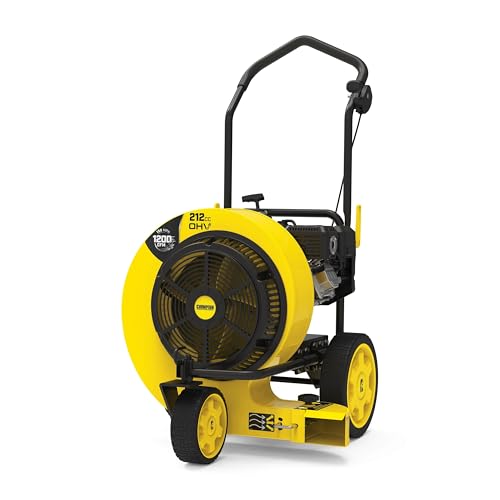
The Champion Power Equipment model offers adjustable throttle control for different jobs, with large never-flat back wheels and a lockable or swivel front wheel for varied terrain. Its ergonomic, height-adjustable soft-grip handle reduces operator fatigue during extended use. Best for homeowners tackling large lawns or uneven ground where wheel maneuverability matters. A potential limitation is the need to manage a heavier gas-powered unit, which may require more storage space and regular maintenance.
YARDMAX YF1565 Walk-Behind Blower

The Yardmax YF1565 uses a powerful 209cc OHV engine and delivers up to 150 mph air speed with 1200 CFM, making it effective for clearing heavy yard debris across medium to large properties. It’s best for buyers who want straightforward, aggressive power with reliable walk-behind control on varied surfaces. A limitation to consider is the absence of advanced ergonomic adjustments beyond standard controls, which could affect comfort on long sessions.
Landworks Leaf Blower Wheeled Walk Behind Jet Sweep

Landworks Jet Sweep combines a 7HP 212cc 4-stroke OHV engine with a robust 340mm metal impeller, delivering 150-200 MPH and 1270-2000 CFM. It has rugged all-terrain wheels, a front swivel wheel, and a 90-degree adjustable flow angle for precise debris management. This model is best for heavy-duty cleanup on larger properties or commercial-style jobs where durability and control are paramount. A potential limitation is the heavier weight and larger footprint, which may be less ideal for small yards or tight spaces.
SuperHandy Tow-Behind Leaf Blower

This tow-behind model offers a high-performance 15HP electric-start engine with a generous 3000 CFM airflow and up to 207 MPH air speed. It’s best for large properties or commercial settings where a tractor, ATV, or utility cart can tow the blower for efficient coverage. Choose this if you regularly clean expansive areas and value transport ease. A caveat is the need for a compatible towing vehicle and appropriate hitch setup to utilize its full capabilities.
WORX Trivac 3 in 1 Electric Leaf Blower

The WORX Trivac combines blower, vacuum, and mulch functions in one unit, delivering 600 CFM of airflow and a 16:1 mulch ratio. It’s well-suited for homeowners who want a compact, electric-powered option with multi-function capabilities. Best for medium yards with mixed leaves and debris. A potential limitation is reliance on an electrical outlet and cord management, which can constrain mobility on very large properties or remote areas.
Buying Guide: Key Considerations for Wheeled Leaf Blowers
- Power source and engine size: Gas engines offer continuous power for large areas but require more maintenance and noise management. Electric and cordless options are quieter and easier to maintain, best for small to medium yards.
- Airflow and speed: CFM (cubic feet per minute) and MPH (miles per hour) indicate clearing capacity. Higher numbers matter for thick, damp leaves or dense debris.
- Mobility and wheels: Look for large, solid wheels and a front wheel that can swivel or lock. Consider wheel diameter as it affects maneuverability on uneven ground.
- Durability and build quality: Metal impellers and rust-resistant components extend service life in rugged environments.
- Safety features and ergonomics: Adjustable handles, soft grips, and proper vibration management reduce fatigue during long sessions.
- Weight and storage: Heavier machines require more storage space and physical effort; balance power needs with yard size and storage options.
- Maintenance needs: Gas models require routine oil changes and filter maintenance; electric models need battery care or cord management.
Frequently Asked Questions
- What size leaf blower should I choose for a large yard with many trees? A gas-powered walk-behind model with high CFM and strong wind speed is typically best for large spaces and heavy debris.
- Are tow-behind blowers practical for residential use? They’re ideal for very large properties or landscaping business use where a towing vehicle is available, offering high airflow with easier transport.
- Do electric wheel blowers work well for wet leaves? Some electric 3-in-1 models can handle damp leaves, but gas-powered units generally perform better in wetter conditions and heavy debris.
- Is a mulching function important? Mulching reduces disposal volume by shredding leaves, which helps when you collect debris for composting or disposal.
- Should I prioritize airflow over speed? Both matter; higher CFM clears loose leaves effectively, while higher MPH helps break up stubborn debris. A balance suits most yards.
- Can I use a wheel blower on concrete driveways? Yes, most wheeled models are suitable for hard surfaces, but ensure the wheels don’t slip and the airflow is appropriate for the debris type.