Choosing the right pull-behind lawn fertilizer spreader can simplify seasonal care, improve uniform coverage, and help you protect your turf. This guide highlights five top options designed for broadcast spreading of seed, fertilizer, salt, and ice melt. Each model offers different hopper capacities, spread widths, and control features to fit riding mowers and standard lawn tractors alike. Read on to compare what matters most when selecting a spreader that rides behind your lawn equipment.
| Product | Hopper Capacity | Spread Width | Notes |
|---|---|---|---|
| Agri-Fab 45-0463 | 130 lb | 10-12 ft | Seat-control flow, USA-made |
| Yard Commander 125 LB | 125 lb | Up to 12 ft | Premium aluminum gears, gate lever |
| Agri-Fab 45-0530-131 | 85 lb | Up to 10 ft | Compact, durable for small jobs |
| Agri-Fab 45-0527 110 lb | 110 lb | Up to 10 ft | Rustproof hopper, seat flow control |
| Additional Spreader (Dethatcher Wing) | 40″ dethatch, 41.5 lb | N/A | Supplemental lawn care tool, separate function |
The following sections cover five pull-behind spreaders in depth. Each entry summarizes key features, benefits, and how they fit different lawn sizes and mowing setups. This overview follows objective criteria to help you pick a model that aligns with your yard care goals.
Agri-Fab 45-0463 Tow-Behind Lawn Spreader

The Agri-Fab 45-0463 is a 130-pound capacity broadcast spreader designed for use from a riding lawn mower seat. It features a 10-12 foot spread width, enabling broad coverage without frequent refilling. The hopper is noted for its sturdy construction and is marketed as Made in the USA. Its seat-of-mower flow control allows quick adjustment while operating, which can reduce overlap and improve efficiency on larger lawns. Suitable for seed, fertilizer, salt, and ice melt, this model emphasizes durability and long-term value for homeowners with mid-size to large yards.
Key considerations include hopper capacity, spread width, and ease of control from the riding mower. The 130 lb capacity minimizes trips to refill, particularly in larger yards or when spreading dense materials. The 10-12 ft spread width helps balance thorough coverage with minimal overlap, supporting a more uniform application. Users should verify compatibility with their mower’s towing hitch and ensure proper calibration for different materials. Maintenance focuses on hopper cleanliness and gate mechanism reliability to ensure consistent flow control.
Yard Commander 125 LB Tow-Behind Spreader

The Yard Commander model offers a substantial 125-pound hopper with a focus on precision through premium aluminum cast gears and a gate lever for easy spread control. The design emphasizes consistent broadcast performance across a range of materials, including seed, fertilizer, salt, and ice melt. The 125-pound capacity makes it suitable for medium-to-large lawns, reducing the frequency of refills during seasonal applications. The aluminum gear system typically provides smooth operation and durability in varying weather conditions.
From an objective perspective, this spreader is positioned for users who prioritize precise control and robust build quality. Operators should consider the setup time, calibration steps for different products, and the effort required to tow across uneven terrain. The aluminum gears are a notable enhancement for longevity, but routine checks for gear alignment and gate leverage will help maintain consistent distribution over time.
Agri-Fab 45-0530-131 Tow Broadcast Spreader

With an 85-pound hopper, the Agri-Fab 45-0530-131 is a compact option designed for smaller lawns or lighter applications. It spreads up to 10 feet wide, offering reliable coverage for routine maintenance tasks like regular fertilization or pre-seeding weed control. The product is marketed as Made in the USA, emphasizing domestic manufacturing and a focus on durability in a lighter, more maneuverable design. This model can be advantageous for homeowners with tight storage spaces or those who do not require frequent refills.
Prospective buyers should note that the lighter capacity directly influences refill frequency on larger areas. However, for small to mid-sized yards, this spreader provides steady performance, easy storage, and straightforward operation. Calibration and flow adjustment remain essential to ensure uniform distribution, especially when switching between granular products and different application rates.
Agri-Fab 45-0527 110 lb Tow-B behind Spreader
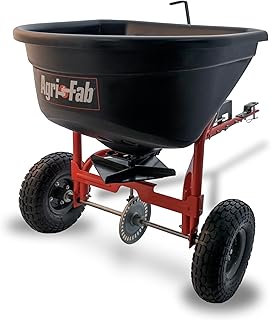
This model provides a 110-pound capacity with rustproof hopper and spreader plate, designed to extend product life and resist corrosion from fertilizer and salt. The 110-pound capacity suits medium yards where fewer refills are preferred, and it generally aligns with spread ranges around 10 feet. Agri-Fab emphasizes compatibility with riding mowers, allowing flow control from the mower seat for convenient operation. The rustproof components benefit longevity in harsh weather or when using salt-based products in winter months.
When evaluating this spreader, consider the typical lawn size and the material type you commonly apply. The rustproof design is a meaningful durability feature, but users should still perform regular gate and drive-chain inspections to prevent uneven distribution. For those who value a balance of capacity and resilience, this model offers a practical blend of features without excessive bulk.
40″ Tow-Behind Dethatcher with Tines

While not a traditional spreader, this 40-inch dethatcher complements spreading tasks by preparing the lawn surface. The dethatcher features 20 flexible rust-proof tines designed to remove thatch, leaves, and pine needles, improving air and water movement in the root zone. At 41.5 pounds, it is a relatively light attachment that can be towed behind a lawn tractor. Proper dethatching can improve the effectiveness of subsequent fertilizer applications by improving soil contact and nutrient uptake.
For users evaluating lawn care plans, adding dethatching can be a strategic step before applying fertilizer or seed. The tool’s transport handle and movable tines enable efficient setup, and the wheels facilitate movement around obstacles. This accessory should be used on dry, well-maintained turf to minimize potential turf damage and ensure effective debris removal.
Note: This accessory does not replace a spreader but serves as a complementary tool in a broader lawn care regimen. When paired with a suitable pull-behind spreader, homeowners can achieve a more comprehensive approach to lawn health across growing seasons.
Buying Guide: Pull-Behind Spreader Essentials
Key purchase considerations for a lawn fertilizer spreader pull-behind include capacity, spread width, and material compatibility. A larger hopper reduces refill frequency for big lawns but adds weight and may require a more robust hitch connection. Spread width determines how quickly you cover turf and how evenly material disperses; wider spreads can increase coverage but risk material run-off on slopes. Material compatibility is essential: some spreaders are designed for seeds, others for fertilizers or salt, and certain products can corrode or clog gates if the hopper or spread plate is not rustproof or properly calibrated.
Other important factors include ease of use, especially if you operate from the seat of a riding mower. A reliable flow control mechanism—ideally accessible from the mower seat—helps maintain consistent application rates. Aluminum gears and rustproof components contribute to longevity, particularly for salt or winter use. Finally, consider the maneuverability of the model, hitch compatibility, and the availability of replacement parts or accessories, such as additional gate levers or spread plates.
In choosing among these options, homeowners should balance yard size, types of products used, and how often they plan to spread. For large properties, higher hopper capacity and a wide spread pattern can save time. For smaller yards, a compact model with straightforward controls may be preferable. Evaluating warranty terms and customer support can also help ensure long-term satisfaction with a pull-behind spreader system.