Broadleaf weeds can invade lawns, landscapes, and turf with ease. This guide reviews five top herbicides designed to tackle common broadleaf challenges, from pre-emergent defenses to post-emergent corrections. Each product below offers distinct active ingredients, application timing, and coverage, helping you choose the right fit for residential or commercial sites.
| Product | Brand | Key Feature |
|---|---|---|
| TZONE SE Broadleaf Herbicide for Tough Weeds | PBI / Gordon | Combination of Triclopyr, 2,4-D, Dicamba, Sulfentrazone; yellow nutsedge suppression |
| SpeedZone EW Broadleaf Herbicide for Turf | SPEED ZONE | Fast weed control and clover reduction; broad activity on broadleaf weeds |
| Drive XLR8 Crabgrass Killer | BASF | Quinclorac-based; post-emergent broadleaf and grassy weed control; up to 30 days residual |
| Torocity Herbicide (8oz) | Atticus | Mesotrione-based; pre- and post-emerge control; broad-spectral weed control |
| Barricade 4FL Herbicide Concentrate | Syngenta | Pre-emergent weed prevention; long-lasting |
Note: This introduction highlights key traits. For effective results, follow label directions and consider your specific turf type, climate, and weed pressure. The five products below are selected for relevance to broadleaf weed control in American lawns and turf settings.
TZONE SE Broadleaf Herbicide For Tough Weeds
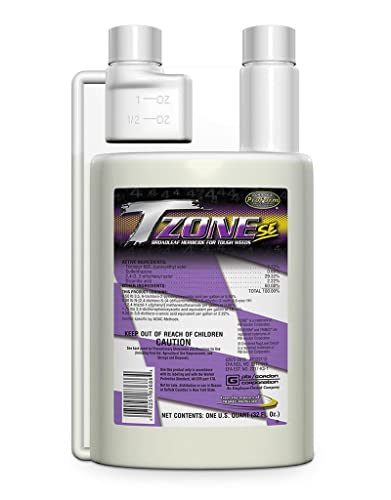
TZONE SE combines multiple active ingredients to address a broad spectrum of tough weeds. Its formulation blends triclopyr, 2,4-D, dicamba, and sulfentrazone to deliver post-emergent control with targeted action on broadleaf species. The product is designed for residential, commercial, and golf-site applications, offering suppression of troublesome grasses like yellow nutsedge in some sites. Use timing and rates per label to optimize performance and minimize turf injury. Ideal for sites requiring robust broadleaf weed management with additional sedge suppression capabilities.
ALLIGARE 2,4 D Amine Herbicide

ALLIGARE 2,4-D Amine provides versatile post-emergent broadleaf control with a high concentration of 2,4-D Amine (46.8%). This formulation targets common broadleaf weeds in lawns and landscapes, delivering rapid foliar action. When applying, consider turf type and potential drift avoidance. This product is suited for homeowners and professionals who need a straightforward broadleaf solution with a proven active ingredient profile.
PBI Gordon SpeedZone EW Broadleaf Herbicide for Turf
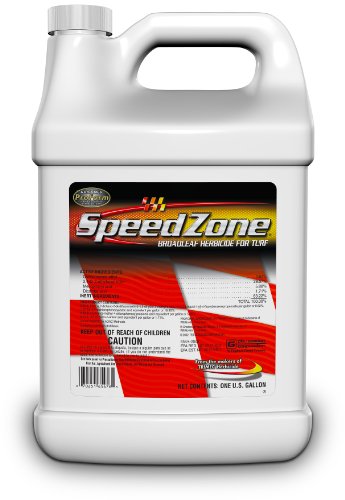
SpeedZone EW is designed for rapid broadleaf weed control in turfgrass. It emphasizes quick visible action and can address clover and other common lawn invaders within a single growing season. The product is not available for sale in certain states, so verify local label restrictions before purchase. Its post-emergent nature makes it suitable for established turf where selective broadleaf control is necessary without harming desirable grasses.
BASF Drive XLR8 Crabgrass Killer

Drive XLR8 uses a quinclorac-based formulation for post-emergent control of broadleaf and grassy weeds, with a stated up to 30 days of residual activity. It offers rapid uptake and a quick visual response, making it a practical choice for lawns dealing with crabgrass, clover, dandelion, and similar species. Consider weather conditions and irrigation requirements to maximize performance and minimize potential turf sensitivity.
Atticus Torocity Herbicide (8oz)
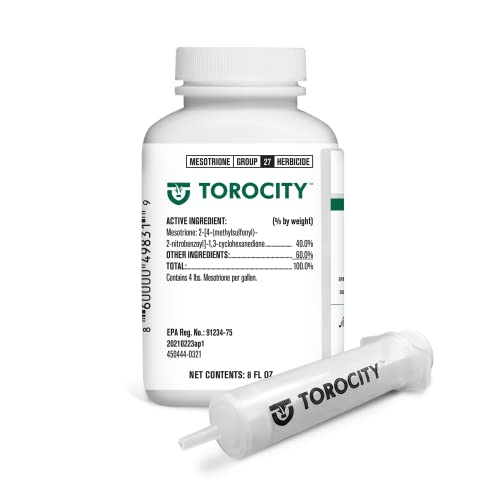
Torocity combines mesotrione as the active ingredient, matching the performance of Tenacity in a comparable formulation. It offers flexible timing for pre- and post-emerge control, broad-spectrum activity against numerous broadleaf and grassy weeds, and suitability for newly seeded lawns as well as established turf. The product is designed to prevent weed establishment and to suppress existing invaders, supporting long-term turf health when used as directed.
Barricade 4FL Preemergent Concentrate

Barricade 4FL is a pre-emergent herbicide designed to prevent weed development before germination. It provides season-long prevention when used as directed and is labeled for use in a variety of settings, including lawns, landscapes, and ornamental areas. This product is particularly effective for establishing turf and ornamental beds where early weed pressure is anticipated, helping to reduce subsequent herbicide applications.
Buying Guide: Key Purchase Considerations
- Active ingredients and weed targets: Match the herbicide’s active ingredients (for example, triclopyr, 2,4-D, dicamba, sulfentrazone, mesotrione, quinclorac) with the weeds you most commonly encounter in your site. Some products excel at post-emergent control, while others are best as pre-emergent barriers.
- Application timing: Pre-emergents prevent germination, while post-emergents address existing weeds. Consider your weed calendar, season, and whether new seedings are planned.
- Site and turf compatibility: Ensure the product is labeled for your turf type (cool-season vs. warm-season grasses) and location (residential lawn, golf course, commercial landscape). Some products have state or site restrictions.
- Residual effects and irrigation: Some formulations offer residual control lasting weeks to months. Check rain-fast times and irrigation requirements to maximize efficacy without washing away the product.
- Safety, drift, and environmental concerns: Follow label directions to minimize off-target damage and ensure safe handling, especially near ornamentals, water features, or edible crops.
- Cost vs. coverage: Compare the coverage rate and container size to estimate cost per square foot and overall project value, factoring in potential repeat applications.
- Resistance management: Rotate herbicides with different modes of action where feasible to reduce weed resistance development over time.
Always read and follow the product label for precise application instructions, limitations, and safety guidelines. The selections above provide a spectrum of options—from pre-emergent barriers to rapid post-emergent control—so you can tailor a weed management plan to your site, climate, and maintenance goals.