Answering buyers seeking steady humidity control in an incubator, these options emphasize precise humidity management, stable temperatures, and automatic turning. Ideal for hobbyists, classrooms, farms, and laboratories, each pick balances ease of use with reliable humidity regulation. Below, five incubators stand out for their humidity features, built‑in candlers, and automated turning. A quick buying table is included to compare capabilities at a glance.
| Product | Humidty Control | Auto Turning | Egg Tray Capacity | Best For |
|---|---|---|---|---|
| MATICOOPX 20 Egg Incubator | External refill, stable humidity | Yes | 20 eggs | Small farm & beginners |
| Onsju 18 Egg Incubator | Auto-regulated humidity system | Yes | 18 eggs | Classroom & home hobbyist |
| APDOE HatchPro 12 | 2-in-1 humidity system | Yes | 12 eggs | Small batches & precise control |
| APDOE 18 Eggs Incubator | Auto humidity & adjustable vent | Yes | 18 eggs | Multi-species |
| Harris Farms Nurture Right | 360° humidity via design | Yes | 12-22 eggs | Educational & hobby farms |
MATICOOPX 20 Egg Incubator With Humidity Display

This model combines a stable circulating airflow system with a humidity display to help maintain consistent moisture levels. It features external water refilling, so you can top up without lid openings that disrupt temperature and humidity. A built‑in egg candler lets you monitor embryo development without buying extra tools. Best for hobbyists and small farms needing predictable humidity and a simple, all‑in‑one incubator. Limitations include reliance on accurate ambient room conditions for best results.
Onsju 18 Egg Incubator With Humidity Control

Onsju’s model emphasizes precision with a digital temperature display and an auto-regulated humidity system. Its sealed construction reduces external interference, while smart replenishment supports stable humidity across development stages. Turn intervals are user‑adjustable (60/120/180 minutes) and the system pauses before lockdown to protect embryos. This option is well suited for classrooms and small home setups, though users should monitor for consistent water supply during peak use.
APDOE HatchPro 12 Egg Incubator

The HatchPro 12 uses an advanced digital control system with real‑time temp and humidity readouts. It supports automatic turning every 2 hours and offers a 2‑in‑1 humidity tray with external water bottles for minimal refills. The egg tray is removable for easy handling during late incubation. Best for compact space and precise control, with the caveat that the 12‑egg capacity may require more frequent replenishment for high turnover scenarios.
APDOE 18 Eggs Incubator With Humidity & Turn
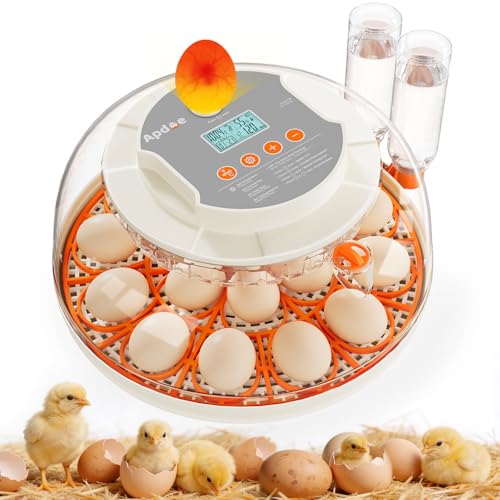
This model holds a larger variety of eggs with adjustable turning intervals (1–3 hours) and a lockdown feature to protect embryos near hatch. It accommodates 18 eggs with separate trays for different sizes, including up to 8 larger poultry eggs. The fully adjustable incubation day and cycle enable species-specific settings. Consider the locking and tray arrangement if you frequently incubate mixed‑species batches.
Harris Farms Nurture Right Egg Incubator

Harris Farms emphasizes 360° visibility and airflow for uniform heat, with an automatic turner and integrated temperature and humidity control. It can hold 12–22 eggs, making it versatile for chickens, ducks, and pheasants. The 360° design helps monitor progress from any angle. A possible limitation is the higher capacity that may be unnecessary for very small setups; ensure you have space for adequate ventilation and cleaning access.
Buying Guide: Humidity Control and Incubation Essentials
What humidity level should you aim for? Most poultry eggs hatch best with humidity around 40–50% during incubation and 65–75% during lockdown, though species differences exist. Look for digital displays, automatic humidity regulation, and external water refilling to minimize temperature fluctuations. Consider turning mechanisms, preservation of airflow, and ease of cleaning when comparing units. For classrooms and farms, durability, tray flexibility, and capacity are key factors.
Key Purchase Questions
- How important is a built‑in candling feature? It helps monitor development without opening the lid, preserving humidity and temperature.
- Is auto turning essential? Auto turning reduces manual handling and replicates natural incubation, improving hatch rates when timed correctly.
- What capacity fits your needs? Choose a model that aligns with your typical egg size and species mix to avoid excessive waste or space use.
- How easy is water refilling, and does it affect interior conditions? External refilling minimizes temperature and humidity disturbances.
FAQ
- What humidity level is best for chicken eggs during incubation? Typically 40–50% during incubation, rising to 65–75% during lockdown.
- Can these incubators handle multiple species? Some models support chicken, duck, quail, and other birds; check tray capacity and egg sizes.
- Do all models stop turning before hatch? Most stop 4 days before hatch to prevent egg damage; verify with your chosen model.
- Is external water filling sufficient for long incubations? External refills help maintain stable humidity without opening the lid.
- Will automatic turning harm embryos if settings are wrong? Incorrect turning intervals can affect hatch rates; ensure you set appropriate intervals for your eggs.
- Are these incubators suitable for classrooms? Yes, many are designed for educational use with clear visibility and safe handling.