Answering the need for precise irrigation data, a drip irrigation flow meter helps you track water usage, optimize efficiency, and prevent overwatering. This guide reviews five reliable options, highlighting who they’re best for, what they measure, and where they excel or fall short. Ideal buyers include DIY gardeners, small-scale farmers, RV owners with garden hoses, and anyone who wants clear, real-time water metrics for outdoor watering projects.
Summary Table of Selected Products
| Product | Best For | Key Benefit |
|---|---|---|
| RESTMO Water Flow Meter with Brass Inlet Metal Thread | Outdoor garden hoses and RV water tank filling | Four modes and durable brass build |
| RESTMO Water Flow Meter with Brass Inlet & Outlet | Hose connections needing both inlet and outlet durability | Hassle-free installs with dual metal threads |
| RAINPOINT Water Flow Meter with Brass Inlet | RV, garden hose, sprinklers, and nozzle sprayers | 180° LCD and four measurement modes |
| RAINPOINT Water Flow Meter with Brass Inlet & Outlet | Versatile outdoor installations requiring bidirectional flow | Reliable accuracy and 180° readable display |
| RESTMO 3-Dial Analog Sprinkler Timer | Automatic and manual drip irrigation control | Three dials for precise scheduling |
RESTMO Water Flow Meter with Brass Inlet Metal Thread

The RESTMO model uses a pure brass inlet and metal thread to deliver durable, leak-resistant performance. It features an LCD screen and a single push button to switch among four measurement modes. Real-time flow rate, last-time usage, daily average, and total usage are available. This configuration is best for gardeners who want a straightforward, hard-wearing meter that screws directly onto garden hoses.
Best for: Outdoor gardeners and RV users who want a robust, easy-to-read meter with flexible measurement options. Why selected: The brass-inlet design and four modes provide versatile tracking without complex setup. Limitation: The unit relies on a single button for mode changes, which may require several presses to switch between options in low-light conditions.
RESTMO Water Flow Meter with Brass Inlet & Outlet

This meter adds an inlet and outlet brass configuration for sturdier, longer installs without frequent reconnections. It shares the LCD readout and four-mode operation, including Flow, Consumption, Average, and Total modes. It’s suited for users who park the meter between a water source and a hose reel, or where frequent hose disconnections occur. Best for: Installers needing durable, reversible connections. Choose this if you frequently switch hoses or move meters between locations. Caution: The dual-thread design may require careful alignment to avoid cross-threading during multi-point connections.
Rainpoint Water Flow Meter with Brass Inlet
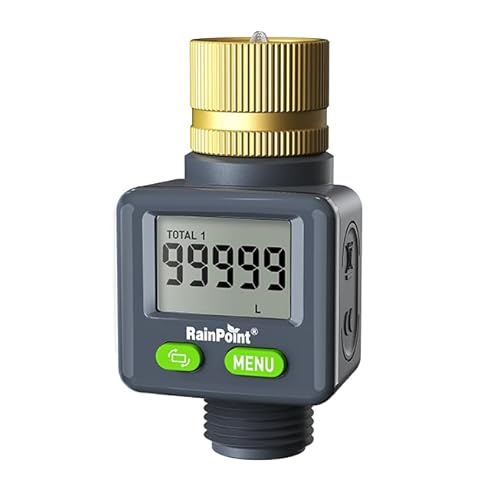
RAINPOINT’s model delivers four measurement modes with a 180° screen that flips for easy reading from different angles. It uses a high-precision hall sensor and efficient wheel design to maintain accuracy, labeled at ±5%. The device supports real-time flow rate, last usage, and two total modes, making it suitable for RV water tanks, sprinklers, and garden hoses. Best for: Users requiring rotation-friendly displays and dependable accuracy. Limitation: The ±5% accuracy, while solid, may not meet premium lab-grade expectations for exact volumes in critical experiments.
RAINPOINT Water Flow Meter, Brass Inlet & Outlet

Another RAINPOINT option emphasizes durability with brass inlet and outlet, offering a 180° flip screen for easy reading and four modes, including two variants of total measurements. It is designed for bidirectional flow installation, which adds flexibility for irregular hose layouts. Best for: Installations where bidirectional flow is beneficial. Limitation: Some users may find the more advanced flow modes unnecessary for simple watering tasks, possibly complicating the setup for casual users.
RESTMO 3-Dial Analog Sprinkler Timer

This analog sprinkler timer provides an automated watering schedule with three dials for how often and how long to water, plus a rain delay option. It supports up to 480 minutes of watering per session and allows scheduling from 1 hour to 72 hours, offering robust control for drip irrigation systems attached to hoses. Best for: Gardeners who want a simple mechanical timer to run independent drip lines. Caution: Analog timers typically require manual adjustments after battery changes or power interruptions.
[2 Pack] RESTMO Heavy Duty Water Flow Meter
![[2 Pack] RESTMO Heavy Duty Water Flow Meter](https://m.media-amazon.com/images/I/510BqmYOabL._SL500_.jpg)
This two-pack offers a durable option with pure brass inlet and metal-thread connections and a four-mode LCD display. It’s efficient for tracking gallon or liter usage and the current flow rate, especially in setups where multiple hoses or lines share a single water source. Best for: Solutions requiring multiple meters for larger properties or multiple zones. Limitation: The two-pack increases upfront cost and bulk storage needs if only a single line is monitored.
LinkTap Micro Flow Meter

LinkTap’s Micro Flow Meter targets drip irrigation and precision low-flow monitoring. It is designed to measure a narrow range (0.05–1.3 GPM) with tight accuracy and is positioned as the ideal companion for drip lines, flower beds, and greenhouses where standard meters lack sensitivity. Best for: Drip systems and hobby greenhouses requiring reliable low-flow data. Caution: It is not compatible with certain LinkTap timers, so verify compatibility with your existing timer before purchasing.
Buying Guide: Key Purchase Considerations
- Flow range and accuracy: Most meters list ±5% accuracy. If you need very precise measurements for plant tissue studies or irrigation audits, consider higher-grade sensors or meters offering tighter tolerances.
- Durability and materials: Brass inlet/outlet, metal threads, and weather-resistant housings increase longevity in outdoor environments. Plastic meters may be cheaper but can wear faster under sun and mineral buildup.
- Measurement modes: Common modes include real-time flow rate, last usage, and total usage. For drip setups, four-mode meters help evaluate short-term and cumulative watering.
- Installation flexibility: Bidirectional flow capability and 180° LCD flips improve readability and placement, especially in tight garden corners or RV setups.
- Ease of use: LCD readability, button or dial simplicity, and clear mode labeling reduce setup time and errors in daily operation.
- Maintenance needs: Look for straightforward cleaning options and replaceable seals to extend life in outdoor climates with mineral buildup.
Practical Buying Considerations: Quick Comparisons
- Drip irrigation focus: LinkTap Micro Flow Meter is specifically tuned for low-flow, drip scenarios; choose it if you mainly monitor drip lines.
- Durability: Brass-inlet models from RESTMO and RAINPOINT are built for long outdoors use; pick these when durability is a priority.
- Bidirectional versatility: If your installation allows flow from either direction, prefer meters that support bidirectional flow to maximize placement options.
- Multiple zones: If you manage multiple hoses or zones, consider a 2-pack or models with multiple total modes to separate zones without cross-contamination of data.
- Display readability: A 180° rotating LCD is highly beneficial for reading data from ground level or from a seated position in outdoor seating areas.
Frequently Asked Questions
- What is a drip irrigation flow meter used for? It measures real-time flow, tracks usage, and helps prevent overwatering in drip irrigation setups.
- Which meter is best for low-flow drip systems? The LinkTap Micro Flow Meter is designed to measure very low flows with good sensitivity (0.05–1.3 GPM).
- Are brass meters more durable than plastic? Yes, brass bodies with metal threads resist rust and wear longer in outdoor environments.
- Can I install these meters in any direction? Many models support bidirectional installation, but always check the product’s installation notes for compatibility.
- Do these meters require batteries? Most meters are passive and rely on the water flow; some models with LCD screens may use small batteries or be powered by flow. Review the product details for exact power needs.
- How should I maintain a flow meter? Rinse with clean water, prevent mineral buildup from hard water, and periodically inspect seals and threads for leaks.