Choosing the right disc filter for drip irrigation helps protect emitters, prevent clogs, and reduce maintenance. The following products represent well-regarded options that balance filtration efficiency, durability, and easy maintenance. This guide highlights five disc filter models commonly used in residential and small-acreage systems, with a focus on 120-mesh to 130-micron filtration to handle organic matter and particulate matter effectively. Use this overview to compare features, flow capabilities, and installation considerations before purchasing.
| Product | Brand | Mesh | Approx. Flow | Notes |
|---|---|---|---|---|
| Netafim Disc Filters | Netafim | 40–200 Mesh options (120 Mesh common) | Varies by size | High-capacity, easy cleaning |
| UPLYKKE Disc Filter Y | UPLYKKE | 120 Mesh | Up to 25 m³/h | Durable polypropylene, preset inspection port |
| UPLYKKE Drip Irrigation Disc Filter Y | UPLYKKE | 120 Mesh | Varies by model | Deep bed filtration, simple cleaning |
| Kivan Base Disc Filter | Kivan Base | 120 Mesh / 130 Micron | Up to ~5 m³/h | Easy to clean and assemble |
| Sanpyl Disc Filter | Sanpyl | 120 Mesh / 130 Micron | Standard garden systems | Practical, reduced maintenance |
Netafim Disc Filters for Lawn & Garden Irrigation

Netafim’s disc filters offer a highly efficient design with multiple disc rings that capture and hold more debris than typical screen filters. They provide a large filtration area and greater holding capacity, which translates to less frequent cleaning. Cleaning is straightforward as discs are removable, enabling quick maintenance without scrubbing. Options span a range of sizes and mesh configurations to fit various drip systems, from residential gardens to orchards.
UPLYKKE Irrigation Y Strainer, 88 GPM Disc Filter

This polypropylene Y-strainer disc filter features a stacked filtration approach for high dirt holding capacity and efficient filtration. It supports a maximum flow rate around 20 m³/h (approximately 88 GPM in its labeled range) and includes a preset hydraulic inspection port. Its compact design makes it suitable for grills, manifolds, and smaller driplines, helping protect downstream components from sediment and organic matter.
UPLYKKE Drip Irrigation Disc Filter Y 120 Mesh
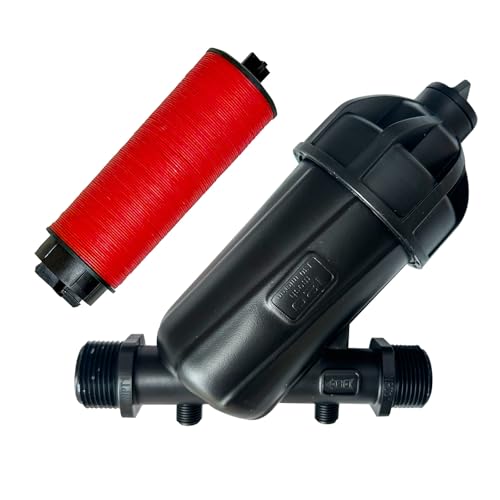
This 1-inch disc Y filter uses a 120-mesh screen to effectively filter debris, protecting irrigation hoses and emitters. The disc laminated filter design enables simple cleaning and reassembly, with a strong emphasis on UV and chemical resistance. The filter is described as easy to control and maintain, with a robust housing designed for outdoor use in gardens and lawns.
UPLYKKE Y Strainer Disc Filter, 120 Mesh, 2″

This larger 2″ Y-strainer disc filter provides substantial filtration capacity with a 120-mesh screen and a high maximum flow rate (~25 m³/h). The design emphasizes a deep bed filter and stamped efficiency, with a preset inspection port for quick checks. It is suited for medium to larger drip systems where water may carry more sediment and organic matter.
UPLYKKE Drip Irrigation Filter 120 Mesh 3/4″

This 3/4-inch disc filter emphasizes a 120-mesh filtration level with a sturdy plastic body designed for outdoor exposure. The unit is described as easy to clean and maintain, with effective debris control to prevent clogging of emitters and downstream components. Its compact profile makes it a good choice for small to mid-sized garden setups with limited space.
Kivan Base 3/4–Inch Drip Irrigation Y-Filter

This 3/4-inch Y-filter features a 120-mesh / 130-micron filtration level, designed for lawn, garden, and agricultural irrigation. It supports easy cleaning, with a quick disassembly process for disc maintenance. Flow capacity is suitable for moderate irrigation setups, and the design emphasizes straightforward assembly in tight spaces.
Buying Guide: Key Purchase Considerations
- Filtration level and mesh size: A 120-mesh (approximately 130 microns) disc filter captures typical particulates seen in municipal and well water, while larger mesh options handle finer debris but may require more frequent cleaning.
- Flow rate compatibility: Match the maximum flow rate of the filter to your irrigation system’s needs. Residential lawns and small gardens often operate in the 5–25 m³/h range; larger properties may require filters with higher capacity.
- Filter type and maintenance: Disc filters generally offer larger filtration areas and easier cleaning than standard screen filters. Look for models with easily removable discs and accessible inspection ports for quick upkeep.
- Material durability: Outdoor exposure demands UV-resistant plastics and corrosion-resistant components. Polypropylene housings are common and durable for drip systems.
- Size and installation space: Select a size that fits your irrigation layout, including pipe threading (NPT) and connection size (1/2″, 3/4″, 1″, 1-1/2″, or 2″).
- Installation environment: Consider where debris concentration is highest (near mains, filter banks, or inline near emitters). A higher-capacity filter may reduce maintenance frequency in dirtier water.
- Maintenance access: Prefer filters with clear access for cleaning and replacement of discs or stacked filter elements to minimize downtime.
- Cost of ownership: While disc filters may have higher upfront costs than screen filters, reduced maintenance and longer intervals between cleanings can lower long-term costs.