For greenhouse growers, maintaining optimal carbon dioxide levels can drive faster growth, bigger yields, and healthier plants. This article highlights five reliable CO2 solutions that fit different growing styles—from simple, maintenance-free options to programmable controllers that automate CO2 delivery. Explore each product’s strengths to identify the best fit for your space, budget, and level of control.
| Product | Brand | Main Benefit | Ideal For |
|---|---|---|---|
| CO2BAG M – Natural CO₂ Generator | CO2BAG | Natural, maintenance-free CO₂ enrichment | Small to medium greenhouses, beginners |
| Inkbird ICC-510 CO2 Controller | Inkbird | Dual outputs for CO₂ and ventilation with smart sensing | Medium to large grow spaces needing automation |
| The Green Pad Junior GP6010 | The Green Pad | Humidity-activated CO₂ release for clones and seedlings | Cloning rooms and propagation tents |
| Inkbird ICC-500T CO2 Controller | Inkbird | Programmable CO₂ control with sensor | Grow rooms seeking reliable ppm management |
| AC Infinity CO2 Regulator System | AC Infinity | Regulated CO₂ flow with gauge and valve | Grow tents and greenhouses needing precise delivery |
Note: This overview emphasizes devices suitable for indoor cultivation environments, with a focus on ease of use, automation potential, and reliability across different greenhouse scales.
CO2BAG M – Natural CO₂ Generator for Indoor Plants & Greenhouses

CO2BAG’s natural CO₂ generator provides steady, maintenance-free enrichment without tanks or electricity. It’s designed for indoor grow rooms and greenhouses, delivering a consistent CO₂ source for weeks. The product emphasizes safety for both plants and people, creating an ideal environment for photosynthesis without risk. This option is particularly suitable for smaller spaces or growers seeking a low-effort approach to carbon enrichment.
Inkbird ICC-510 CO2 Controller

The Inkbird ICC-510 pairs a dual-output design with an intelligent light sensor that adjusts CO₂ output in response to light levels. This promotes energy efficiency while maintaining stable CO₂ concentrations. A universal power supply makes it adaptable for global setups, and its design supports connecting a CO₂ regulator and an inline exhaust fan for integrated climate control in grow tents, rooms, or greenhouses.
The Green Pad Junior GP6010 CO2 Generator

The Green Pad GP6010 focuses on humidity-activated CO₂ release, making it a compelling choice for propagation areas where humidity is already elevated. It’s especially helpful for seedlings and clones, delivering a measured CO₂ boost aligned with the humidity-driven chemical reaction. The product is designed for propagation domes and small-scale clonal work, offering a simple, low-cost CO₂ solution.
Inkbird ICC-500T CO2 Controller
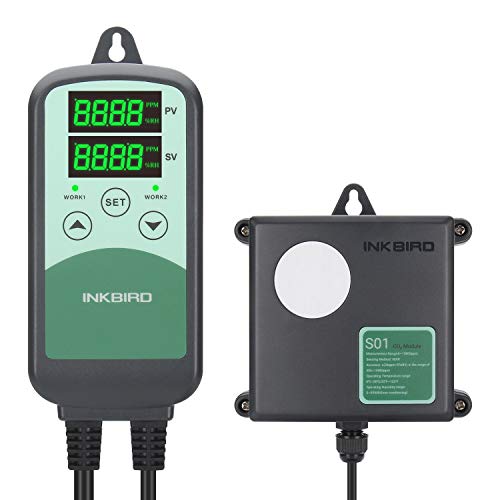
Inkbird’s ICC-500T provides a dedicated carbon dioxide controller with a sensor to monitor ppm levels and drive connected devices. It supports programmable ranges and alarms, enabling growers to set precise CO₂ targets and receive alerts if levels drift. The system is well-suited for reliable, automatic management in grow rooms that demand consistent CO₂ conditions across cycles.
AC Infinity CO2 Controller and Regulator System

AC Infinity’s system combines a smart outlet controller with regulated CO₂ output and integrated exhaust management. The product focuses on dynamic programming that alternates CO₂ release with ventilation in response to measured levels, supporting scaled environments from tents to larger greenhouses. It’s especially useful for growers who want automated, coordinated control of both CO₂ delivery and air exchange.
CO2 Controller Carbon Dioxide Monitor with Day/Night Relay

This DANOPLUS CO2 controller offers a wide LCD display, 0-5000 ppm measurement, and trend analysis through charts. It includes Plant and Human modes, allowing manual CO₂ adjustments or automatic control of a CO₂ generator or ventilation system. The audible alarm feature helps maintain safety and prevents overexposure in work areas or occupied spaces.
Clscea G200 Aquarium DIY CO2 Generator

The Clscea DIY kit targets aquarium-based CO₂ generation using a citric acid and baking soda reaction. While intended for planted tanks, it offers a low-cost entry point for hobbyists and small-scale setups seeking a simple, safe CO₂ source. It emphasizes ease of use and a contained reaction with safety features designed for home use.
Buying Guide: Key Considerations For Choosing A Greenhouse CO2 System
- Grow space size and layout: Match a CO₂ source or controller to the square footage and ventilation constraints of your greenhouse. Larger spaces may require automated systems with multiple outputs or integrated ventilation.
- Automation and control: Decide between passive sources (like CO2 bags or humidity-activated pads) and active systems (controllers with sensors, alarms, and automated regulators). Automation improves consistency across day-night cycles and seasonal changes.
- Safety and compliance: Evaluate safety features, especially for enclosed or occupied spaces. Look for alarms, auto-shutoff, and clear labeling to minimize risk to workers and pets.
- Maintenance and long-term cost: Consider ongoing costs (refills, replacements) versus upfront investment. Maintenance-free options reduce labor, while programmable controllers offer precision but require setup.
- Compatibility: Ensure the system works with your existing regulators, fans, and grow lights. Some controllers support dual outputs for simultaneous CO₂ delivery and ventilation.
- Monitoring capabilities: Prioritize devices with real-time ppm readings, trend charts, and remote access if you need to track CO₂ performance over time.
- Seedling and propagation needs: For cloning or propagation rooms, humidity-activated CO₂ sources may align well with humidity control, providing a gentle enrichment during early growth.
- Budget vs. scale: Budget-conscious growers might start with a simple passive option or a basic controller, then expand as the operation grows or as yields justify investment.
- Reliability and support: Choose brands with solid customer support and proven reliability, particularly for systems relied upon to sustain plant health consistently.
- Environmental impact: Consider emissions, safety of release methods, and whether the solution minimizes waste or tank dependencies for your operation.
In summary, the right CO₂ solution for a greenhouse depends on space, desired level of automation, and maintenance tolerance. Passive options provide simplicity, while controllers offer precise management and scalable control as growing operations expand.