Answer: A 600W-class LED grow light is best for mid-sized grow tents or rooms, delivering strong full-spectrum output with efficient energy use. For buyers, the top picks suit different setups: those needing high canopy coverage, adjustable intensity, and easy daisy-chaining for larger installations. The table below compares five strong options to help you decide quickly.
| Product | Best For | Key Strength |
|---|---|---|
| NAILGIRLS LED Grow Light | All growth stages, compact setups | Full spectrum with VEG/BLOOM modes, daisy chain |
| ECOHOM 800W LED Grow Light | 5×5 ft tents, scalable larger spaces | Expandable coverage, high efficiency, easy dimming and daisy chain |
| FECiDA 600W Equivalent | Budget-conscious grow spaces | Real 65W with 0–100% dimming, daisy chain |
| LUYIMIN 600W Full Spectrum | Seed starting to bloom in compact rigs | Full spectrum, efficient heat dissipation |
| VIVOSUN VSFD6500 | Balanced performance with modular design | High efficiency, 6-dimming levels, removable light bar |
NAILGIRLS LED Grow Light, 600W Full Spectrum with Daisy Chain

This full-spectrum fixture uses 60 upgraded 10-watt dual-chip LEDs (blue, red, white and warm white) designed to support both vegetative growth and flowering. A VEG/BLOOM switch lets you tailor output to plant stage, and a daisy-chain option enables stacking multiple fixtures for larger deployments. A temperature/hygrometer accessory helps monitor environment. Best for small to mid-size grow rooms or tents where precise spectrum control matters for seedlings through fruiting. Caution: higher light intensity may require closer spacing to avoid leaf burn for very delicate plants.
ECOHOM 800W LED Grow Light

Designed for larger grow areas, this 800W-class fixture offers expandable coverage from 5×2.5 ft to 5×5 ft, ensuring even canopy penetration. It uses a mix of 3000K, 5000K, 660nm, and 730nm diodes to mimic sunlight, with a reported high efficacy of around 2.80 µmol/J. Best for growers running in tents up to 5×5 ft who want edge-to-edge illumination and scalable light control. Limitation: requires compatible power setup for full multi-light daisy chains and may be overkill for very small spaces.
FECiDA 600W Equivalent LED Grow Light

This light delivers the intensity and spectrum of a traditional 600W system while consuming only 65W, making it a strong choice for energy-conscious setups. It supports 0–100% dimming and a daisy-chain network to grow with your space. Best for hobbyists who want reliable full-spectrum output at a lower running cost. Limitation: true PAR output will depend on spacing and ambient conditions; avoid stacking too many units in a tight tent without adjusting height.
LUYIMIN 600W Full Spectrum Grow Light

LUYIMIN offers a sleek 600W fixture with a complete full-spectrum layout intended to support vegetative growth through flowering. The design emphasizes heat dissipation, making it suitable for longer runtimes in spaces with limited airflow. Best for compact rooms where a sturdy, thermally efficient light is prioritized. Caution: actual wattage is labeled as 60W in product listing; verify power draw and ensure adequate clearance from plants to avoid heat buildup.
VIVOSUN VSFD6500 LED Grow Light
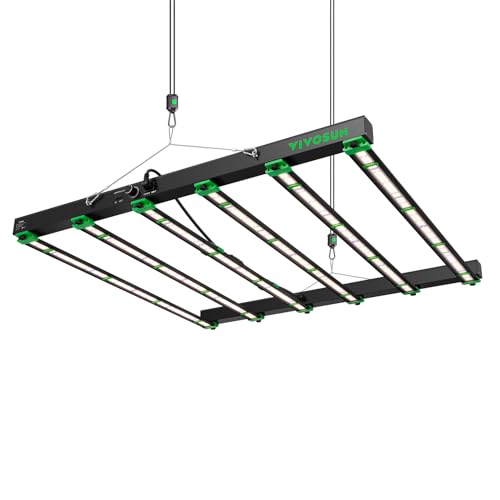
VIVOSUN offers a patented design with a detachable light bar and a built-in driver, providing high efficiency (around 2.8 μmol/J) and a broad PPFD map. The 6-level dimming and removable bar support flexible installation and maintenance. Best for users who want a modular setup and easy maintenance in a mid-sized grow tent. Limitation: premium features may require more complex mounting and setup compared to simpler fixtures.
Buying Guide: 600W LED Grow Lights For Indoor Growing
What to prioritize when choosing
- Spectrum and Ranges: Look for full-spectrum lights with blue, red, white, and infrared elements to cover seedling, vegetative, and flowering phases.
- Dimming and Control: Stepless dimming or multiple intensity levels help tailor output to plant stage and energy goals.
- Coverage Area: Match light spread to your grow space (tent size or room). Daisy-chain capability helps scale across larger areas.
- Thermal Management: Quiet, efficient cooling reduces heat stress and extends fixture life in enclosed spaces.
- Energy Efficiency: Compare PAR efficiency (μmol/J) and real power draw to estimate ongoing costs.
- Durability and Maintenance: Removable components and accessible drivers simplify upkeep in long-running grows.
How to position and use
- Distance From Plants: Start with recommended manufacturer spacing; adjust as plants grow and stretch.
- Lighting Schedule: Align photoperiods to plant species; many veg plants benefit from longer light periods while flowering varieties require specific timing.
- Ventilation: Ensure adequate airflow to maintain stable temperatures and humidity for consistent growth.
- Safety: Prioritize fixtures with proper heat sinks and cords rated for your space; avoid overloading outlets in daisy-chain configurations.
What to avoid
- Overestimating light ceiling height without adjusting height and intensity.
- Choosing the highest wattage without considering space constraints and heat management.
- Ignoring spectrum balance, which can lead to uneven growth or elongated stems.
FAQ
- Q: Do I need a 600W LED grow light if I have a small tent?
A: For small tents, consider lower-wattage units with strong PAR output and good heat management to avoid overheating. - Q: What does “daisy chain” mean and why is it useful?
A: Daisy chaining allows linking multiple lights to share power control, creating uniform coverage in larger grows. - Q: Is 650W output better than 600W?
A: Not necessarily; output depends on efficiency, spectrum, and canopy design. A well-tuned 600W system can outperform a less efficient higher-wattage option. - Q: How important is the cooling system?
A: Very important; effective cooling extends fixture life, maintains consistent light output, and reduces risk to plants in extended runs. - Q: Should I trust claimed PAR values?
A: Compare independent data and manufacturer specifications; actual performance depends on installation and spacing. - Q: Can these lights replace natural sunlight entirely?
A: They can supplement and extend growing periods indoors, but natural sunlight provides a broader spectrum for outdoor growth.