Answer: A tow-behind fertilizer broadcast spreader is ideal for homeowners with medium to large lawns, riding mowers, or ATVs who want even, efficient distribution of seed, fertilizer, ice melt, or other granular materials. The top picks listed here are best for different setups—riding-mower users, ATV owners, or those needing larger hopper capacity. This guide highlights five strong options, explains who they’re best for, and notes practical limits to help buyers decide quickly.
Summary table of selected products:
| Product | Capacity | Spread Width | Best For | Notes |
|---|---|---|---|---|
| Agri-Fab 45-0463 | 130 lb | 10–12 ft | Riding mower users needing high capacity | Made in USA; seat-control flow |
| Agri-Fab 45-0527 | 110 lb | Noted small to mid spreads | Seasonal use with lighter materials | Rustproof hopper; seat flow control |
| Agri-Fab 45-0530-131 | 85 lb | Up to 10 ft | Smaller yards or tight spaces | Compact, affordable option |
| Brinly BS36BH-A | 175 lb | Balanced, adjustable | Larger yards (1 acre+) | Autoflow pattern control; durable |
| Buyers Products ATVS100 | 100 lb | Medium | ATV and all-season use | Rain cover; enclosed 12V motor |
Agri-Fab 45-0463 130 lb Tow-Behind Spreader

Best for riding mower setups requiring a larger hopper. The 130 lb capacity and 10–12 ft spread width support broad coverage with fewer refills. Made in the USA, this model emphasizes durability in field conditions and is designed for seed, fertilizer, salt, and ice melt.
Who it’s best for: Homeowners with mid- to large-sized lawns who ride a mower and want a single, capable spreader that minimizes downtime between fills.
Limitations: The spread width is fixed within a standard range, which may be less flexible for very narrow borders or complex landscape shapes.
Agri-Fab 45-0527 110 lb Tow-Behind Spreader
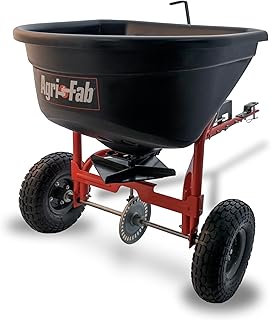
Best for riders needing a lighter, rustproof option with efficient flow control. The 110 lb hopper and poly construction increase longevity in weather-prone environments, suitable for seasonal seed and fertilizer tasks.
Who it’s best for: Riders who want a reliable, mid-capacity spreader with a focus on durability and ease of maintenance.
Limitations: The features emphasize durability over maximum capacity, so very large areas or heavy season-long use may require a second refill or a larger model.
Agri-Fab 45-0530-131 85 lb Tow Broadcast Spreader

Best for smaller yards or tight spaces. The compact 85 lb capacity and up to 10 ft spread width provide manageable coverage without excessive bulk.
Who it’s best for: Homeowners with compact lawns or limited storage space who still need dependable broadcast spreading.
Limitations: Smaller hopper means more frequent refills for larger projects; consider for lighter loads or smaller landscapes.
Brinly BS36BH-A Tow Behind Broadcast Spreader

Best for large yards needing high capacity and precise pattern control. The 175 lb hopper is designed for extended spreading, ideal for 1-acre-plus properties. The patented Autoflow and durable materials help ensure even distribution and long life.
Who it’s best for: Property owners with bigger landscapes who value optimized spread patterns and minimal refilling downtime.
Caution: Higher capacity comes with more weight; ensure hitch and towing capacity are adequate for your equipment to prevent strain.
Buyers Products ATVS100 ATV Broadcast Spreader

Best for all-season use on ATVs with a rain cover and enclosed 12V motor. The 100 lb hopper supports year-round tasks including seed, fertilizer, salt, and feed, with weather protection for sensitive materials.
Who it’s best for: ATV owners who operate in varying weather and require reliable, protected spreading capability.
Limitation: The 12V motor is enclosed for protection but may require periodic maintenance; consider compatibility with your ATV electrical system.
Buying Guide: Tow Behind Spreader Essentials
What should you consider when choosing a tow-behind spreader?
- Hopper capacity: Larger yards benefit from higher capacities (e.g., 130–175 lb). Smaller lawns can use lighter models to reduce weight and maneuvering effort.
- Power and control: Look for spreaders with easy flow control, seat-mounted levers, or autoflow features that prevent waste when stopping.
- Hopper material and durability: Poly hoppers resist corrosion; metal parts may offer robustness but require maintenance against rust.
- Spread pattern and width: A wider spread is faster but may require more precise steering near landscape edges. Pattern control helps with uniform coverage.
- Terrain compatibility: Riding mowers, ATVs, and UTVs each have different hitch and towing requirements. Confirm hitch compatibility and load limits.
- Weather resistance: If you spread ice melt or fertilizer in damp conditions, a weather-resistant cover or enclosed hopper can protect materials.
Practical Buying Considerations
- Weight distribution: Heavier hopper models alter towing dynamics. Ensure your vehicle can safely handle the added weight when full.
- Maintenance needs: Stainless or reinforced components reduce wear in corrosive materials; check the gearbox and auger components for clearance and lubrication needs.
- Storage and size: Consider where you’ll store the spreader and whether its dimensions fit in your garage or shed.
- Material compatibility: Some spreaders are optimized for seed, fertilizer, salt, or ice melt; choose a model aligned with your primary tasks to maximize effectiveness.
- Warranty and support: Look for models with solid customer support and accessible replacement parts for long-term use.
FAQs
- What is a tow-behind broadcast spreader best used for?
They are designed to evenly spread granular materials across lawns, gardens, driveways, and other outdoor surfaces, often attached to riding mowers or ATVs.
- How wide should the spread pattern be for a typical lawn?
Most models offer around 10–12 feet; larger yards may benefit from wider patterns or multiple passes for uniform coverage.
- Is a higher hopper capacity always better?
Not necessarily. It reduces refilling time but adds weight and may be harder to maneuver. Choose capacity based on lawn size and equipment.
- Can these spreaders spread salt or ice melt safely?
Some models are designed for ice melt; check hopper and drivetrain materials for chemical compatibility and corrosion resistance.
- Do all spreaders require electricity or batteries?
Many use a manual or gravity feed system, while some have enclosed 12V motors for consistent spreading. Verify compatibility with your equipment.
- What maintenance is recommended for a tow-behind spreader?
Regularly inspect the hopper seal, spinner plate, gears, and gearbox. Keep components clean and lubricate moving parts as advised by the manufacturer.