Answering the common question: which 288-cell plug tray is best for seed starting and cloning? This guide highlights five solid choices, detailing who they suit, and why each stands out. Best for commercial growers, home gardeners, or serious hobbyists, these trays support organized germination, easy transplanting, and durable reuse. Below, a quick buying table helps compare core specs at a glance.
| Product | Cells | Depth | Best For | Key Benefit |
|---|---|---|---|---|
| Kapok Candle Co 288 Cell Tray | 288 | 1.34″ deep | Home growers and small nurseries | Thick 1.0mm plastic for durability |
| RooTrimmer 200 Cell Tray | 200 | 1.5″ deep | Seed starting with broader spacing | Durable, reusable design |
| Gardzen 200 Cell Seed Starter Tray | 200 | 1.5″ deep | Compact setups | Drainage holes for healthier roots |
| Daisy J&M 288 Cell Plug Tray | 288 | Not specified | Bulk propagation | Drainage holes in each cell |
| IGC 288 Cells Seed Starter Flats | 288 | Not specified | Flat-pack seed propagation | Rigid design with denesting features |
Kapok Candle Co 288 Cell Tray Review

The Kapok Candle Co 288 Cell Tray features 288 cells sized to hold about 5cc of soil per cell, with each cell measuring about 1.34 inches deep and 0.71 inches opening. The tray uses 1.0mm thick plastic, designed to resist bending and cracking across multiple growing seasons. It is compatible with standard 1020 trays, enabling easy integration into most existing propagation systems. This makes it a strong option for hobbyists growing many small plants or for small commercial operations that need high-capacity starter flats. Best for users who value durability and a straightforward plug-tray workflow, without needing specialized equipment.
Why choose this tray: It provides a dense configuration that supports efficient space utilization and organized seed starting. The 1.0mm plastic offers a balance of rigidity and flexibility, reducing the risk of warping as soil moisture fluctuates. A potential limitation is that the dense cell count can require careful watering management to avoid over-saturation in a crowded tray. Overall, this is a practical, long-lasting choice for bulk seed starting.
RooTrimmer 200 Cell Plug Tray
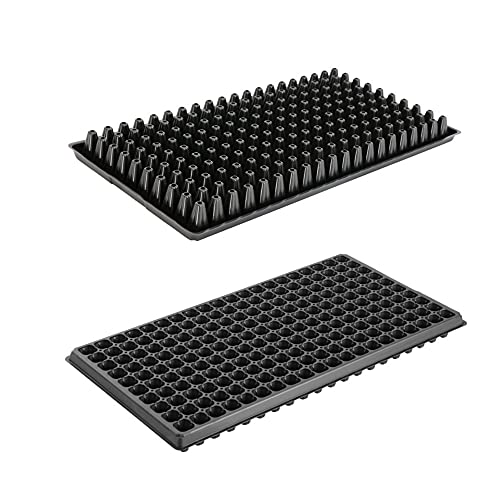
The RooTrimmer 200 Cell Plug Tray uses a thick, high-quality plastic designed for repeated use. Its 200 cells promote strong seed development and reduce transplant shock, with a shallow depth of about 1.5 inches that is well-suited for vegetables, herbs, flowers, and microgreens. It fits shallow 1020 trays (BY01 models), aiding transplant efficiency. The tray is lightweight and stackable, aiding storage in compact spaces. Best for growers who need robust durability and frequent re-use, or for commercial setups where repeated cycles are common. A caution: it has fewer cells than 288-cell trays, which reduces total plant count per tray.
Pick this if your priority is long-term durability and fewer, larger cells that improve root development. It’s a solid choice for batch propagation and repeat planting, though if you require maximal cell density, a 288-cell option may be preferable.
Gardzen 200 Cell Seed Starter Tray

The Gardzen 200 Cell Seed Starter Tray is built from sturdy plastic designed to resist bending and cracking. It includes drainage holes to prevent overwatering and encourage air pruning of roots, helping prevent tangling. Each cell depth is 1.5 inches, allowing a solid root ball development while keeping the tray compact for easy handling. Best for gardeners who want reliable root health and easier transplantation. A potential limitation is that it is a 200-cell option, which provides fewer plants per tray than 288-cell models, impacting overall seedling output per session.
Choose Gardzen when you want robust drainage that supports healthier seedlings and simpler transplanting, particularly in damp climates or with heavy soil mixes.
Daisy J&M 288 Cell Plug Tray

The Daisy J&M 288 Cell Plug Tray is sold in packs that suit bulk propagation needs. Each tray includes 288 cells with drainage holes, supporting consistent moisture management and easier drainage in dense plantings. Rigid construction helps maintain shape during handling and full trays can be moved without sagging. Best for large seedling operations or classrooms where many flats are used simultaneously. A caution: product availability may vary, and some users may prefer trays with deeper cells for certain crops. Nevertheless, this tray supports high-volume propagation with reliable drainage.
Use this tray when you need to scale up quickly for large projects or seasonal programs, while keeping transplant timing predictable and orderly.
IGC 288 Cells Seed Starter Flats

The IGC 288 Cells Seed Starter Flats are rigid and designed for use without a carrying tray, though they do not fit standard 1020 trays. They emphasize uniformity and improved de-nesting, with die-cut centered drainage holes to support moisture control. Best for growers who want a standalone flat that can be used independently or integrated into a custom propagation setup. A limitation is the non-fit with 1020 trays, which reduces compatibility in some standard systems. Consider this option if you require a compact, stand-alone 288-cell solution.
Buying Guide
What to consider when choosing a 288 cell plug tray
- Cell size and depth: Deeper cells support sturdier root systems; shallower cells save space but may require more careful watering.
- Material and durability: 1.0mm to thicker plastics withstand reuse and transport; look for rigid, warp-resistant designs.
- Tray compatibility: Ensure the tray fits your existing 1020 or other propagation systems to avoid extra handling.
- Drainage: Holes reduce overwatering risk and promote air pruning for healthier roots.
- Reusability and cost per season: Durable trays may have a higher upfront cost but lower long-term expenses.
- Best use case: Large-scale propagation vs. hobby seed starting; choose cell density accordingly.
Frequently asked questions
- What is a 288-cell plug tray best used for?
Best for bulk germination and propagation where many seedlings are started at once. - Do 288-cell trays fit standard 1020 trays?
Some do; always check product specs for compatibility with your setup. - Are deeper 288-cell trays better for root growth?
Deeper cells generally support larger taproots, which can reduce transplant shock, depending on crop. - Is drainage important in plug trays?
Yes. Drainage holes help prevent root rot and encourage healthy root pruning. - Which 288-cell tray is best for beginners?
Look for durable, easy-to-clean plastics with clear drainage design and straightforward compatibility. - Can I reuse plug trays for multiple seasons?
Most durable trays are designed for multiple seasons, but inspect for cracks or warping before reuse.