Answering your search, these iron chelate products help citrus stay vibrant by fighting iron chlorosis in challenging soils. They’re best for homeowners with alkaline or calcareous soil, citrus growers needing quick green-up, and those seeking versatile options for soil and foliar feeding. The list below highlights five well-suited options, with practical notes on who benefits most and why each was selected. A quick buying table follows to compare core details at a glance.
Product Comparison Table
| Product | Best For | Chelate Type | Size | Key Benefit |
|---|---|---|---|---|
| Grow More 0.2-0-0 EDDHA Iron Chelate | Citrus in high-pH soils | EDDHA | 1 lb | Soluble iron in alkaline conditions; fast green-up |
| Grow More 3-0-1 Organic Iron Chelate Concentrate (10%) 24 oz | Indoor & outdoor citrus and lawns | Organic chelate | 24 oz | Versatile foliar and soil use; large area treatment |
| Greenway Biotech Chelated Iron DTPA 11% (1 lb) | Alkaline soils; easy to use | DTPA | 1 lb | Effective up to pH 7.5; rapid greening |
| Boca Hydro Chelated Iron EDDHA 6% | Citrus and hydroponics in high pH | EDDHA | 1 lb | Wide pH range stability; no residue |
| Carl Pool Iron Chelate 1 Lb | General chlorosis reduction | Unknown (information provided) | 1 lb | Easy to mix; broad-use iron source |
Grow More 0.2-0-0 EDDHA Iron Chelate

Best for citrus grown in problematic soils with pH above 7.0, this water-soluble EDDHA iron chelate targets iron deficiency quickly. It is designed to dissolve readily in water, enabling fast absorption and rapid greening of leaves. Suitable for use on soils with caliche, adobe clay, and other alkaline conditions.
Who it’s best for: Homeowners or small-scale citrus growers facing persistent yellowing in alkaline soils. Why selected: EDDHA chelation offers stability at high pH, helping iron stay available where others fail.
Limitation: The product’s effectiveness depends on proper dosage and distribution in high-pH soils; oversaturation can lead to waste or minor leaf spotting in sensitive plants.
Grow More 3-0-1 Organic Iron Chelate Concentrate (10%) 24 oz

Best for lawns and citrus in mixed environments, this organic chelate concentrate provides a versatile option for both soil and foliar feeding. The 24-ounce bottle treats large areas and is suitable for ongoing iron support in homes or small landscapes.
Who it’s best for: Those seeking an organic-based iron supplement with broad application. Why selected: Ultra-concentrated formula supports multiple applications and provides solid coverage for larger spaces.
Caution: Follow dilution instructions to avoid over-application, which can cause leaf burn in sensitive varieties or under-watering conditions.
Greenway Biotech Chelated Iron DTPA 11% (1 lb)
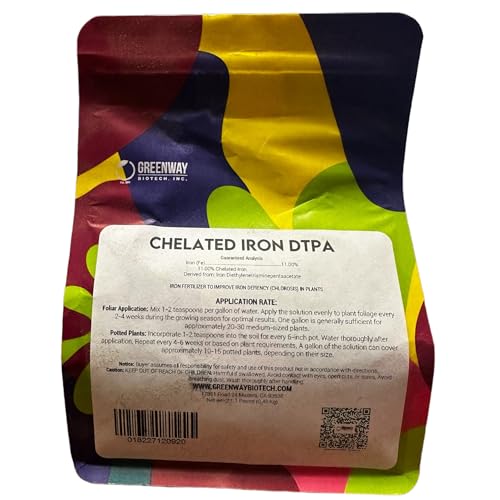
Best for alkaline soils (pH 4.0-7.5) where EDTA-based chelates fail, this DTPA formulation provides strong iron delivery for citrus, lawns, and hydroponics. It corrects iron chlorosis with visible greening typically within 7-10 days when applied to new growth.
Who it’s best for: Growers needing reliable iron delivery in moderately alkaline soils. Why selected: DTPA offers stability and absorption advantages in soils where other chelates lose effectiveness.
Limitation: The product’s primary advantage is in alkaline settings; performance may vary if soils skew outside the recommended pH range.
Boca Hydro Chelated Iron EDDHA 6%

Best for citrus in calcareous soils and hydroponics, this EDDHA-based iron chelate remains soluble across a wide pH range, including alkaline conditions up to around 10. It’s designed to prevent and correct yellowing in a variety of setups, from soil beds to aquaponic systems.
Who it’s best for: Citrus growers needing robust iron delivery in highly alkaline soils or hydroponic systems. Why selected: EDDHA’s wide pH stability supports steady iron availability for ongoing growth.
Caution: For hydroponics, ensure compatibility with your system’s nutrient mix to avoid potential imbalances or salt buildup.
Greenway Biotech Chelated Iron DTPA 11% (5 lb)

Best for larger citrus plantings or extended use in alkaline environments, this 5-pound option provides a cost-effective way to manage chlorosis across bigger areas. It delivers sustained iron availability with soil applications that support longer intervals between applications.
Who it’s best for: Garden centers, larger home citrus plots, or anyone needing bulk iron delivery for alkaline soil. Why selected: High-volume packaging reduces frequent repurchase needs while maintaining effective chlorosis control.
Limitation: Very large quantities require appropriate storage and dosing planning to prevent waste or accidental overuse.
Buying Guide: How To Choose The Right Iron Chelate For Citrus
What soil pH is your citrus growing in?
Iron chelates differ in stability across pH ranges. EDDHA remains effective in highly alkaline soils (pH9+), DTPA works well up to around pH7.5, and EDTA-based chelates lose solubility earlier. Match the chelate to your soil’s pH to maximize absorption.
What’s the application plan: soil, foliage, or both?
Some products are formulated for soil application, others for foliar spray, and many are versatile for both. Consider your plant growth stage and watering routine. For rapid greening, a product with fast solubility and foliage compatibility can be advantageous.
What size fits your landscape or operation?
Smaller homes or potted citrus often do well with 1 lb or 8 oz to 24 oz bottles, while larger plots benefit from 5 lb or bulk options. Bulk sizes reduce cost per application but require careful handling and storage.
Are there organic options available?
Organic-leaning chelates may be preferred for ornamental landscapes or organic-certified setups. Organic chelates tend to be more concentrated and require clear dosage guidelines to avoid over-application.
Any contraindications or cautions?
Over-application can cause foliar burn or soil imbalances. Always follow label directions for dilution rates, application frequency, and compatibility with existing fertilizers or irrigation systems.
What about long-term soil health?
Chelated iron helps correct chlorosis, but pairing it with balanced nutrition—nitrogen, potassium, and micronutrients—supports sustained citrus vigor. Consider rotating formulations or combining with soil amendments designed for alkaline soils.
FAQ
- What causes iron chlorosis in citrus?
- Can I use iron chelates on foliage and soil?
- Which chelate is best for alkaline soil?
- How soon will I see results?
- Should I mix chelates with other fertilizers?
- Is bulk iron chelate better for large citrus groves?
Iron chlorosis occurs when iron becomes unavailable to plants, often in high-pH or calcareous soils. Leaves yellow with green veins as the plant struggles to transport iron to new growth.
Yes. Many products are formulated for both soil and foliar application, which allows quick correction on new growth and longer-lasting soil nourishment.
EDDHA chelates are the most stable in highly alkaline soils, maintaining iron availability where other chelates fail.
Greening can be visible within 7–10 days for some products, especially if applied to actively growing tissue, though results vary with plant condition and soil readiness.
Always consult product labels for compatibility. In many cases, chelates mix well with water-soluble fertilizers, but certain micronutrient combinations may require staggered applications.
Bulk options reduce cost per application and are convenient for large areas, but they require careful storage and dosing planning to avoid waste or overuse.