Answering the need for faster, gentler goat milking, this guide highlights five top goat milking machines. Each option targets different farming setups—from small homesteads to mobile barns—so you can pick the best fit for your herd and milking routine. The featured models emphasize gentle pulsation, safety features, and portability, helping reduce labor and protect goats’ teats. The following product table compares key attributes to aid quick decisions for buyers.
| Product | Best For | Capacity | Power |
|---|---|---|---|
| PAMUNULA 5L Goat Milking Machine | Beginners and small farms | 5 L | Electrical, adjustable pulsation |
| VEVOR 0.8 Gal / 3 L (Cordless) | Outdoor milking, remote locations | 3 L | Rechargeable battery |
| Zlshmoee 7L 2-in-1 | Medium to larger herds, dual goals | 7 L | Rechargeable battery, adjustable pulsation |
| Hantop 6L Pro Model | Professional or larger operations | 6 L | Rechargeable battery, adjustable pulsation |
| VEVOR 6 L Stainless Steel | Stable, docile routine milking | 6 L | Standard electrical, adjustable suction |
PAMUNULA 5L Goat Milking Machine

The PAMUNULA 5L milker uses an adjustable pulsation system to mimic natural suckling, which helps reduce teat trauma and supports comfortable milking. With a 5-liter stainless steel bucket, it is designed for smaller herds or home operations. The unit is described as efficient and portable, making it suitable for beginners and professionals who want a simple setup without sacrificing effectiveness. The milk flow is influenced by its 40–46 cycles per minute pulsation, a factor that supports faster milking relative to traditional manual methods.
Best for: hobby farms, smallholders, and new milkers who want a straightforward, safe, and reasonably fast milking experience. Choose this if you want a compact, stainless setup with adjustable pulsation. Limitations include a smaller capacity relative to larger farm needs, which may require more frequent milk collection for busy herds.
VEVOR Goat Milking Machine (Cordless)

This VEVOR model features a 5200 mAh rechargeable battery, enabling cordless milking in barns or pastures. It uses a biomimetic pulsation system to imitate calf suckling, aiming to deliver a gentle milking experience that can reduce teat stress. A 3 L capacity and thickened stainless steel teat cups help ensure a secure fit and reduced slippage. Its 35–45 kPa vacuum range allows adaptable milking stages from stimulation to the final milk-out, with higher power for efficiency.
Best for: users who value mobility and working away from outlets, such as pasture-based operations. Better for: those who need a cordless option with reliable teat cup fit. Caution: battery life and charging times can influence workflow during long milking sessions, especially in cold weather.
Zlshmoee 7L 2-in-1 Electric Milking Machine

The 7-liter Zlshmoee 2-in-1 model emphasizes high efficiency with a pulsation cycle around 32–42 times per minute. It promises a milking speed about three times faster than traditional devices and includes pre-connected silicone hoses for quick setup. The milker simulates calf suckling to protect teats and offers an adjustable suction knob for comfort. An automatic shutdown feature prevents milk from entering the pump when the bucket is full, enabling multitasking during milking.
Best for: farms needing quicker milking with a robust, switch-ready design. Choose this if you want plug-and-play readiness and a built-in safety shutoff. Limitation: still relies on a battery or power source capable of supporting extended milking sessions; ensure battery capacity matches herd size.
Zlshmoee 14L 2-in-1 Electric Milking Machine
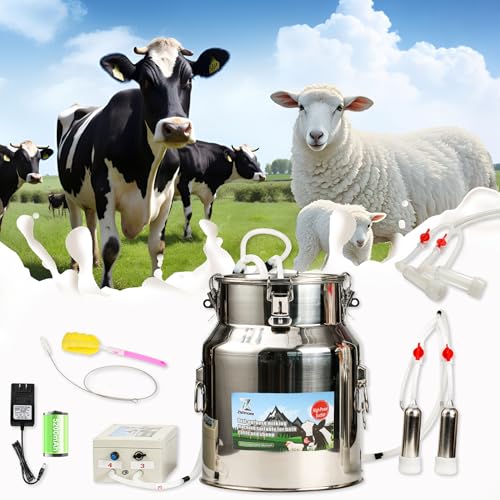
The 14-liter version shares the same 32–42 cycles per minute pulsation range and aims to deliver three times the efficiency of traditional milking equipment. It uses a rechargeable battery and comes with four teat cups for multi-animal milking. The automatic shutdown on full capacity helps prevent overflow and allows handlers to perform other tasks during milking. The design emphasizes ease of use with pre-connected hoses for faster setup and a focus on reducing labor intensity on larger operations.
Best for: medium to larger herds that require higher capacity without sacrificing milking speed. Better for: users who want a larger-capacity 2-in-1 option with automatic safety features. Caution: higher capacity means more bulk; ensure storage space and battery support are adequate.
Hantop 6L Pro Goat Milking Machine

The Hantop Pro model uses a 6-liter stainless steel bucket with a reinforced pulsation system. It features a built-in 5200 mAh battery for cordless operation and a quick-release design for component replacement, extending service life. The pulsation rate is in the 43–46 times per minute range, delivering substantial labor savings. A check valve on the bucket lid prevents milk from flowing back into the pump, increasing reliability during milking sessions.
Best for: serious hobbyists and small farms seeking a rugged, portable pro-grade milker. Choose this if you need durability and a system designed to minimize teat stress. Limitation: heavier than smaller units, which may affect mobility in very small or uneven spaces.
Buying Guide: Key Considerations For Goat Milking Machines
- Capacity vs. herd size: Match bucket volume to daily milk output and routine. Larger herds benefit from higher-capacity models, while small operations can start with 3–5 L.
- Pulsation rate and rhythm: A rate around 32–46 cycles per minute is common. Look for systems that mimic natural suckling to reduce teat trauma.
- Portability and power source: Cordless battery models offer flexibility in barns and pastures; corded options may provide steadier long-duration milking.
- Safety features: Check valves to prevent milk backflow, automatic shutdown on full capacity, and non-slip teat cups to protect animals.
- Materials and hygiene: Food-grade stainless steel buckets and silicone hoses are easier to clean and less prone to contamination.
- Ease of use: Pre-connected hoses and straightforward controls help new users achieve consistent milking without extensive training.
- Maintenance: Consider modular components and replacement part availability for quicker repairs.
- Durability vs. portability: Heavier units may endure frequent use in larger barns but be harder to move by a single person.
Frequently Asked Questions
- What is the preferred capacity for a small goat dairy? A 3–5 L bucket fits most small farms and daily milking needs without excessive weight.
- Are cordless milking machines reliable for ongoing farm work? Cordless models work well in barns and pastures, but ensure battery life meets your daily milking schedule.
- Do these machines protect goats’ teats during milking? Yes, many models use pulsation that mimics natural suckling to reduce teat injury when adjusted properly.
- Is automatic shutdown important? It helps prevent milk overflow and frees hands for other tasks, improving workflow efficiency.
- Can one machine handle multiple goats at once? Some models come with multiple teat cups, but check the manufacturer’s guidance on simultaneous milking to avoid overloading.
- What maintenance steps are essential? Regular cleaning of stainless buckets, teat cups, hoses, and check valves helps maintain milk quality and machine longevity.