Answering your search for reliable, high-performing solar lights for the garden, these five options stand out for durability, brightness, and easy installation. Each product is suited to different yard layouts and lighting goals—from bright path illumination to decorative ambient glow. Use this guide to compare features, installation needs, and ideal use cases so you can choose the best solar lighting solution for your outdoor space.
| Product | Best For | Key Feature |
|---|---|---|
| URAGO Super Bright Solar Lights Outdoor (10 Pack) | Decorative pathways and front yards | Mandala light pattern with high-brightness LEDs |
| DERAYSION 6 Pack Solar Lights | Premium curb appeal for driveways | Stainless steel + ripple glass for 360° light |
| KOOPER Taller Solar Pathway Lights (8 Pack) | Tall, statement pathway lighting | 25.6-inch height with bright, durable LEDs |
| BITPOTT Bright Solar Pathway Lights (8 Pack) | Romantic garden lighting and long runtime | Large solar panel, 12–14 hour runtime |
| Eyrosa Solar Outdoor Lights (10 Pack) | Elegant yard accents and walkways | One-piece lamp head with diamond look |
URAGO Super Bright Solar Lights Outdoor – 10 Pack
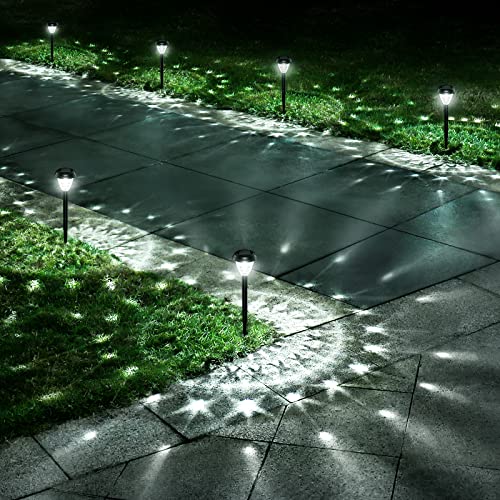
Best for decorative pathways and ambient yard lighting, the URAGO set emphasizes bright LEDs and an eye-catching Mandala pattern. The lampshade’s high transparency and LED strength create clear, decorative shadows that enhance lawn and patio zones. Spikes are inside the tube, keeping the look clean during installation. This option is ideal for homeowners seeking noticeable illumination with a striking ornamental effect for gatherings or holiday décor.
Best use: illuminate walkways or garden borders where you want a strong, decorative glow. Caution: ensure the area is free of heavy shade to maximize charging efficiency.
DERAYSION 6 Pack Solar Lights – Warm White

Best for premium curb appeal with reliable performance, this set uses heavy-duty stainless steel and ripple glass for a clear, 360° light pattern. A 3000K warm white LED offers inviting illumination suitable for driveways, walkways, and landscape borders. The solar panel provides efficient charging and a runtime that typically covers evenings after a full charge. Choose this if you want durable hardware and a high-end aesthetic.
Best use: driveway and path lighting where durability and a refined look are priorities. Caution: heavier metal construction may require more stable ground during installation.
KOOPER Taller Solar Pathway Lights – 8 Pack

Best for bold, vertical lighting, KOOPER’s 25.6-inch tall lamps create a striking line of light along walkways and driveways. The rectangular lampshade with a bottom diamond design adds modern elegance, while a 45% efficient monocrystalline panel powers longer runs. Expect 10–15 hours of light after dusk, which helps maintain safety and ambiance through late evenings. This is a good pick when you want a taller presence that guides steps clearly.
Best use: long pathways, entry drives, or garden borders where height and visibility matter. Caution: taller lamps may require sturdier install anchors in soft soil or uneven ground.
BITPOTT Bright Solar Pathway Lights – 8 Pack

Best for reliable runtime and practical charging, BITPOTT uses a high-performance monocrystalline solar panel with a 3.7V/1.85Wh battery. Fully charged in 4–8 hours, these lights deliver 12–14 hours of illumination, depending on sun conditions. The warm white tungsten-style bulbs and thicker, translucent lampshades project a cozy, retro glow that complements gardens with a traditional aesthetic.
Best use: garden borders and patios where a warm, lasting glow is desired. Caution: charging time varies with weather, so plan for shorter days if it’s cloudy.
Eyrosa Solar Outdoor Lights – 10 Pack

Best for modern, compact landscape lighting, Eyrosa offers a one-piece lamp head with a diamond-like appearance and high-transparency acrylic. The solar panel and battery enable faster charging and longer illumination windows, typically 8–10 hours after a full charge. This set is well-suited for decorative pathways, garden features, and small patios where a contemporary look is preferred.
Best use: intimate garden paths and focal points where a neat, contemporary aesthetic matters. Caution: ensure the one-piece head is positioned for optimal sun exposure to maximize charging.
Buying Guide
- Brightness and pattern: Decorative patterns (like mandala or glass effects) add ambiance but may be less uniform than plain LEDs. If illumination is the priority, verify lumen output and beam angle.
- Durability: Look for metal housings and tempered or ripple glass; these materials resist weather and extend life in harsh conditions.
- Solar panel efficiency: Higher conversion rates improve charging in low light. Monocrystalline panels generally perform better in dim conditions than amorphous panels.
- Runtime vs. charge time: Expect longer runtimes with larger batteries. If you have short winter days, prioritize models with thicker batteries and efficient panels.
- Height and spread: Taller lights create a visible line, while shorter lights emphasize ground-level glow. Choose based on pathway width and desired foot-path visibility.
- Ease of installation: Ground spikes that fit in soft soil simplify setup. Check if spikes are inside the tube or attached externally, as this affects maintenance and stability.
- Weather resistance: IP rating and material quality matter for rain, snow, and wind. Look for IP65 or higher for outdoor use.
Frequently Asked Questions
- Do solar path lights require wiring? No. They are designed to be installed without wiring; simply place and stake them into the ground and allow the sun to charge the battery.
- How long do solar lights last after a full charge? Most options provide 8–14 hours of light, depending on weather, sun exposure, and battery size.
- Can solar lights withstand winter conditions? Durable models with stainless steel or robust plastics and good seals typically tolerate cold and moisture better, but performance lowers with very short daylight.
- Should I choose warm white or cool white? Warm white (around 2700–3000K) is common for cozy, ambient lighting; cool white (around 4000K) is crisper and more utility-focused for visibility.
- Are higher-priced solar lights worth it? Higher cost often reflects better materials, larger solar panels, longer runtimes, and more durable construction, which can translate to longer life and better performance under variable conditions.