Answering the common question “which floating pond de-icer should I buy?” this guide highlights five reliable options that balance safety, efficiency, and cost for American ponds. These devices create a small hole in the ice to release harmful gases and maintain oxygen exchange for fish and beneficial microorganisms during freezing weather. Each product below is suited to different pond sizes, climates, and wiring setups. Read on to compare features, identify who will benefit most, and find practical buying tips.
Summary table of selected products
| Product | Best For | Key Benefit |
|---|---|---|
| TURBRO PD400A | Medium to large outdoor ponds | Strong 400W heater with long cord and advanced safety features |
| Farm Innovators 1250W | Very cold climates, larger ponds | High wattage for faster ice-hole formation and reliable operation |
| TetraPond De-Icer | Budget-conscious small to medium ponds | Thermostatic control and wide operating temperature range |
| K&H Deluxe Thermo-Pond 1500W / 250W / 100W variants | Versatile sizing, energy-conscious choices | Thermostatic control with floating or submersible use |
| Laguna PowerHeat 315W | Budget-friendly, small to medium ponds | Thermostat-controlled with visible LED indicator |
TetraPond De-Icer, Thermostatically Controlled

The TetraPond De-Icer provides a simple, thermostatically controlled solution designed to keep a specific area of your pond free from ice. It enables toxic gases from decaying matter to escape under the ice in winter, supporting fish and beneficial bacteria. This model is noted for operating effectively in temperatures as low as -20 degrees, making it suitable for regions with harsh winters. Best for small to medium ponds where a single, dedicated de-icer is sufficient. A potential limitation is that its wattage is moderate, which may be less ideal in very large ponds or extremely cold climates where higher heat output is beneficial.
Farm Innovators 1250 Watts Cast Aluminum Floating De Icer

This Farm Innovators model uses a robust cast aluminum floating heater with a built-in thermostat and a 10-foot cord. It’s designed to create a protected opening in the ice, which serves as a safe haven for aquatic life during winter. The device is thermostatically controlled to turn on only when needed, offering energy efficiency and a straightforward installation. It’s best for larger ponds or colder climates where steady ice management is crucial. A caution: ensure the unit is placed away from pond edges and floatation devices to prevent entanglement with liners and plants.
TURBRO Pond De-icer, 400 Watts, Stainless Steel

The TURBRO de-icer emphasizes safety and durability with a full stainless steel casing and IP68 water resistance. It features a UL-approved cord and GFCI leakage protection, and uses SCR technology for precise temperature control. This makes it a strong choice for for outdoor ponds where rapid response and extended cord reach are helpful. It’s best for hobby ponds with longer run distances to power sources. A limitation: high-tech circuitry may be less forgiving for novice users; ensure proper drainage and outdoor wiring practices.
Danner Pondmaster De-Icer, Red

The Pondmaster floating de-icer from Danner focuses on reliability in very cold locations. It maintains a controlled hole in the ice to vent gases and keep fish alive during long winters. Its epoxy-sealed electronics add watertight protection, a feature that helps in damp, sub-freezing conditions. It’s best for moderate-to-large ponds that require a steady de-icer with strong protection against moisture intrusion. A note: ensure compatibility with your pond liner or pre-formed pond to avoid potential interference with floating devices.
K&H Pet Products Deluxe Thermo-Pond Deicer 1500W
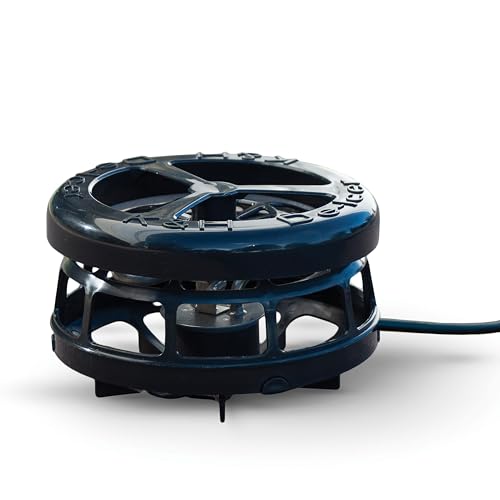
The K&H Deluxe Thermo-Pond line offers energy-saving options with three wattage choices. It is thermostatically controlled to cycle on and off as needed, keeping the pond ice-free while conserving energy. It can be used as a floating unit or converted to submersible operation. Best for owners who want flexible placement and scalable heating for ponds of varying sizes. A limitation: wattage and heat output should be matched carefully to pond size to avoid unnecessary energy use.
K&H Pet Products Thermo-Pond 3.0 Deicer, 250W

This K&H model emphasizes low energy consumption with a 250W option suitable for smaller ponds. It is thermostatically controlled, floating by default and convertible to submersible. It’s a good pick for smaller ponds or for users who want a compact, energy-efficient solution. Limitation: smaller wattage may be insufficient in consistently freezing climates or larger waters.
K&H Pet Products 12-Inch 100W Deicer

The 12-inch K&H Deicer uses only 100W to keep a hole in the ice, ideal for smaller ponds or simple setups with liner protection. It floats on the water and remains safe for liners or plastic ponds. Best for budget-minded users or ponds where only a minimal opening is required. A limitation: the single-hole approach may not be sufficient in extremely cold environments or larger ponds needing more Open Water exposure.
Buying Guide: Practical Considerations For Selecting A Floating Pond De-Icer
- Pond size and depth: Larger ponds often need higher wattage or multiple units for consistent ice-breaking action. Match wattage to water volume and expected cold spells.
- Ambient winter temperatures: In regions with harsh winters, prioritize models rated for very low temperatures and those with thermostatic control to minimize energy use.
- Electrical safety and cords: Look for UL listing, GFCI protection, and long, outdoor-rated power cords to reduce risk and improve placement options.
- Installation flexibility: Floating versus submersible options, and models with adjustable cords or easy conversion between modes, offer broader placement options.
- Durability and materials: Stainless steel or rugged cast aluminum housings resist corrosion and weather. Epoxied electronics increase water protection.
- Maintenance and accessibility: Consider models with simple de-icing operation and clear indicators (like LED status) to minimize service time during winter.
- Budget and energy efficiency: Thermostatically controlled units save energy by turning off when ice-free conditions exist. Evaluate total running costs against pond requirements.
Frequently Asked Questions
- How does a pond de-icer improve fish health in winter?
It creates an opening in the ice to allow oxygen exchange and gas release, reducing harmful gas buildup under the ice. - Do I need more than one de-icer for a large pond?
For very large ponds or very cold climates, more than one unit or a higher-wattage model may be necessary to maintain a proper opening. - Can I use a de-icer with a pond liner?
Yes, many models are designed to be safe with liners, but always verify compatibility and placement to avoid punctures or entanglement. - Is thermostatic control essential?
Thermostatic control helps conserve energy by cycling the heater on only when necessary, especially in milder days or late winter. - What are the main safety features to look for?
Look for UL listing, GFCI protection, IP ratings, and automatic shutoff features to prevent overheating or electrical faults. - Can I substitute a de-icer for a heater in an outdoor pond?
A de-icer maintains a hole in the ice and supports gas exchange; it is distinct from a pond heater that warms the water and is typically used in conjunction with or as part of winter care.