Answering the common buyer question: which palm tree fertilizers deliver reliable green fronds, sturdy roots, and overall healthy growth? The top picks below are geared toward different palm care needs—indoor palms, outdoor landscape palms, or containers. This guide helps you choose by formulation, application method, and growth goals. Each product section highlights who benefits most and includes a practical caution if relevant. A quick summary table follows to compare the essentials at a glance.
| Product | Best For | What It Delivers |
|---|---|---|
| Miracle-Gro Shake ‘N Feed Palm Plant Food | Container and in-ground palms | Up to 3 months of feeding; magnesium, iron, manganese; prevents yellowing |
| Palm Tree Fertilizer – Liquid 8 oz (TPS NUTRIENTS) | Indoor and outdoor palms requiring easy mixing | Balanced nutrients for strong roots and green fronds |
| Farmer’s Secret Palm Tree Booster (8 oz) | All palm types at all life stages | Concentrated macronutrients plus trace minerals; weekly dilute feed |
| Jobe’s Plant Food Fertilizer Spikes (30 Count) | Low-maintenance palms and ferns | Slow-release NPK with minimal runoff; easy 60-day cycle |
| Southern Ag Palm Nutritional Spray (1 Pint) | Palms showing nutrient deficiencies | Spray-on foliar nutrition to correct yellowing and curling |
Miracle-Gro Shake ‘N Feed Palm Plant Food
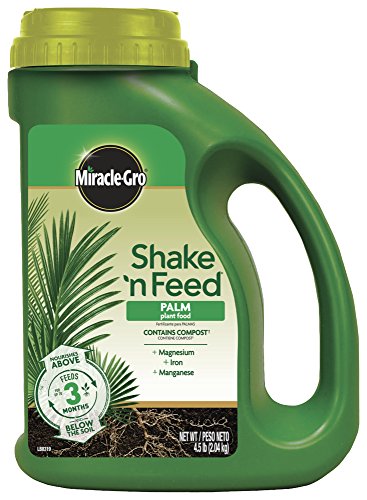
Best for palm containers and mixed native or tropical plantings. The formula feeds for up to three months, delivering magnesium, iron, and manganese to support lush green fronds and reduce yellowing. Use in both indoor and outdoor settings where palms are in pots or garden beds. Caution: avoid over-application on very drought-stressed soils to prevent leaf burn.
Palm Tree Fertilizer – Liquid 8 oz (TPS NUTRIENTS)
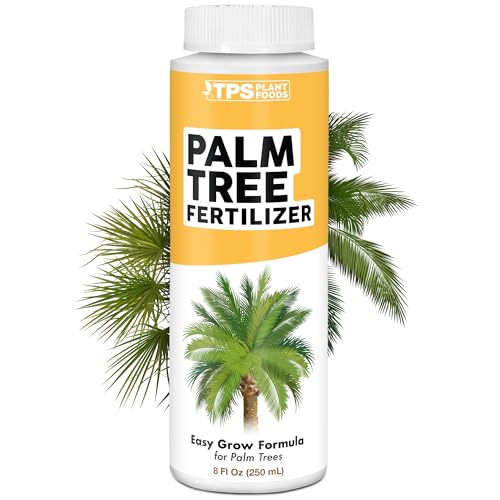
Best for straightforward mixing and quick uptake. Mix two tablespoons per gallon of water, then water as usual. This liquid formula supports stronger roots and greener fronds for both indoor and outdoor palms. It pairs well with occasional fertilizer spikes for broader nutrient coverage. Caution: test on sensitive varieties first to avoid leaf spotting if concentration is misapplied.
Farmer’s Secret Palm Tree Booster Fertilizer (8 oz)

Best for all palm types and life stages, with a highly concentrated formula. The product provides a potent blend of macronutrients plus trace minerals like iron and zinc, designed for use with weekly dilute applications along the drip line. Caution: use the recommended weekly limit to avoid nutrient buildup in soil over time.
Jobe’s Plant Food Fertilizer Spikes (30 Count)

Best for hands-off feeding. The 16-2-6 NPK spikes are inserted near the drip line and release nutrients gradually to palms and ferns over about two months. Use every 60 days for ongoing support. Caution: avoid placing spikes directly against bark to prevent localized burn, especially in hot weather.
Southern Ag Palm Nutritional Spray (1 Pint)

Best for correcting nutrient deficiencies visible as yellowing, browning, or curling. This foliar spray delivers four essential nutrients directly to the leaves, offering a quick corrective option for palms showing stress symptoms. Caution: foliar sprays should be applied in mild weather and avoided during peak sun to prevent leaf burn.
Buying Guide
What should I look for in a palm fertilizer?
Key factors include nutrient balance (N-P-K ratio appropriate for palms), presence of micronutrients (magnesium, iron, manganese, zinc), and whether the product is tailored for indoor, outdoor, or container palms. Consider whether you prefer granular, liquid, spikes, or foliar formats based on maintenance style and palm type.
Granular vs. liquid vs. spikes
- Granular/tabular blends are long-lasting and good for steady feeding in soil or pots.
- Liquid formulas offer faster uptake and are useful for correcting deficiencies quickly.
- Spikes provide a simple, low-effort option with slow release and minimal runoff.
Indoor vs outdoor palms
Indoor palms often benefit from balanced organic or micronutrient-rich formulas that support lush foliage without overloading root zones. Outdoor palms may require higher nutrient levels and formulations designed to withstand irrigation and rainfall leaching.
Frequency and application tips
- Follow label directions for dilution and frequency to avoid fertilizer burn.
- Apply around the drip line where roots actively absorb nutrients.
- Gradually adjust feeding based on palm size and growth stage.
Common cautions
- Avoid over-fertilizing; excessive nutrients can stress palms and cause leaf burn.
- Test soil or substrate for existing nutrient levels if unsure about deficiencies.
- Water well after feeding to help distribute nutrients to the root zone.
FAQ
- Q: How often should I fertilize a mature palm? A: Most palms benefit from feeding every 6–8 weeks during the growing season, with reduced frequency in winter for many species.
- Q: Can I mix different fertilizers together? A: It’s generally best to apply products as directed by their labels to avoid nutrient imbalances or salt buildup.
- Q: Do these products work for both indoor and outdoor palms? A: Yes, several products are suitable for both scenarios, though some are optimized for one setting or the other.
- Q: What signs indicate nutrient deficiency in palms? A: Yellowing fronds, browning tips, curling or stunted growth can indicate deficiencies in micronutrients or macronutrients.
- Q: Should I use fertilizer spikes on small or young palms? A: Spikes can be convenient, but ensure proper spacing and timing to avoid over-fertilization in young plants.
- Q: Are there organic palm fertilizers available? A: Yes, some products emphasize organic nutrients or organic bases; check product labels for specifics.