If you’re seeking a balanced 20-20-20 granular fertilizer, you’ll want options that deliver steady, even nutrition for a variety of plants. This guide highlights five reliable 20-20-20 products and explains who they’re best for, why they were selected, and potential limitations. Ideal for homeowners, hobby gardeners, and small landscapers, these picks support leafy growth, robust roots, and vibrant blooms without overloading any single nutrient.
Product Overview Table
| Product | Form | Best For | Why Picked |
|---|---|---|---|
| Southern Ag PowerPak 20-20-20 (5 Lb) | Granular, water-soluble mix | General garden use, larger projects | High-NPK with micronutrients; chelated minor elements |
| Jack’s Professional 20-20-20 (25 Lbs) | Water-soluble powder | Heavy feeder setups, continuous feeding | Cost-effective, scalable for larger areas; includes micronutrients |
| Gardenwise 20-20-20 Water-Soluble Fertilizer | Powder, dissolves in water | Indoor/outdoor plants, orchids, lawns | Balanced formula for a wide range of plants |
| Jack’s Classic All Purpose 20-20-20 | Water-soluble powder | General purpose feeding, multiple application types | Versatile feeding options; good for foliar or root feeding |
| GS Plant Foods All Purpose 20-20-20 | Water-soluble, with micronutrients and kelp | Indoor/outdoor gardens, turf and perennials | Includes kelp for additional natural nutrients |
Southern Ag PowerPak 20-20-20 (5 Lb)

Formula: 20% Nitrogen, 20% Phosphorus (P2O5), chelated minor elements. Best for: general garden use, larger areas, and crops needing balanced NPK with micronutrients. Why selected: provides a balanced NPK with micronutrients to support both vegetative growth and root development. Caution: avoid over-application to prevent nutrient buildup in containers or compacted soils.
Southern Ag PowerPak 20-20-20 (1 Lb)
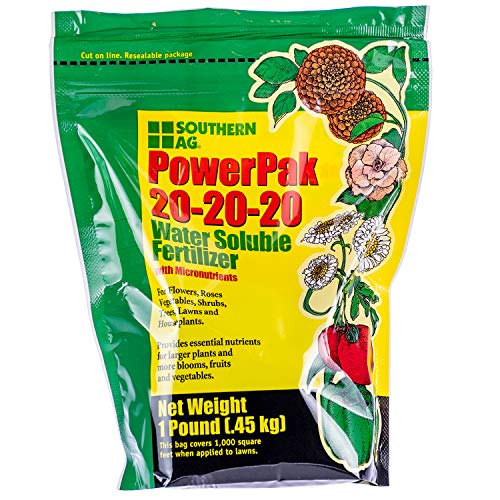
Formula: 20-20-20 with chelated minor elements. Best for: gardeners needing a compact, ready-to-use option for small beds or container plants. Why selected: same balanced formula in a smaller bag for precise dosing. Caution: smaller bags require careful measurement to avoid misapplication.
Jack’s Professional 20-20-20 (25lbs)

Formula: 20-20-20 with micronutrients. Best for: heavy feeding plants and continuous liquid feed programs. Why selected: bulk powder provides cost efficiency for large setups; micronutrients support robust growth. Caution: ensure complete dissolution to prevent settled pockets in irrigation systems.
Gardenwise 20-20-20 Water-Soluble Fertilizer

Formula: 20-20-20 with balanced nutrients and soft release. Best for: indoor and outdoor plants, including orchids, vegetables, lawns, and flowers. Why selected: convenient powder that dissolves quickly for rapid uptake. Caution: some users may prefer foliar feeds for quick bursts of growth rather than steady soil feeding.
Jack’s Classic All Purpose 20-20-20

Formula: 20-20-20 with micronutrients. Best for: homes and gardens needing a versatile feeding option for both indoor and outdoor plants. Why selected: multiple feeding methods—foliar or root—offer flexibility in care routines. Caution: ensure proper mixing to avoid streaking or uneven nutrient distribution.
GS Plant Foods All Purpose 20-20-20

Formula: 20-20-20 with micronutrients and kelp. Best for: indoor/outdoor gardens, turf, and perennials seeking balanced nutrition plus added kelp benefits. Why selected: kelp can support nutrient uptake and plant resilience. Caution: kelp-containing formulas may affect salinity in sensitive soil types; test before broad application.
Buying Guide: 20-20-20 Fertilizer Essentials
- What is 20-20-20? It’s a balanced NPK fertilizer containing equal parts nitrogen (N), phosphorus (P), and potassium (K). It supports overall growth, root development, and flowering when used as directed.
- Granular versus water-soluble? Granular products are often slower-release, while water-soluble forms enable rapid nutrient delivery through soil or irrigation systems. Choose based on your feeding schedule and application method.
- Micronutrients matter? Look for chelated trace elements (like iron, manganese, zinc) to support steady growth and prevent deficiencies, especially in containers or high-demand crops.
- Consider your plants’ needs. Heavy feeders and flowering plants may benefit from a consistent 20-20-20 plan, while sensitive species might tolerate lower application rates or staggered feeding.
- Application tips. Always follow package directions for dilution and timing. Water thoroughly after application to prevent fertilizer burn and ensure nutrient mixing.
- Safety and storage. Store in a cool, dry place away from children and pets. Keep containers sealed to avoid moisture clumping, especially for powders.
FAQ
- Is 20-20-20 fertilizer safe for all plants? It’s suitable for many common garden plants but can cause nutrient burn if over-applied. Always follow label directions and tailor use to plant needs.
- Can I use 20-20-20 fertilizer for vegetables? Yes, 20-20-20 can support vegetable growth, especially early vigor and leaf development, but adjust timing to avoid excessive foliage at the expense of fruiting in some crops.
- Should I mix 20-20-20 with other fertilizers? Often not necessary; start with one product and monitor plant response. If needed, combine with a targeted fertilizer plan that matches growth stages.
- What’s the difference between the 5 lb and 25 lb Jack’s options? The 25 lb version is designed for larger areas or frequent feeding, offering cost efficiency per square foot. The smaller bag suits homeowners with limited space or lighter usage.
- What should I do if I see leaf burn? Stop fertilizing temporarily, flush the soil with water, and reintroduce fertilizer at a lower rate once growth resumes normally.
- Can I use 20-20-20 on potted plants? Yes, but be mindful of pot size and frequency; containers can accumulate salts faster, so flush periodically and avoid over-fertilizing.