Moisture sensing irrigation systems automate garden and indoor plant care by using soil moisture data to determine when and how much to water. This guide highlights five reliable options that blend sensor technology, automation, and ease of use. Whether you grow herbs on a kitchen windowsill or maintain a larger container garden, these kits help conserve water while preventing under- or overwatering. Read on to compare features, setup needs, and how each product addresses common irrigation challenges.
| Product | Brand | Key Feature |
|---|---|---|
| AEDIKO Upgrade Automatic Irrigation DIY Kit | AEDIKO | Capacitive soil moisture sensor with 5V relay and inline water pump for automatic watering |
| RAINPOINT Smart Drip System | RAINPOINT | Dual control: app/remote and local operation with solar or USB power options |
| UMLIFE Automatic Irrigation Kit | UMLIFE | Capacitive moisture sensor with 1-channel relay and pump for Arduino-compatible projects |
| VIVOSUN Automatic Drip Irrigation Kit | VIVOSUN | 16 emitters, app-controlled options, advanced pressure and flow for multiple plants |
| AITRIP Soil Moisture Sensor Kit | AITRIP | DIY-ready kit with soil moisture detector, relay, mini pump and wiring accessories |
The following sections review five carefully selected products that align with moisture-based irrigation goals. Each product description covers core capabilities, setup considerations, and practical scenario use. This format helps you compare how different sensor types, power sources, and control methods fit your gardening approach.
AEDIKO Upgrade Automatic Irrigation DIY Kit
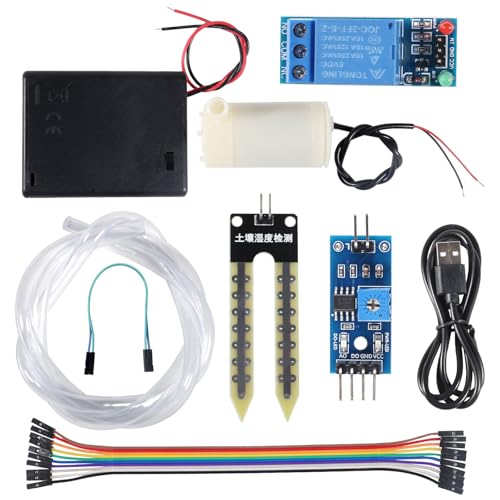
The AEDIKO kit integrates a capacitive LM393 soil moisture detector with a small water pump and a one-channel 5V relay module. It is designed for autonomous watering based on soil moisture thresholds. The LM393 sensor operates between 3.3V and 5V, with a compact PCB footprint suitable for DIY projects. A fixed mounting bolt simplifies installation in pots or garden beds. The relay module supports control of up to 250V AC or 30V DC, enabling safe automation of a small watering pump. This setup is particularly useful for Arduino-based projects or standalone microcontroller experiments where moisture readings trigger pump activity.
What to consider: This option emphasizes a compact, integrated kit with essential components for plant watering automation. If you want a simple, low-cost moisture-driven system that’s easy to assemble and customize, this kit offers a straightforward starting point. Users should ensure proper wiring, power supply compatibility, and mounting stability for outdoor use. It’s best suited for small planters or DIY gardens rather than large-scale irrigation networks.
RAINPOINT Smart Drip Irrigation System
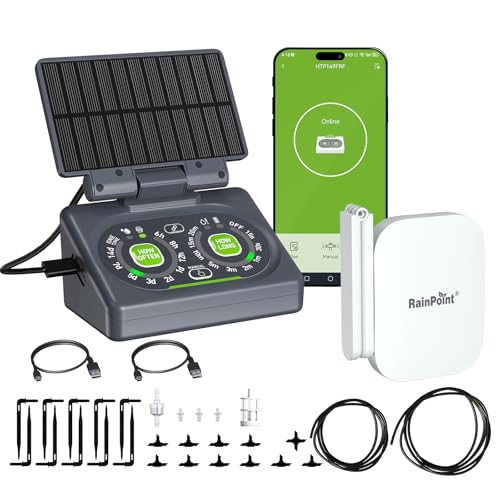
The RAINPOINT system offers dual control: manual or app-based via the RainPoint Home App with a Wi-Fi hub. It supports flexible power sources, including a detachable solar panel or USB charging, making it adaptable for balconies, greenhouses, or indoor setups. Its design emphasizes even water distribution to prevent overwatering near the source and water shortage farther away, aided by an anti-backflow valve to minimize distribution deviations. The device is intended for up to several plants, with a focus on user-friendly remote management and reliable power options for off-grid or mixed environments.
Practical notes: If you want convenient remote monitoring and the option to run off solar power, this model provides an appealing blend of automation and flexibility. Check compatibility with your Wi-Fi network and ensure your space can accommodate the solar panel placement for optimal charging. It’s a strong fit for patios or rooms where you want periodic watering with minimal manual intervention.
UMLIFE Automatic Irrigation Kit

UMLIFE’s kit centers on a capacitive soil moisture sensor and a 1-channel 5V relay, paired with a mini water pump. The sensor provides an analog output representing soil moisture levels, enabling precise control thresholds. The kit includes a 1-meter vinyl tube and standard components for basic DIY irrigation projects, with an interface designed for Arduino-style workflows. This configuration is well-suited for hobbyist setups or educational experiments where users want to tune watering behavior based on real-time soil data.
Key considerations: Optical sensing accuracy and power management are important with capacitive sensors. A robust enclosure and weatherproofing help extend life in outdoor environments. If you’re building a garden automation project that ties to microcontrollers, this kit is a practical choice for learning and experimentation while delivering functional moisture-driven watering.
JIYANG Solar Automatic Drip System

This solar-powered drip irrigation kit supports up to 20-30 pots and features 12 timing modes to tailor watering frequency and duration. The system uses a drip network designed to maintain even moisture across multiple pots, reducing runoff and water waste. It’s built for outdoor use with IP67-level waterproofing and weather resistance, plus a ground stake for easy soil insertion or wall mounting. The kit adapts well to balconies, patios, or small gardens lacking a fixed faucet, offering an eco-friendly watering approach powered by sunlight.
Points to ponder: Consider your climate and sun exposure, as solar reliability directly affects performance. The variety of timing modes is valuable for customizing schedules to plant types, but ensure the drip emitters and tubing match your plant spacing for efficient coverage. This option is ideal for growers seeking a self-contained, off-grid irrigation solution with programmable timing.
VIVOSUN Automatic Drip Irrigation Kit

The VIVOSUN kit is designed to water up to 16 plants simultaneously using 16 emitters. It features a quiet 15W pump and a 4mm fast-flow system, along with anti-siphon and filter components to protect water quality and system integrity. The tubing is flexible to accommodate various layouts, making it a scalable option for indoor setups, greenhouses, or outdoor beds. App control is mentioned in some configurations, enabling remote adjustments and monitoring without manual intervention.
Considerations: This kit is well suited for users with medium to larger plant collections who want centralized control and strong flow. For best results, plan emitter placement to ensure uniform distribution across all plants, and check compatibility with your growing medium (soil, coco, or hydroponic substrates). Regular maintenance of filters and emitters helps sustain performance over time.
AITRIP Soil Moisture Sensor Kit

The AITRIP kit emphasizes an Arduino-friendly approach with a soil moisture detector module, relay, mini water pump, and essential wiring. A note warns against pouring water directly onto the sensor to prevent corrosion, highlighting the need for correct setup and protection. The kit includes a USB power option and a battery storage case, making it suitable for experiments and small-scale automation projects. It is a flexible option for developers who want to experiment with threshold-based irrigation and sensor-driven watering logic.
Practical use: If you enjoy tinkering and want to build a custom moisture-based system from the ground up, this kit provides the core sensors and actuation. Be mindful of moisture handling to protect sensors and electronics, and plan for enclosure and waterproofing in outdoor environments. It’s a good educational tool that translates soil data into actionable irrigation decisions.
Buying Guide: Key Purchase Considerations For Moisture-Sensing Irrigation
- Sensor type and accuracy — Capacitive sensors tend to be more durable than resistive options in outdoor conditions. Look for calibration guidance and clear output signals that integrate with your controller.
- Power source and reliability — Solar-assisted systems offer off-grid operation, but you may need a dependable USB or battery backup for low-light days. Consider your location’s sun exposure and available outlets.
- Control method — Decide between manual/app control, local relays, or DIY microcontroller integration. App connectivity adds convenience, but a local override is useful during outages.
- Water distribution design — Drip emitters, tubing layout, and anti-backflow features influence how evenly moisture is delivered. Plan for zone-by-zone watering if you have diverse plant needs.
- Maintenance and durability — Outdoor kits require weatherproof enclosures, quality seals, and easy-to-clean filters. Check the availability of replacement parts and spare pumps.
- Scalability — If you expect your garden to expand, choose a system that supports more pots or higher flow without a complete rewrite of the setup.
- Compatibility and integration — Some kits are ready-to-use with specific microcontrollers; others offer plug-and-play simplicity. Align with your preferred platform and skill level.
In summary, moisture-sensing irrigation systems range from compact DIY kits to feature-rich, app-enabled networks. Whether your priority is off-grid solar operation, precise moisture control, or multi-plant scalability, the options reviewed here provide solid starting points for creating a water-efficient, plant-friendly watering routine.