Choosing the right push spreader helps homeowners achieve even lawn fertilization, seed distribution, and weed control with less effort. This guide reviews five top options that balance capacity, spread precision, and ease of use. Whether you’re treating a small yard or a larger lawn, these spreaders are designed to minimize waste and maximize coverage across American suburban lawns.
The table below highlights the featured products and key traits to help you compare at a glance.
| Product | Brand | Capacity | Terrain / Tires | Notable Feature |
|---|---|---|---|---|
| Scotts Turf Builder EdgeGuard Mini Broadcast Spreader | Scotts | Up to 5,000 sq.ft. | Compact, standard wheels | EdgeGuard technology |
| Scotts Turf Builder EdgeGuard DLX Broadcast Spreader | Scotts | Up to 15,000 sq.ft. | Standard wheels | Pre-calibrated, EdgeGuard DLX |
| SmarketBuy Fertilizer Spreader | SmarketBuy | 23 L / 90 lbs | All-terrain pneumatic tires | Three flow settings, precise control |
| Brinly P20-500BHDF-A Push Spreader | Brinly | 50 lbs | Large pneumatic tires | Deflector kit included |
| Agri-Fab 45-0463 130 lb Tow-Behind Spreader | Agri-Fab | 130 lbs | Tow-behind, lawn tractors | Wide hopper capacity |
Scotts Turf Builder EdgeGuard Mini Broadcast Spreader

The Scott’s EdgeGuard Mini is designed for small to medium yards, offering a compact footprint without compromising spread quality. It ships pre-calibrated and fully assembled for immediate use. The fold-down handle simplifies storage when the season ends. EdgeGuard technology minimizes product fall-off onto landscaping, driveways, and sidewalks, protecting delicate areas while delivering precise coverage where it’s needed.
Scotts Turf Builder EdgeGuard DLX Broadcast Spreader

The DLX version expands capacity to cover larger areas—up to 15,000 square feet—while maintaining edge protection with EdgeGuard technology. Like the Mini, it comes pre-calibrated for convenient use, reducing the setup time typically required for fertilizer or seed applications. The DLX model emphasizes consistent results across mid-sized lawns with a focus on ease of use and protection of landscaping features.
SmarketBuy Fertilizer Spreader

Designed with versatility in mind, the SmarketBuy spreader features a 23-liter hopper (about 90 pounds capacity), enabling longer intervals between refills. It’s built on sturdy 12.5 x 4.5-inch pneumatic wheels that help traverse uneven turf. The spreader offers three flow settings and a precise control lever to adjust the width and pattern, which supports accurate fertilizer distribution or seed placement across varied lawn sizes and terrain.
Brinly P20-500BHDF-A Push Spreader

The Brinly model offers a 50-pound capacity with a practical hopper size and a deflector kit to control material flow and prevent off-target distribution. Large 12″ x 3″ pneumatic tires aid in maneuverability across lawns with varying contours. This unit emphasizes durability and versatility for mid-size to larger residential lawns, making it a strong option for homeowners who need straightforward operation with solid coverage.
Agri-Fab 45-0463 130 lb Tow-Behind Spreader

This tow-behind spreader is built for large lawns and tractor-equipped setups, with a 130-pound hopper (capacity for up to 25,000 square feet). The 10-12 foot wide spread is ideal for consistent coverage across wide areas. It’s designed to pull behind riding mowers or tractors, offering a practical solution for homeowners managing extensive turf or multiple plots on a single property.
Agri-Fab 45-0288 175 lb Tow-Behind Spreader
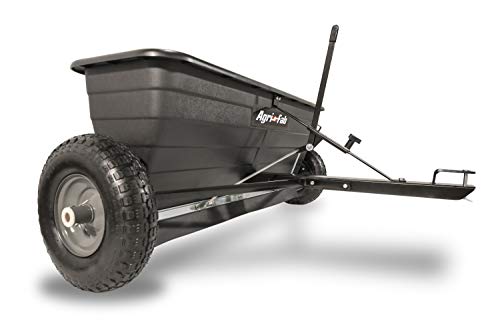
Note: This listing covers a 175-pound capacity tow-behind model with wide coverage (about 40,000 square feet). It’s designed for tractors and riding mowers, making it a fit for large lawns and property landscapes where substantial quantities of seed, fertilizer, salt, or ice melt are needed in a single pass.
Buying Guide
Purchase considerations for push lawn fertilizer spreaders span capacity, spread width, and user ergonomics. Homeowners should assess yard size, terrain, and the type of material to spread—fertilizer, seed, or ice melt—before selecting a model.
- Capacity and refills: Larger lawns benefit from higher hopper capacities (e.g., 90 lbs to 130 lbs) to minimize trips to the shed. Smaller yards can prioritize compact, lightweight units.
- Spread width and pattern control: Look for adjustable flow settings and a reliable pattern to ensure even distribution without over- or under-application. Some units include a deflector kit for precision near edges.
- Edge protection: EdgeGuard or similar technologies prevent product from spilling onto sidewalks, driveways, or garden beds, preserving landscaping and reducing waste.
- Calibration and ease of use: Pre-calibrated spreaders save setup time. Choose models that are easy to calibrate if you plan to apply different products or rates.
- Terrain compatibility: Pneumatic tires offer better traction on uneven turf; consider the wheel size and weight of the spreader for your lawn slope and soil conditions.
- Tow vs. push design: Tow-behind units suit larger properties with tractors or riding mowers; push models are typically lighter and favored for small-to-mid-sized lawns.
- Durability and materials: Powder-coated steel and rust-resistant hoppers extend life in outdoor environments and resist weather exposure.
Maintenance tips include cleaning after use, drying the hopper to prevent clogs, and inspecting connectors and wheels for wear. For best results, follow product-specific guidelines for calibration and refilling intervals to achieve even coverage across varied lawn textures.