Choosing the right watering system for a grow tent can simplify care, conserve water, and help keep plants thriving. This article highlights five top options that work well in compact indoor environments, focusing on reliability, ease of use, and adaptability to varying plant needs. Each option is evaluated for automation, reservoir size, and suitability for a grow tent setup. The following selection emphasizes systems that minimize manual watering while delivering consistent moisture where it matters most.
Summary of chosen products:
- Spider Farmer Auto Drip Irrigation System Kits with 13-Gallon Bucket (Spider Farmer)
- RAINPOINT Large Display Automatic Plant Waterer Indoor (RAINPOINT)
- Spider Farmer Gravity-Fed Self-Watering System (Spider Farmer)
- VIVOSUN 4-Pack FlexFeed Self-Watering Pots (VIVOSUN)
- RAINPOINT Smart Automatic Watering System Pot Plants (RAINPOINT)
Spider Farmer Auto Drip Irrigation System Kits

The Spider Farmer kit includes a 25W intelligent water pump capable of up to 12 L/min, with a low water level sensor to auto stop or start irrigation as needed. A 13-gallon bucket base offers substantial reservoir capacity, reducing refill frequency and enhancing usability in grow tents. An 8-outlet drip emitter provides adjustable multi-spout coverage with 0-360° spray, enabling precise water distribution across plant groups. This setup supports customized irrigation schemes for diverse tent layouts and plant varieties.
In practical terms, this system supports automated irrigation with a compact footprint suitable for tents. The reservoir and pump work together to maintain steady moisture levels, while adjustable emitters allow tailoring to plant size and soil type. The materials’ durability and ROHS compliance contribute to long-term reliability in indoor environments where space is at a premium.
RAINPOINT Large Display Automatic Plant Waterer
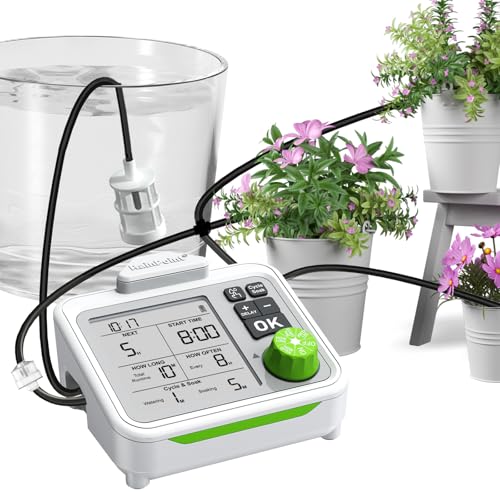
RAINPOINT’s large-display unit focuses on cycle-and-soak irrigation, a method that divides watering into shorter cycles with soak periods. This approach can reduce water usage by up to 30% and potentially improve yields by up to 18% for some crops. The system offers quick setup and flexible scheduling, with a broad range for watering frequency—from every 8 hours to once every 30 days—and duration from 20 seconds to 20 minutes. The design supports real-world variability in plant size, pot type, and seasonal needs in a grow tent.
The device supports manual override and delayed watering to accommodate rain or soil moisture fluctuations. For tent environments, the cycle-and-soak feature helps maintain even soil matric moisture without overwatering sensitive root zones. Easy programming and a visible display make ongoing adjustments straightforward, which is valuable when tent conditions shift with lights on/off cycles.
Spider Farmer Gravity-Fed Self-Watering System

This gravity-fed system uses a 13-gallon reservoir and wick-based delivery to keep pots evenly moist without electricity. The design relies on gravity and capillary action to move water to plant roots, reducing the need for daily checks in a grow tent. The included wick lines regulate moisture uptake, promoting balanced watering while minimizing overwatering risk. A single refilling session can maintain multiple pots for up to two weeks, depending on plant size and environmental conditions.
Kept simple by avoiding power requirements, this option is especially appealing for growers who want low-maintenance irrigation. It offers predictable moisture, which helps stabilize root development and plant health during tent cycles or vacations. The four-pack configuration ensures that a small tent or a cluster of pots can be watered consistently without complex wiring or timers.
VIVOSUN 4-Pack FlexFeed Self-Watering Pots

These 4-pack self-watering pots use a fabric pot base with an integrated water reservoir and a maintenance window for easy refilling. The pots are designed for fabric grow bags up to 5 gallons and can be paired with the FlexFeed Drip Irrigation Kit if needed. A 1.3-gallon reservoir provides the capacity to sustain plants for about a week, depending on plant type and environmental factors. The system includes a water meter to track moisture and a maintenance window for easy adjustments, supporting a balanced indoor watering routine in grow tents and greenhouses.
The combination of durable construction and upgradeability makes FlexFeed a flexible option for tent growers. Its passive design helps prevent overwatering, a common issue in confined spaces, while the ability to extend to a drip kit offers potential for more complex irrigation zones if needed. The compact footprint is well-suited to tent environments where space is at a premium.
RAINPOINT Smart Automatic Watering System Pot Plants
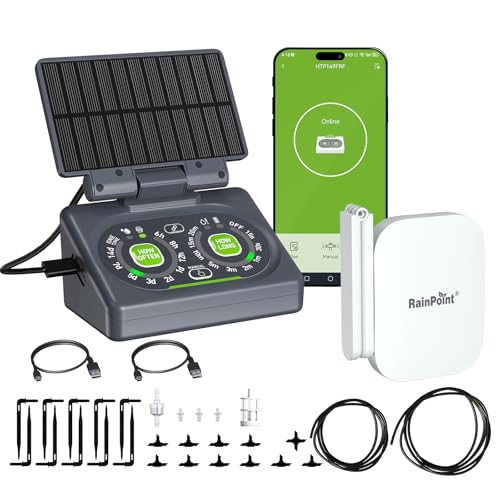
The RainPoint system combines dual-control technology, offering both manual operation and app/remote control via a dedicated Wi-Fi hub. This flexibility is ideal for tent setups where remote monitoring and adjustments are beneficial, such as during travel or changing grow conditions. The device supports dual power sources, including a solar panel for off-grid use or USB charging for continuous operation when solar input is unavailable. Water distribution is designed for even delivery across emitters, with an anti-backflow valve to prevent siphoning and uneven hydration across plants.
For grow tents with multiple plant zones, the dual-control feature enables quick adjustments on the fly without reconnecting to a computer or app. The combination of solar and USB power adds resilience in environments with variable electricity access, making it suitable for longer tent cycles or seasonal changes in light intensity and humidity.
Buying Guide: Key Considerations for Grow Tent Irrigation
- Reservoir size and refill frequency: larger reservoirs reduce maintenance but require more space. Consider a 8–13 gallon unit for tents with several plants.
- Power needs: choose gravity-fed or passive systems to minimize electricity use, but ensure compatibility with tent power constraints if you value automation.
- Distribution method: drip emitters vs. wick-based systems; emitters allow more precise control for diverse plant types, while wick systems simplify setup.
- Control options: manual, timer-based, and app-controlled setups provide different levels of automation. App control adds remote monitoring benefits for busy schedules.
- Environment and plant type: cycles and soak methods suit plants with varying moisture needs. Cycle-and-soak can conserve water while improving uptake for some species.
- Maintenance and durability: look for corrosion-resistant materials and easy access to components for refilling and cleaning, especially in humid tent environments.
- Expandability: systems that support additional pots or different zones allow growth without replacing entire setups.
In summary, for grow tents, a mix of gravity-fed, reservoir-driven, and app-controlled irrigation options provides flexibility across plant types and schedules. Weigh reservoir capacity, automation level, and space constraints to select a system that aligns with tent size, climate control, and cultivation goals. Each listed option offers distinct advantages, from fully automated app-based control to low-maintenance gravity-fed operation, helping growers maintain stable moisture without constant manual intervention.